
Airbus opens Aerospace Integrated Research and Test Centre
Jointly funded by Airbus and the U.K. government’s ATI program, the £40 million research and testing facility serves to undertake structural testing of large-scale aircraft assemblies.


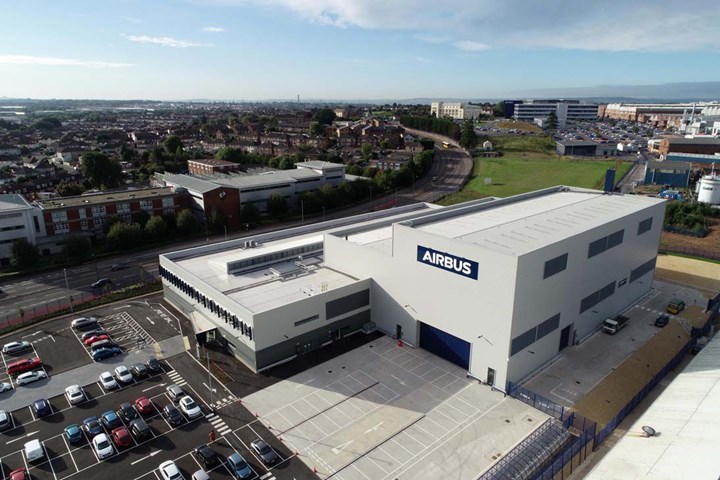
AIRTeC center. Photo Credit: Airbus
Secretary of State for Business, Energy and Industrial Strategy, Kwasi Kwarteng, has formally launched Airbus’ (Toulouse, France) Aerospace Integrated Research and Test Centre (AIRTeC) in Filton, Bristol, U.K.
AIRTeC is a £40 million, state-of-the-art research and testing facility jointly funded by the government’s Aerospace Technology Institute (ATI) program and Airbus. Covering more than 10,000 square meters of gross internal floor space — the equivalent of two football pitches — the Centre reportedly is designed to undertake structural testing of large-scale aircraft assemblies, from full-size wings down to the individual components and materials used in aircraft design. Airbus says it provides the most advanced working environment and tools for the company, alongside external suppliers, partners and academia, to deliver the next generation of aircraft wing, landing-gear systems and fuel system designs.


Furthermore, Airbus believes the facility is a key asset in helping industry accelerate the design, manufacture, testing, certification, infrastructure and commercial operation of zero-emission aircraft through sustained investment in R&T and R&D and fostering greater collaboration across sectors.
Companies in other sectors, such as maritime and nuclear, along with universities are able to use AIRTeC’s innovative, highly flexible and easily adaptable environment, which includes 65,000 square meters of state-of-the-art specialist test space, a 40-meter-long strong floor, and a 14 x 10-meter strong wall capable of testing full-size wings — with a force equivalent to the weight of 240 cars — using a 25 MN high-capacity loading test machine.
The facility also includes labs, collaborative office space and reconfigurable testing areas. Airbus notes that this combination of test assets is unique in Europe. The facility will enable Airbus and its partners to develop new and cutting-edge designs and is central to Airbus’ Wing of Tomorrow (WOT) program, which is said to be exploring the best materials, manufacturing and assembly techniques to help deliver more fuel-efficient, cleaner aircraft. The Airbus Filton site is also home to a 3D-printing plateau and digital manufacturing laboratory, as well as the Airbus low-speed wind tunnel.
Airbus employs about 2,800 people at its site in Filton. The company is said to be the largest commercial aerospace company in the U.K., as well as its biggest civil aerospace exporter, employing more than 13,500 people at 25 sites across the country.
“The launch of this new center comes as Airbus prepares to ramp up production of its most popular aircraft towards the end of the year— a clear vote of confidence in Britain as we build back better from the pandemic,” says Kwasi Kwarteng.
Related Content
-
Plant tour: Airbus, Illescas, Spain
Airbus’ Illescas facility, featuring highly automated composites processes for the A350 lower wing cover and one-piece Section 19 fuselage barrels, works toward production ramp-ups and next-generation aircraft.
-
First Airbus A350 crash confirmed in Haneda
Shortly after touch-down, a JAL A350-900 aircraft recently collided with a De Havilland Canada Dash 8. Exact circumstances are still unknown.
-
“Structured air” TPS safeguards composite structures
Powered by an 85% air/15% pure polyimide aerogel, Blueshift’s novel material system protects structures during transient thermal events from -200°C to beyond 2400°C for rockets, battery boxes and more.


