
Composites end markets: Industrial (2026)
Composites solve performance, weight, durability challenges and more in a variety of industrial applications. Recent notable examples include fire truck pumps, biogas reactor tanks and shipping pallets.
.jpg;width=70;height=70;mode=crop;format=webp)


Industrial applications of composites include large modular tanks (top left), corrosion-resistant pumps (top right), more durable shipping pallets (bottom right), faster-to-produce tooling fixtures (bottom left) and much more. Sources (clockwise from top left) | Toro Equipment, KASE Pumping Systems, PalletX, Additive Manufacturing
The inherent corrosion resistance of composite materials, along with their light weight, durability, tailorability and other advantages, make them ideal for many industrial applications ranging from machines and tools used in manufacturing facilities to pumps and tanks carrying corrosive materials.
However, traditional and long-used materials like metals or, in some cases, inexpensive plastics or wood, are often still used in certain applications and could benefit from switching to a composite alternative.


A few developments covered recently by CW — and summarized below — include some of these stories where more traditional materials have been successfully reimagined as more efficient, lighter, stronger composite versions, including industrial pumps, tanks, shipping pallets, tools and fixtures, and more.
Corrosion-resistant, ultra-lightweight pumps
KASE Pumping Systems (KASE, Coatesville, Pa., U.S.) is one company changing the material paradigm for how industrial pumps are manufactured, starting with displacing cast iron for high-performance carbon fiber composite fire truck pumps.
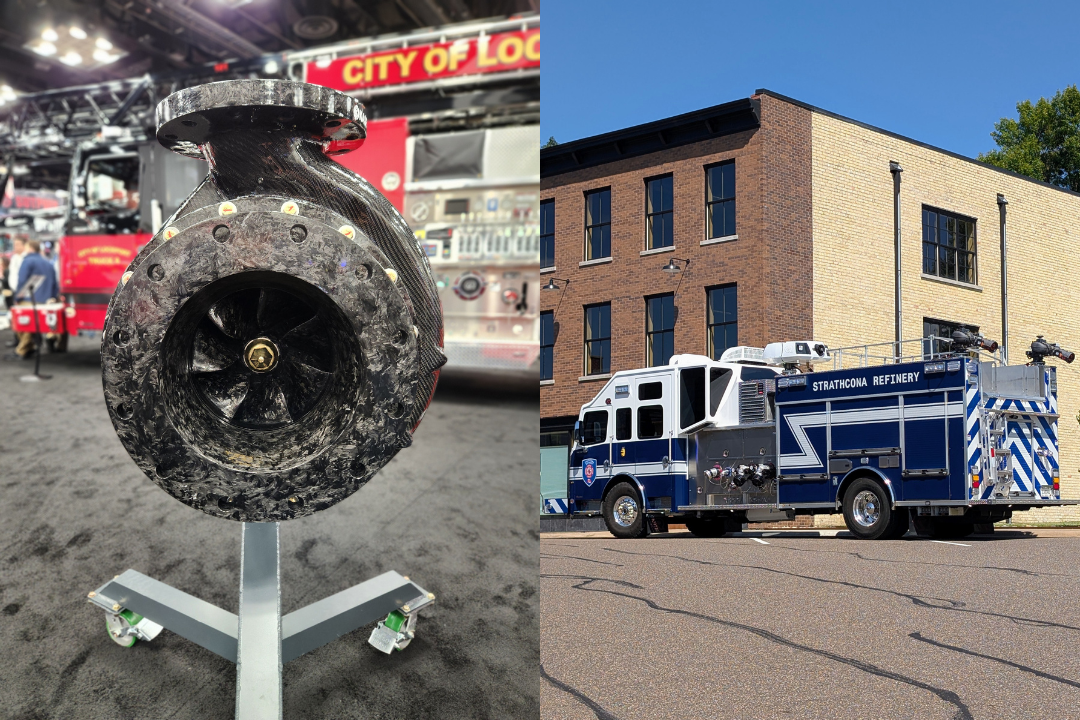
KASE Pumping Systems’ RFP6 fire truck pump on display (left), and one of the Rosenbauer America trucks it was designed to operate on (right). Source | KASE Pumping Systems and Rosenbauer America
Fire truck pumps are relatively large, complex systems that need to be incredibly durable — they are used primarily in emergency situations and need to perform under a variety of unpredictable conditions. They also need to be lightweight enough for easy transport, meet payload limits on trucks and in some cases are capable of handling corrosive materials like saltwater. All of these requirements led KASE Pumps to start designing and manufacturing carbon fiber composite pump components using a proprietary resin transfer molding (RTM) process.
One of KASE’s most ambitious pump designs to date is the RFP6, said to hold the world’s highest National Fire Protection Association (NFPA) flow capacity rating of 6,500 gallons per minute while weighing in at less than 200 pounds (versus 600-1,200 pounds for a cast iron pump).
“Our biggest success is being able to introduce a new material technology like composites into a very well-developed industrial market,” says Kyle Chandler, president of KASE Pumping Systems. “The fire industry is recognizing that the whole pump, manifold and gear assembly can weigh in excess of 2,000 pounds depending on the design layout, and with CFRP we can drop that by up to 70%.”
While the company began with fire truck pumps, it also plans to expand into pumps for energy and other industrial applications where anti-corrosive properties are required. Read more in “CFRP boosts power, drops weight for next-gen fire truck pumps.”
Lighter, more durable shipping pallets
For decades, typical shipping pallets have been made from wood or plastic, or metal for specific applications. However, these materials come with inherent limitations: Wood is heavy and susceptible to swelling, mold growth, insect infestations and decay, while plastic can lack durability, shatter due to impact and/or low temperatures, and is often not repairable.
As reported by CW contributing writer Michelle Maniscalco, PalletX s.r.o. (Jihlava, Czech Republic) has developed a lighter weight, modular, carbon fiber composite shipping pallet design that solves these issues.

Shown here are PalletX’s first-generation design (left) and final configuration (right) of the LOG Point Pallet. Source | PalletX
The company’s first product is the LOG Point Pallet. “LOG is short for logistics,” explains company founder Eva Kratochvílová. “Manufacturers put their goods on the pallet, then it is transported to logistics centers and then to stores, factories, etc. It is a key part of goods moving swiftly and safely.”
PalletX worked with CompoTech (Sušice, Czech Republic) to develop a carbon fiber composite pallet manufactured using CompoTech’s advanced winding technology. The LOG Point Pallet is said to weigh only 7.5 kilograms but is able to confidently carry up to 4 tons of goods.
According to Kratochvílová, the higher cost of composites versus wood or plastic is mitigated by the advantages achieved. “For example, the reduced weight of our pallet increases the volume that can be transported,” she says. “Therefore, vehicles can carry more load for the same costs. Also, our lightweight pallets are easier for manual handling. They are similar in weight to carry-on baggage on an airplane.” They are also ideal for automated handling processes, she notes, because, unlike traditional options, these composite pallets maintain a consistent weight and shape. Read more in “Carbon fiber composite pallet revolutionizes freight industry.”
Wider, faster, more precise cutting machines
Kongsberg Precision Cutting Systems (Kongsberg PCS, Kongsberg, Norway) has aimed to reduce operational costs and increase productivity by developing wider, faster, high-precision digital systems for high-volume converters of flat and corrugated packaging and display materials. These automated machines feature a gantry beam that enables a gear-driven cutting head to fly back and forth across the wide table, cutting shapes out of the material beneath.


A lightweight and high-stiffness CFRP gantry beam enables the Ultimate’s high-speed precision cutting. Source | CompoTech
Working with R&D partner CompoTech, Kongsberg PCS launched its Ultimate digital cutting machine, featuring a latest-generation CFRP gantry beam to help cut and crease materials up to 30 millimeters thick with a high degree of accuracy.
Using its in-house developed fiber placement and winding technology, CompoTech starts with foam core and applies ultra-high modulus (UHM) pitch carbon fiber plus standard and intermediate modulus PAN carbon fiber combined with a standard epoxy resin. This design provides a high level of stiffness and natural frequency damping which helped enable much higher cutting speeds — from acceleration of 7 meters/seconds in the previous machine to 26.5 in the new Ultimate machine — with minimal deflection and increased accuracy.
The Ultimate has received awards in Europe and the U.S. for its quantum leap forward in technology and performance for print and packaging producers. Meanwhile, Kongsberg PCS and CompoTech continue to explore innovative new product developments. Read more details in “Optimized CFRP gantry beam enhances Ultimate cutting machines.”
Modular, larger, corrosion-resistant tanks
As CW senior technical editor Ginger Gardiner explains, “Glass fiber and vinyl ester resin have been used for decades to construct corrosion-resistant pipes and tanks for a wide range of infrastructure and industrial uses. Well-proven processes most commonly used to manufacture these include filament winding, spray-up, hand layup (contact molding) and centrifugal casting.”
Toro Equipment (Valladolid, Spain), which Gardiner recently reported about, has taken a different approach, replacing bolted steel tanks with modular systems made from biaxial fabrics, carbon fiber and Magnum Venus Products’ (Knoxville, Tenn., U.S.) Flex Molding process to eliminate corrosion but also significantly increase the possible size of tanks, while reducing weight and speeding installation.
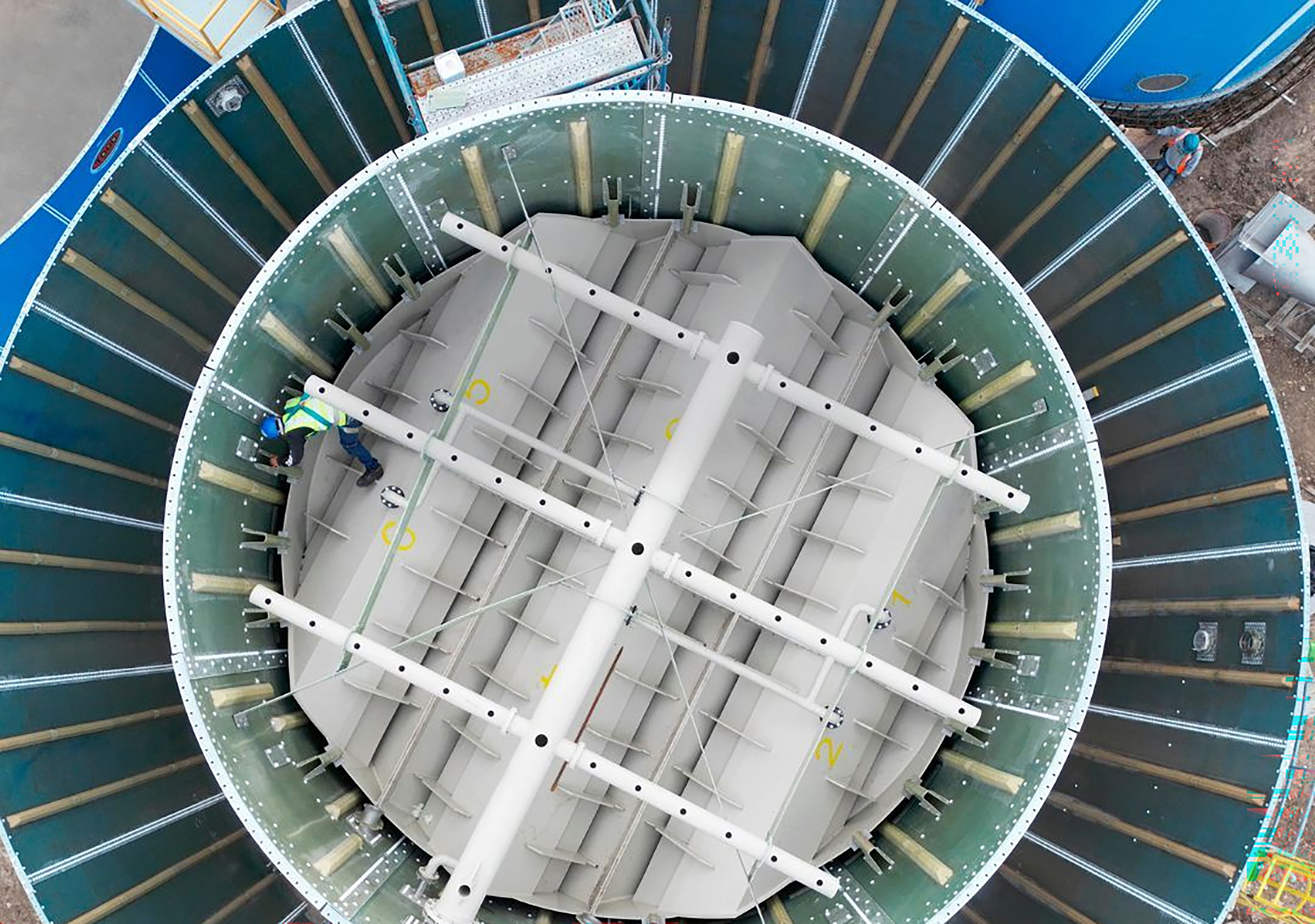
An example application of Toro Equipment’s W-Tanks are settlers for biogas reactors, which are used to separate and collect biogas in anaerobic reactors. Shown at top, the settler is the angular white structure beneath the white pipes while the yellowish vertical stripes on the green tank wall are foam-cored glass fiber composite stiffeners. The completed reactor facility is shown at bottom. Source | Toro Equipment
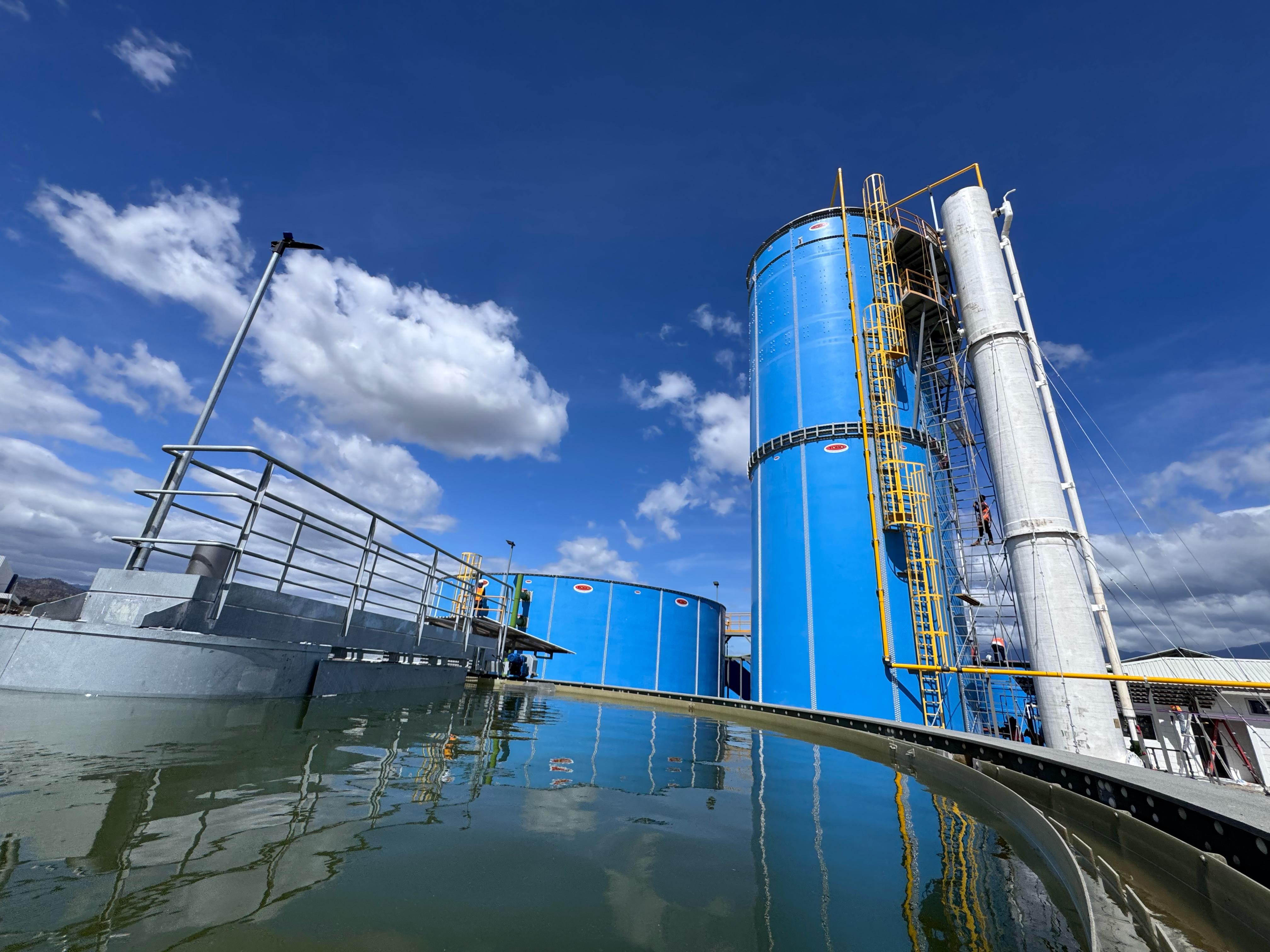
These W-Tanks comprise modular systems of curved, high-performance glass fiber composite plates manufactured from 0°/90° biaxial stitched fabric supplied by Castiltex (Valladolid, Spain) and carbon fiber in the bolting lines. Each section is made using the Flex Molding process with reusable silicone membranes. These tanks can be manufactured up to 38 meters in diameter and 22 meters tall, and able to withstand up to 12,000 cubic meters of water — significantly larger than typical 4-meter-diameter tanks.
W-Tanks are not only high-strength products but are also cost competitive compared to steel and concrete tanks, notes Santiago Salcedo Marbán, head of production for W-Tank at Toro Equipment. “We supply these for wastewater treatment in many sectors, including the paper industry, food companies and biogas reactors, which is a growing industry especially in France, Germany, Italy and Spain.” Read more in “Modular composites enable larger tanks for wastewater, biogas reactors.”
Anti-corrosion industrial tank repair
It’s worth noting that composites are also being used as a repair solution for industrial tanks and pipes — including those made from metal.
For example, Belzona (Harrogate, U.K.) supplies fiberglass and carbon fiber composite wrap systems that can be used to repair corroded industrial applications to prolong their lifespan and eliminate future corrosion issues.
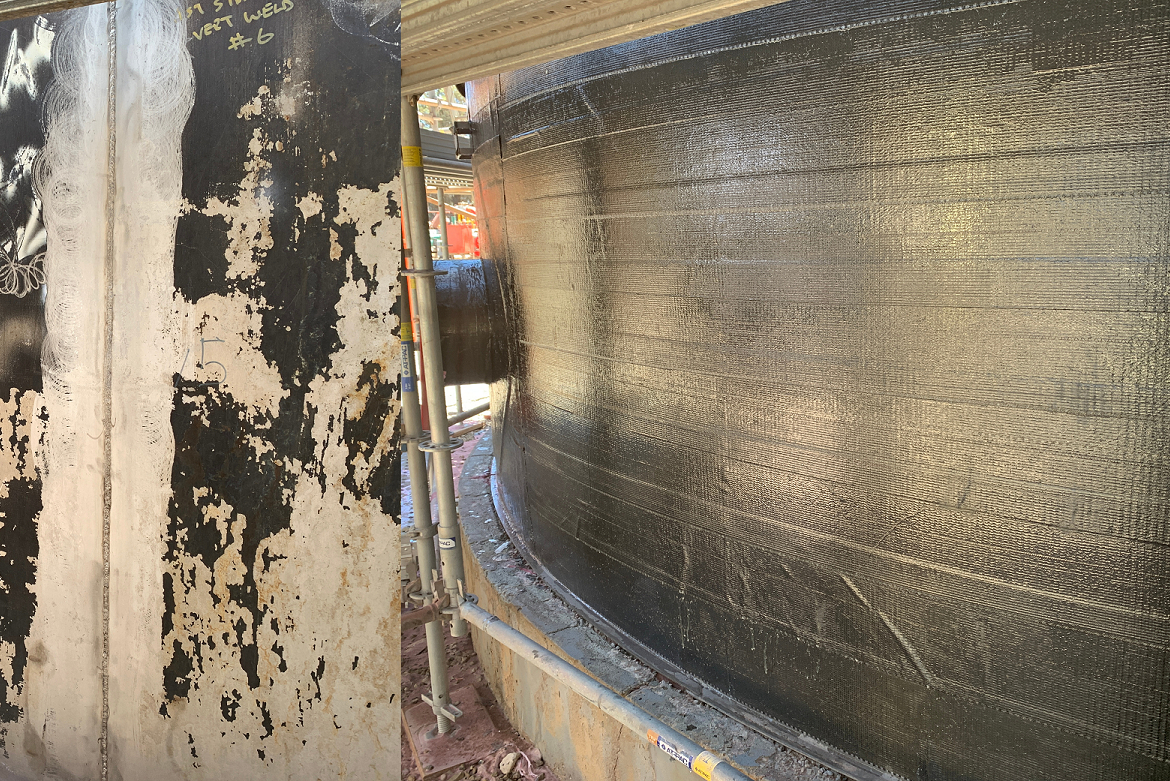
Belzona’s fiberglass/carbon fiber composite wrap system curbs corrosion in the repair of a stainless steel nickel mine industrial tank application. Source | Belzona
As described in a CW column contributed by Belzona, one example of this work in action was the case of a nickel mine in Australia. The mine’s 2-meter-tall, 9.5-meter-diameter stainless steel ammonium sulphate feed tank was in need of repair after corrosion caused by chloride-induced stress cracking. According to Belzona’s Chloe Hirst, “The company required a solution that would not only restore the integrity on the substrate, but also protect the asset against future corrosion damage. Not only this, but as the tank operates at elevated temperatures of approximately 70°C and processes highly corrosive media, the repair solution would need to be able to withstand these harsh conditions.”
The mine worked with industrial maintenance company Rezitech (Melbourne, Australia), which used Belzona SuperWrap II — a system incorporating epoxy, bespoke reinforcement sheets comprising fiberglass and carbon fiber, and a release film — to repair the corroded portion without having to replace the entire tank. Read more in “Composite wrap system combats corrosion in industrial tank repair.”
CMC for high-temperature industrial applications

Close-up of WPS’ CMC burner lances after 18 months of continuous operation. Traditional metallic burner lances would be severely damaged after 6 months of operation. Source | WPS
For industrial applications requiring high temperatures, there is also a growing market for ceramic matrix composites (CMC) — especially oxide-reinforced oxide (Ox/Ox) CMC. As Ginger Gardiner reports, “These materials are increasingly being sought for use in thermal industrial processes, where higher temperatures increase efficiency. For example, prototype CMC reaction vessels have shown as much as 50-60% improvement in steam cracking of hydrocarbons.”
For example, Keramikblech Ox/Ox CMC (referred to as OCMC) from Walter E.C. Pritzkow Spezialkeramik (WPS, Stuttgart, Germany) is used by industrial companies as well as those doing metal casting and heat treatment for parts like petrochemical burner lances to increase process efficiency and extend the service life up to 10 times versus metals.
3D printed composite tools and fixtures
There are many examples of additive manufacturing (AM) of composites being used to build end-of-arm tools and fixtures for composites molding processes.
One story recently published by CW is that of plastics processing equipment supplier KraussMaffei (Brighton, Mich., U.S. and Parsdorg, Germany). Stephanie Hendrixson, editor-in-chief of CW sister publication Additive Manufacturing, reports that the company’s recent foray into the large-format additive manufacturing (LFAM) sector has given KraussMaffei both the chance to sell its PowerPrint Plus and PowerPrint Flex machines to customers, but also to acquire a set of skills to produce its own trimming tools, risers and similar manufacturing equipment internally.
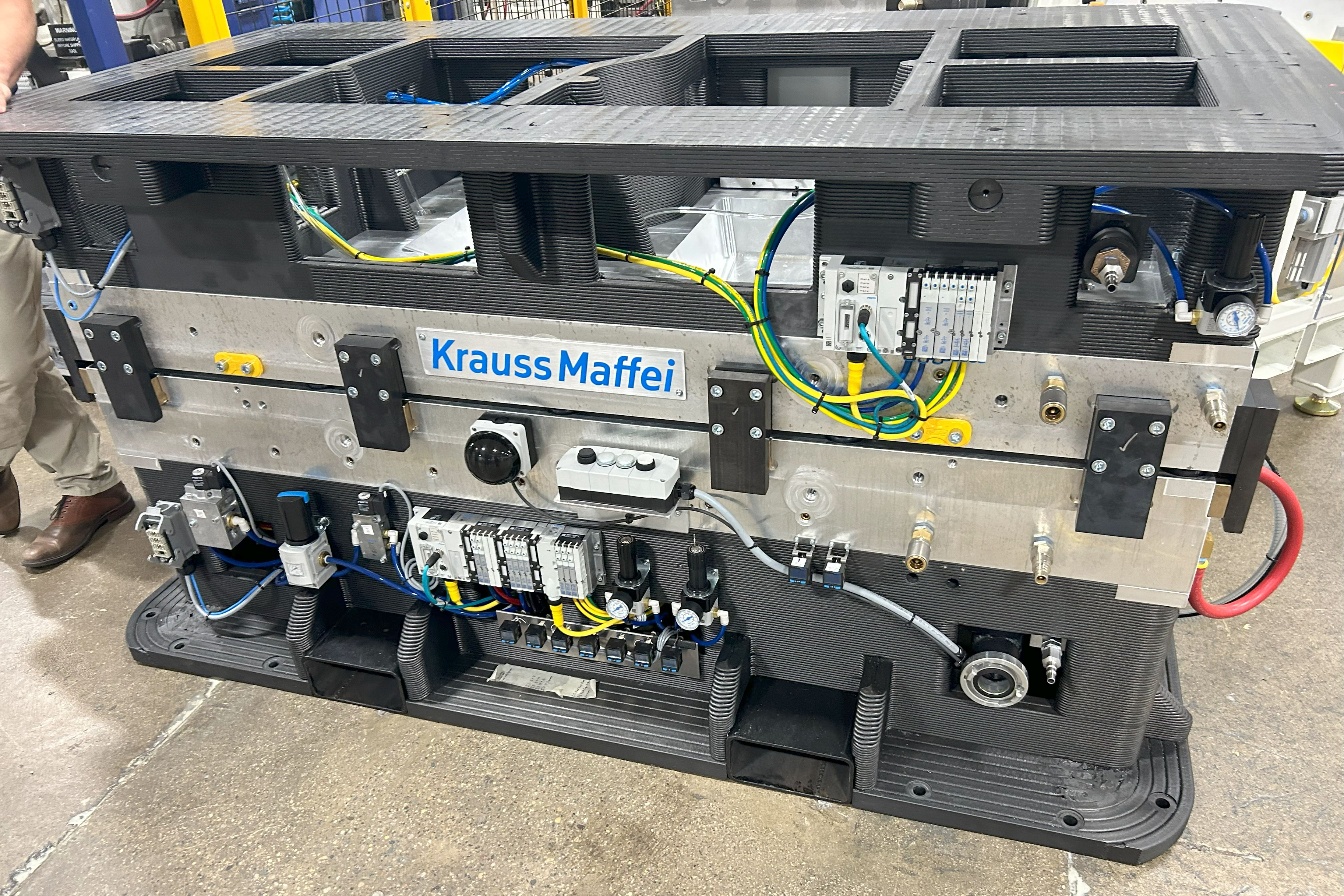
This tool features two 3D printed risers, produced from carbon fiber-reinforced polycarbonate. Source | Additive Manufacturing
For example, KraussMaffei discovered that it could print carbon fiber-filled polycarbonate (PC) or glass-filled PETG risers — a typically machined aluminum structure that holds the mold in place — which perform just as well or better than aluminum risers, and are produced in about 1 week versus the 10 weeks required for a metal version.
“The time to machine these risers is about the same as it would be to machine an aluminum casting,” says Dan Rozelman, technical and application sales manager at KraussMaffei, “but the material cost is about 30% less, and there is a 40% weight savings over the aluminum tooling.” Read more in “KraussMaffei makes LFAM both a product line and an internal benefit” or watch an Additive Manufacturing video showcasing the risers.
Tubes, frames, fans, sprockets and more
There are a variety of small industrial components from tubes to bushings and more that are increasingly being manufactured from composites to solve corrosion or weight challenges. Here are a few new products covered by CW recently:
Tubes, profiles, bushings. Corrosion-resistant composites are used in a variety of tubes, profiles, bushings and other small components used in industrial applications. For example, MCS Industrial Ltda. (Guarulhos, Brazil) offers customizable filament-wound tubes and flat springs for equipment like feeders and conveyors, as well as a range of tubes, sheets, rings and bushings.
Epsilon Composite (Gaillan Médoc, France) specializes in carbon fiber composite pultruded or pull-wound profiles for a variety of end markets and applications, including industrial parts and technical rollers. Many of these components would typically be adhesively bonded with metal fittings and inserts to connect them to the rest of a larger part — but bonding adds several steps and can cause challenges. The company sought a better solution in developing a specialized injection overmolding process to join its thermoset-based profiles with metal fittings using a thermoplastic as a bonding material.
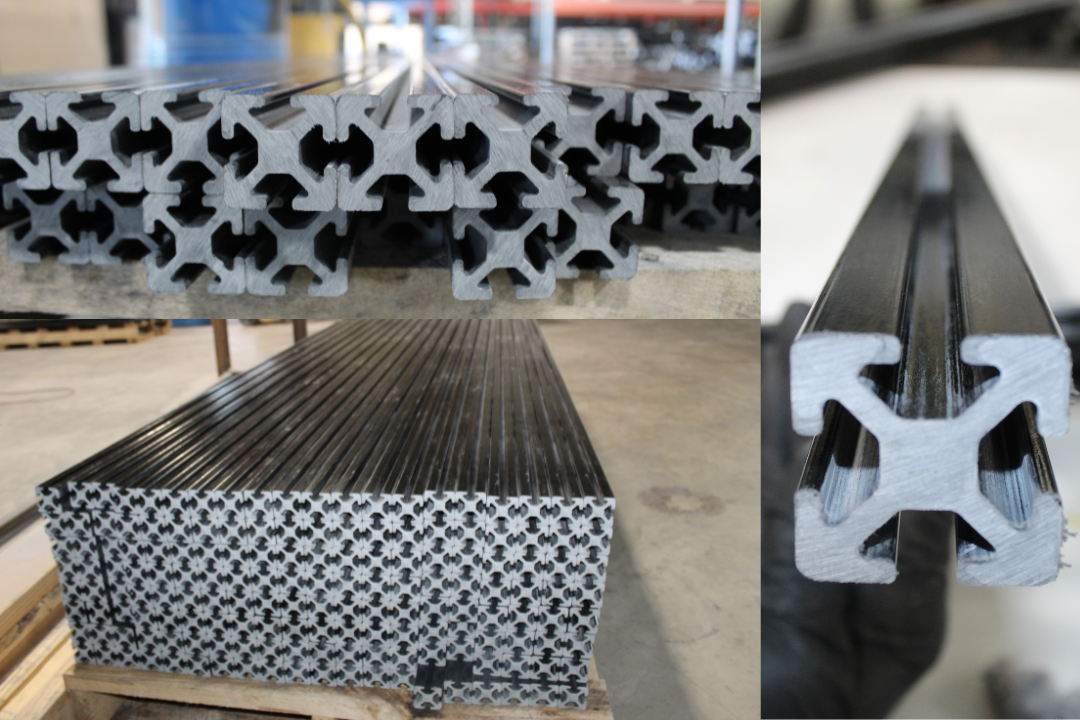
FlexConnect T-slot rods. Source | PulFlex Technologies
Framing solutions. In late 2024, polyurethane-based pultrusion specialist PulFlex Technologies (Ford City, Pa., U.S.) launched a direct-to-market T-slot framing solution called Flex Connect.
The 1.5 × 1.5-inch glass fiber composite T-slot rods are said to enable comparable or better properties than metals like aluminum, such as low electrical conductivity, reduced thermal transfer and less energy to produce.
The parts can be used at manufacturing sites for quick and easy construction of tables and enclosures for automation or other process systems.
Fans. A variety of industries from certain manufacturing sites to petrochemical plants require high-performance industrial fans, which are traditionally made with high-tensile steel impellers that require frequent inspection. Industrial Fan Services Ltd. (WDB Group, Halesowen, U.K.) is one company offering a line of carbon fiber composite impellers that are said to boast higher strength, corrosion resistance and require less frequent inspection and maintenance.
Sprockets. Continental Corp. USA’s group sector ContiTech (Fairlawn, Ohio, U.S.) has launched Thunderbolt SilentSync carbon fiber composite sprockets to optimize the drive performance and reduce system costs for demanding synchronous belt applications.
The sprockets offer up to 80% weight reduction compared to steel counterparts, reducing rotational inertia and easing installation, especially in vertical shaft applications. Thunderbolt SilentSync provides high durability with more than 200,000 hours of combined lab testing and 5 years of successful field operation in industries ranging from HVAC to food processing. The company claims Thunderbolt SilentSync composite sprockets are already being deployed in commercial and industrial applications.
Visit compositesworld.com/topics/markets for the latest on the use of composites across end markets.


Related Content

Composite Conductor Cores Boost Capacity, Cut Cost to Help Power Grids Meet AI Demand
Composite cores have evolved to increase conductor capacity 2X and cut transmission losses by up to 50%, achievable within 1-3 years with existing infrastructure, but also enable sensing and smart, adaptive grids.
Read More
Composites end markets: Sports and recreation (2025)
The use of composite materials in high-performance sporting goods continues to grow, with new advancements including thermoplastic and sustainability-focused materials and automated processes.
Read More
What is the future for Owens Corning Glass Reinforcements?
An industry pioneer discusses divergent visions in a global industry, consolidation and growth in Asia, doubling market share and tells a composites sustainability story involving circular fibers.
Read More
Composites end markets: New space (2025)
Composite materials — with their unmatched strength-to-weight ratio, durability in extreme environments and design versatility — are at the heart of innovations in satellites, propulsion systems and lunar exploration vehicles, propelling the space economy toward a $1.8 trillion future.
Read MoreRead Next

Carbon fiber composite pallet revolutionizes freight industry
LOG Point Pallet fuses advanced materials with innovative design and manufacturing to improve supply chains worldwide.
Read More
Modular composites enable larger tanks for wastewater and biogas reactors
Toro Equipment uses biaxial fabrics, carbon fiber and Flex Molding for corrosion-resistant tanks that compete with steel, concrete and speed global installations.
Read More
CFRP boosts power, drops weight for next-gen fire truck pumps
Carbon fiber enables KASE Pumping Systems to eliminate corrosion and increase durability, including a high-capacity 6,500-gpm, ultra-compact 200-pound pump that aids emergency services.
Read More


