
Stack3d demonstrates composite LFAM proficiency with trade show booth furniture series
Functional and recyclable glass fiber-reinforced PETG booth elements are achieved through robotic pellet-extrusion technology.


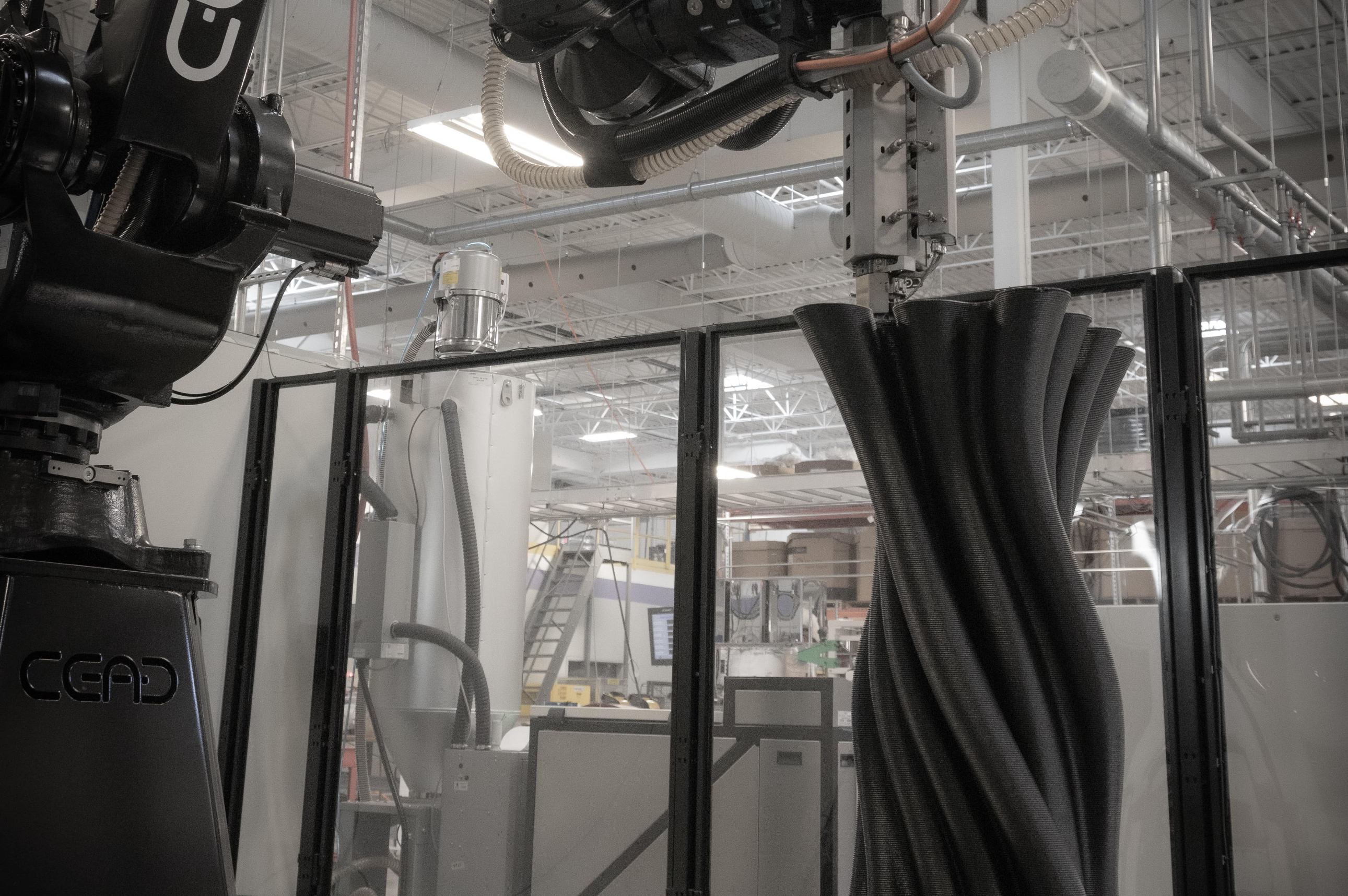
Stack3d installed a CEAD Hybrid Flexbot system into its industrial facility. Source | Stack3d
Stack3d Digital Manufacturing LLC (River Falls, Wis., U.S.), a provider of large-format composite additive manufacturing (AM) solutions, introduced a series of booth furniture components produced with a glass fiber-reinforced thermoplastic during the MD&M Midwest trade show. The printed structures were developed to demonstrate the company’s capability to manufacture functional, load-bearing components using robotic pellet-extrusion technology.
According to Stack3d, the booth elements were fully designed in-house using parametric modeling tools that enabled rapid iteration and geometry optimization. Components included sculptural tables and seating structures featuring complex, organic geometries that would not have been feasible to produce using traditional subtractive, molded or fabricated manufacturing methods. All parts were fabricated without molds or conventional tooling, enabling designs to be updated digitally and reprinted in a matter of hours.


The furniture was produced on Stack3d’s robotic additive manufacturing platform using a glass fiber-reinforced PETG formulation selected for its balance of stiffness, impact resistance, thermal stability and dimensional consistency. The material also provides favorable surface characteristics in large-format pellet extrusion, which helped reduce postprocessing needs for exhibition-ready finishes.
Throughout the event, attendees interacted directly with the printed components, demonstrating the functional performance achievable through composite pellet-extrusion printing. The successful deployment highlights opportunities for rapid, customized composite structures in industrial fixturing, lightweight tooling and architectural or display applications, particularly where geometry, scale or lead time limitations constrain traditional manufacturing approaches.
Beyond performance, the project underscores sustainability advantages associated with thermoplastic composite AM. One hundred percent recycled polymer was used to create the feedstock. The reinforced polymer can be recycled and reprocessed into new pellet feedstock, supporting repeated reuse of booth elements across multiple events while minimizing material waste. Local production in River Falls, Wisconsin, further reduced the freight and logistical footprint typically associated with trade show exhibits.
Stack3d plans to expand this approach into modular, reconfigurable booth systems with integrated functional features. The company says the MD&M deployment served as a validated demonstration of how digitally manufactured composite structures can replace conventional fabricated or molded components in short-run environments.
Related Content
-
Carbon fiber, bionic design achieve peak performance in race-ready production vehicle
Porsche worked with Action Composites to design and manufacture an innovative carbon fiber safety cage option to lightweight one of its series race vehicles, built in a one-shot compression molding process.
-
Bladder-assisted compression molding derivative produces complex, autoclave-quality automotive parts
HP Composites’ AirPower technology enables high-rate CFRP roof production with 50% energy savings for the Maserati MC20.
-
Carbon fiber composite pallet revolutionizes freight industry
LOG Point Pallet fuses advanced materials with innovative design and manufacturing to improve supply chains worldwide.


