
IDI International launches material solution for EV battery covers
IDI Composites International is introducing FLAMEVEX, a new family of fiber reinforcements and resins designed specifically for the manufacture of battery enclosure systems.


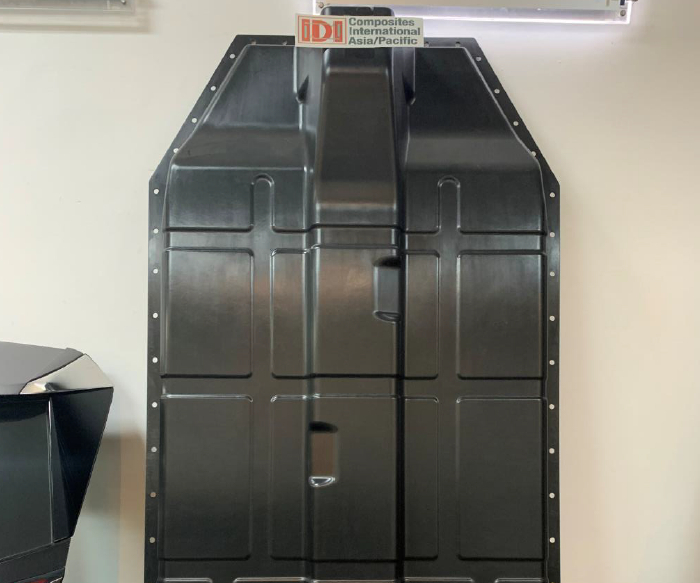
IDI Composites International EV battery enclosure manufactured with FLAMEVEX. Source | IDI
IDI Composites International (Noblesville, Ind., USA) is introducing FLAMEVEX, a new family of fiber reinforcements and resins designed specifically for the manufacture of battery enclosure systems for the electric vehicle (EV) and new energy vehicles (NEV) market.
The FLAMEVEX family of products, which include chopped glass fibers combined with either unsaturated polyester (UPR) or a combination of UPR and vinyl ester, has been used on battery packs that have passed the stringent Chinese Standard GB/T 31467.3 test, commonly known as the “Chinese bonfire test.” FLAMEVEX, says IDI, offers designers a strong, lightweight and cost-effective alternative to steel and aluminum materials traditionally used to enclose battery packs in EVs and NEVs.


Ramon Rodriguez-Irizarry, vice president and group director for electric vehicle market development at IDI, notes that EV battery pack design, configuration and location are currently not standardized and vary greatly from OEM to OEM. Because of this, the cost, dimensions, wall thickness and flame-retardant requirements of battery pack enclosures vary as well. FLAMEVEX, therefore, is being offered by IDI as a custom-compounded combination of fibers, resins and fillers designed to meet the customer’s application specific requirements.
FLAMEVEX is produced by IDI in a format that allows it to be processed like a sheet molding compound (SMC), but Rodriguez-Irizarry is quick to point out that the bespoke nature of the FLAMEVEX chemistry distinguishes it from traditional SMCs. He also notes that it will be possible, soon, to co-mold FLAMEVEX with continuous fiber preforms. Further, although the FLAMEVEX family currently uses chopped glass fiber, Rodriguez-Irizarry says carbon fiber is an option as well, but the cost penalty it brings limits its feasibility.
Working in collaboration with OEMs and Tier 1 partners, IDI FLAMEVEX materials have been used on battery packs which have passed the Chinese bonfire test at wall thicknesses as small as 2.5 mm.
“Thermoset composites represent an ideal replacement for metals in these kinds of battery enclosures,” noted Yves Longueville, general manager for IDI Composite Materials (Shanghai) - China. “Thermoset materials can be formed into complex shapes and they are also strong and lightweight. Beyond these benefits, a high level of fire performance distinguishes FLAMEVEX from traditional SMC composites,” Longueville explained. “FLAMEVEX maintains its impressive fire performance even at low thicknesses and without compromising the strength or moldability of the compound. It is the best choice for designers who aim to delight EV consumers with high-performing and affordable products.”
IDI says the market for EV and NEV vehicles is growing exponentially, with sales expected to double in 2020, reaching 4 million new cars globally. “As cost of ownership goes down, range increases and emissions requirements become tighter, electric and alternative fuel vehicles are only becoming more attractive to buyers,” says Rodriguez-Irizarry. “With FLAMEVEX, we’re not only helping to meet a need for OEMs and designers, we’re introducing a material that contributes to the strength, safety and affordability of this next generation of vehicles for consumers around the world.”
IDI Composites International says FLAMEVEX is available internationally via its locations in the United States, Mexico, Europe and Asia.


Related Content

Spanish startup to ramp up production of “recyclable” EV prototype
Liux’s BIG electric vehicle features multiple structural components manufactured via RTM from flax fabric and a thermoset resin said to enable the entire component to be recycled and reused again.
Read More
Trinseo demonstrates DLFT, PC for electric vehicle battery packs
The DLFT production process enhances polycarbonate’s performance qualities through high thermal stability that next-gen battery packs demand.
Read More
SMC composites progress BinC solar electric vehicles
In an interview with one of Aptera’s co-founders, CW sheds light on the inspiration behind the crowd-funded solar electric vehicle, its body in carbon (BinC) and how composite materials are playing a role in its design.
Read More
Bcomp ampliTex makes appearance in Cupra EV Cup Bucket seats
The entire Cupra Born VZ line-up features all-natural fiber front seats that highlight functionality, aesthetics and reduced CO2 emissions.
Read MoreRead Next

Cutting 100 pounds, certification time for the X-59 nose cone
Swift Engineering used HyperX software to remove 100 pounds from 38-foot graphite/epoxy cored nose cone for X-59 supersonic aircraft.
Read More
Next-gen fan blades: Hybrid twin RTM, printed sensors, laser shock disassembly
MORPHO project demonstrates blade with 20% faster RTM cure cycle, uses AI-based monitoring for improved maintenance/life cycle management and proves laser shock disassembly for recycling.
Read More
Ceramic matrix composites: Faster, cheaper, higher temperature
New players proliferate, increasing CMC materials and manufacturing capacity, novel processes and automation to meet demand for higher part volumes and performance.
Read More