
TPRC investigates AFP in-situ consolidation alternative
The two-step process involves deposition of thermoplastic prepreg via AFP, followed by vacuum-bag-only (VBO). Research has already been completed in the qualitative stage.


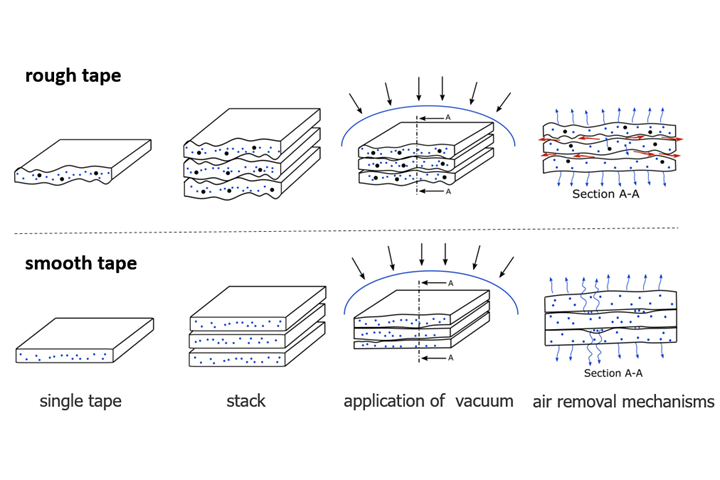
Figure 1. Different air removal mechanisms such as in-plane permeation and through-thickness diffusion for, respectively, rough tape (top) and smooth tape (bottom). Source | TPRC
The ThermoPlastics composites Research Center (TPRC, Enschede, Netherlands), is currently investigating a two-step approach for the manufacturing of thermoplastic composite structures, involving the rapid deposition of preimpregnated thermoplastic tape, using automated fiber placement (AFP) followed by vacuum-bag-only (VBO) consolidation. Compared to the AFP with in-situ consolidation alternative, TPRC says its AFP + VBO project combines the lay-down of tape material at a cost-effective rate and an affordable post-processing step to ensure the required consolidation quality.
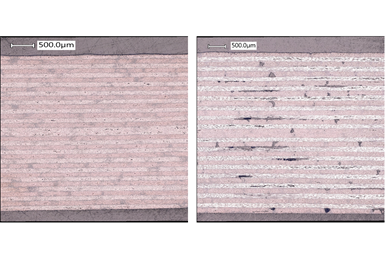
Figure 2. Laminates consolidated under vacuum pressure with free (left) and constrained (right) in-plane permeation; the latter was achieved by sealing off the laminate edges with tape. Source | TPRC
The main aim of the project, TPRC says, is to enable the cost-efficient out-of-autoclave (OOA) manufacture of advanced components by developing material guidelines and process models. This requires a thorough understanding of the physical mechanisms that control the OOA consolidation of fiber-placed thermoplastic laminates — for example, the in-plane permeation and diffusion of entrapped air during different stages of the consolidation process for various material configurations (Figure 1). TPRC says the mechanisms have been explored qualitatively, as seen through the effect of sealing the edges of a stack on air removal (Figure 2).
TPRC notes that the research is still ongoing, and measurement set-ups are being developed for the quantitative determination of both diffusion and permeation related material properties.
Related Content
-
Plant tour: Collins Aerospace, Riverside, Calif., U.S. and Almere, Netherlands
Composite Tier 1’s long history, acquisition of stamped parts pioneer Dutch Thermoplastic Components, advances roadmap for growth in thermoplastic composite parts.
-
Troubleshooting thermoplastic composite stamp forming
Understand the basic science of TPC stamp forming, a manufacturing process steadily gaining momentum in aerospace and mobility applications thanks to its rapid forming, short cycle times and automated methods.
-
Aerospace prepregs with braided reinforcement demonstrate improved production rates, cost
A recent time study compares the layup of a wing spar using prepreg with A&P’s TX-45 continuous braided reinforcement versus traditional twill woven prepreg.


