
SpaceShip Two prepares for first spaceflight
Virgin Galactic prepares its vehicles, pilots, team and facilities with rigorous pre-flight checks and objectives before the flight which will be carried out later this fall.


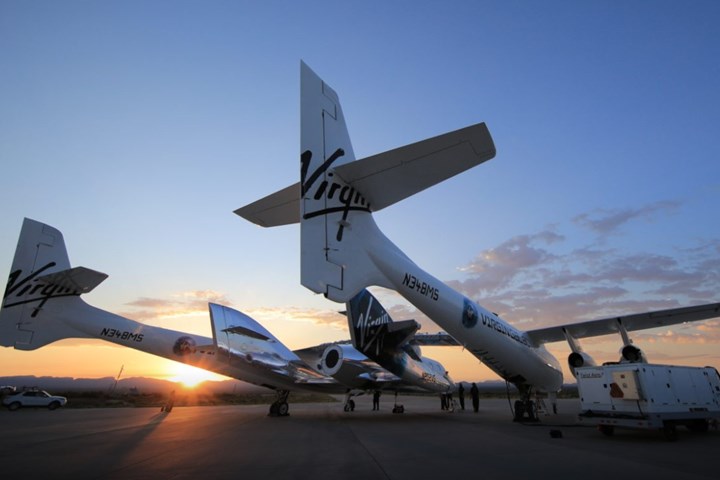
Photo Credit: Virgin Galactic
Virgin Galactic Holdings Inc. (Mojave, Calif., U.S.) reported on Oct. 14 that the company is preparing for the SpaceShipTwo’s first spaceflight from its operational base at Spaceport America (Las Cruces, N.M., U.S.) (see “SpaceShip Two completes second test flight”). Occurring later this fall, the flight will be crewed by two pilots and carry several research payloads (which are part of the NASA Flight Opportunities Program) in the cabin of VSS Unity. In these final preparations, Virgin Galactic says it is working through a number of rigorous steps to prepare the vehicles, pilots, team and facilities, ensuring that safety remains a top priority.
To ensure the pilots are well-prepared for the flight test objectives about to be conducted, Virgin Galactic notes the significant amount of training that has occurred in the company’s ground-based simulator, both with its own pilots, and those in sessions that are linked to the mission control room. Another training tool for the pilots included Virgin Galactic’s mothership vehicle, VMS Eve.


“VMS Eve has the ability to test pilot proficiency by simulating the glide and approach-to-land phase up flight for SpaceShip Two pilots,” chief pilot Dave Mackay explains. “The cockpit structure of Eve is almost identical to that of Unity: the same pilot seats and windows, as well as very similar flight controls and instruments. This, coupled with the fact that that with VMS Eve’s landing gear down, and one set of speed brakes out, it descends on the same flight path angle as SpaceShip Two, means that the crew can practice the identical approach and landing pattern to the one they will fly in Unity. This makes Eve a very valuable in-flight simulator.”
Virgin Galactic say preparing VSS Unity for flight also includes a “practice run” for the spaceship, as well as for the pilots and teams in mission control. This pre-flight check will put Unity through its paces on the ground by testing all systems prior to take-off to ensure functionality. This includes raising the feather, swinging the landing gear, firing the reaction control thrusters and sweeping the flight control systems through their full range of motion.
Further, with this flight being Virgin Galactic’s first spaceflight from Spaceport America, it reports that it has planned a full rehearsal of its spaceship propellant landing procedure. During this rehearsal, the company says it will perform a full tanking test, loading high-pressure helium and nitrous oxide into their respective spaceship tanks on-board VSS Unity. This particular rehearsal will provide the teams the opportunity to review the end-to-end execution of every step in the flight process to Spaceport.
Consistent with how Virgin Galactic conducted VSS Unity’s glide flights earlier this year, the company says all operations are following a set of stringent operational protocols that include changes to the work areas and procedures to enforce social distancing and universal mask usage, as advised by state guidelines.
Reporting it is still on track to meet its timeframe, Virgin Galactic expects its first spaceflight to occur later this fall. In September, the company disclosed, via its application for a multi-year Federal Communications Commission (FCC) license, that October 22, 2020, would be the opening of the company’s flight planning window. The company also says it includes preliminary test flight dates for its mothership, VMS Eve. While preparations are going well, Virgin Galactic states that it is not yet at the stage where it can confirm specific planned flight dates for either the VSS Unity or VMS Eve test flights.


Related Content

Revisiting the OceanGate Titan disaster
A year has passed since the tragic loss of the Titan submersible that claimed the lives of five people. What lessons have been learned from the disaster?
Read More
Filament winding increases access to high-performance composite prostheses
Steptics industrializes production of CFRP prostheses, enabling hundreds of parts/day and 50% lower cost.
Read More
Cutting 100 pounds, certification time for the X-59 nose cone
Swift Engineering used HyperX software to remove 100 pounds from 38-foot graphite/epoxy cored nose cone for X-59 supersonic aircraft.
Read More
Otto Aviation launches Phantom 3500 business jet with all-composite airframe from Leonardo
Promising 60% less fuel burn and 90% less emissions using SAF, the super-laminar flow design with windowless fuselage will be built using RTM in Florida facility with certification slated for 2030.
Read MoreRead Next

Ceramic matrix composites: Faster, cheaper, higher temperature
New players proliferate, increasing CMC materials and manufacturing capacity, novel processes and automation to meet demand for higher part volumes and performance.
Read More
Scaling up, optimizing the flax fiber composite camper
Greenlander’s Sherpa RV cab, which is largely constructed from flax fiber/bio-epoxy sandwich panels, nears commercial production readiness and next-generation scale-up.
Read More
Cutting 100 pounds, certification time for the X-59 nose cone
Swift Engineering used HyperX software to remove 100 pounds from 38-foot graphite/epoxy cored nose cone for X-59 supersonic aircraft.
Read More