
Siemens Gamesa, Siemens Energy partner for offshore green hydrogen production acceleration
Five-year project is the first major step to develop an industrial-scale system capable of harvesting green hydrogen from offshore wind.


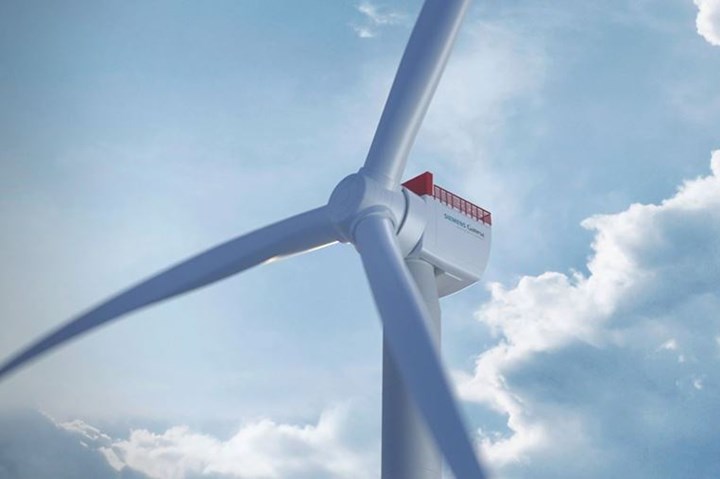
SGRE’s SG 14-222 DD turbine, which retains a 222-meter rotor and 108-meter-long B108 blades, based on IntegralBlade technology. Photo Credit: SGRE
Siemens Gamesa Renewable Energy (SGRE, Zamudio, Spain) and Siemens Energy AG (Munich, Germany) have announced that the companies are combining ongoing wind-to-hydrogen developments to address decarbonizing the economy (see “Siemens Gamesa powers carbon-free future with green hydrogen”).
The innovative solution will fully integrate an electrolyzer — a system that uses electricity to break water into hydrogen and oxygen in a process called electrolysis — into an offshore wind turbine as a single synchronized system to directly produce green hydrogen. The companies intend to provide a full-scale offshore demonstration of the solution by 2025/2026. Further, German Federal Ministry of Education and Research announced that the developments can be implemented as part of the ideas competition “Hydrogen Republic of Germany.”


“Our more than 30 years of experience and leadership in the offshore wind industry, coupled with Siemens Energy’s expertise in electrolyzers, brings together brilliant minds and cutting-edge technologies to address the climate crisis,” says Andreas Nauen, Siemens Gamesa CEO. “Our wind turbines play a big role in the decarbonization of the global energy system, and the potential of wind to hydrogen means that we can do this for hard-to-abate industries, too. It makes me proud that our people are a part of shaping a greener future.”
Over a timeframe of five years, Siemens Gamesa plans to invest EUR €80 million and Siemens Energy is targeting to invest EUR €40 million in the developments. Siemens Gamesa says it will adapt development of its SG 14-222 DD offshore wind turbine to integrate an electrolysis system seamlessly into the turbine’s operations. By leveraging Siemens Gamesa’s knowledge and decades of experience with offshore wind, electric losses will reportedly be reduced to a minimum, while a modular approach ensures a reliable and efficient operational setup for a scalable offshore wind-to-hydrogen solution. Siemens Energy plans to develop a new electrolysis product to not only meet the needs of the harsh maritime offshore environment and to be in perfect sync with the wind turbine, but also to create a new competitive benchmark for green hydrogen.
According to Siemens Gamesa, the solution will ultimately lower the cost of hydrogen by being able to run off-the-grid, opening up more and better wind sites. The companies’ developments will also serve as a testbed for making large-scale, cost-efficient hydrogen production a reality.
Further, the developments are part of the H2Mare initiative, which, under the consortium lead of Siemens Energy, is a modular project consisting of multiple sub-projects to which more than 30 partners from industry, institutes and academia are contributing. Siemens Energy and Siemens Gamesa will contribute to the H2Mare initiative with each company’s own developments in separate modular building blocks.


Related Content

Revolutionizing space composites: A new era of satellite materials
A new approach for high volumes of small satellite structures uses low-CTE, low-cost CFRP cellular core, robust single-ply skins and modular panel systems to cut lead time, labor and cost for reflectors, solar arrays and more.
Read More
Honda begins production of 2025 CR-V e:FCEV with Type 4 hydrogen tanks in U.S.
Model includes new technologies produced at Performance Manufacturing Center (PMC) in Marysville, Ohio, which is part of Honda hydrogen business strategy that includes Class 8 trucks.
Read More
ZEBRA project demonstrates closed-loop wind recycling system
Consortium partners have proven the complete recycling of thermoplastic wind turbines via two manufactured wind blades, featuring reduced operating cost, CO2 emissions.
Read More
Composite bipolar plates provide 81% improvement to hydrogen fuel cell power density
Ultra-thin CFRTP plates developed by Hycco achieve a 7.5 kilowatt/kilogram power density, high durability for fuel cells in long-flight drone and heavy-mobility applications.
Read MoreRead Next

Scaling up, optimizing the flax fiber composite camper
Greenlander’s Sherpa RV cab, which is largely constructed from flax fiber/bio-epoxy sandwich panels, nears commercial production readiness and next-generation scale-up.
Read More
Next-gen fan blades: Hybrid twin RTM, printed sensors, laser shock disassembly
MORPHO project demonstrates blade with 20% faster RTM cure cycle, uses AI-based monitoring for improved maintenance/life cycle management and proves laser shock disassembly for recycling.
Read More
Ultrasonic welding for in-space manufacturing of CFRTP
Agile Ultrasonics and NASA trial robotic-compatible carbon fiber-reinforced thermoplastic ultrasonic welding technology for space structures.
Read More