
Kordsa partners with University of Sheffield research center
Kordsa, the University of Sheffield and Sabancı University will collaborate on advanced composites research for aerospace and automotive applications.
.jpg;width=70;height=70;mode=crop;format=webp)


Source | Kordsa
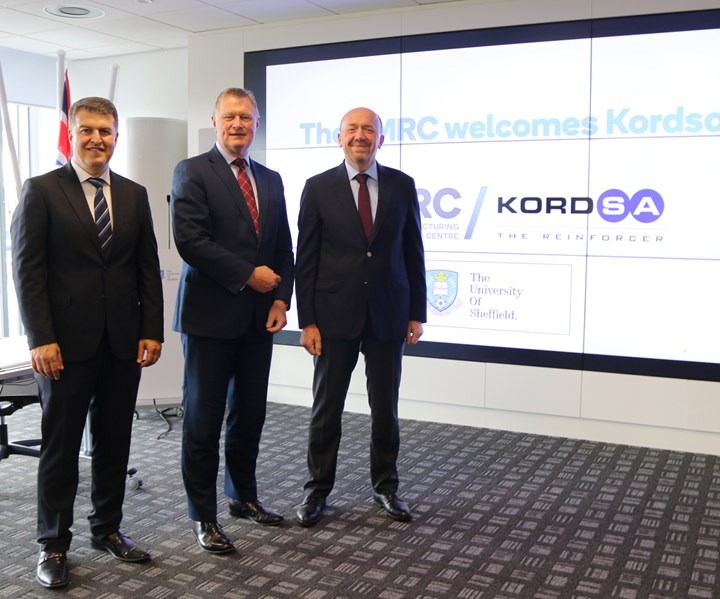
Kordsa (Istanbul, Turkey) has partnered with the University of Sheffield Advanced Manufacturing Research Centre (AMRC, Sheffield, U.K.) for the development of new advanced composite technologies for the aviation and automotive markets. The collaboration is part of a business strategy to position Kordsa, known for supplying cord products for the global tire market, in the composites technology space.


A Memorandum of Understanding (MoU) was signed between the University of Sheffield, Kordsa and Sabancı University (Istanbul, Turkey). Kordsa partnered with Sabancı University in 2016 to establish its Composite Technologies Center of Excellence (CTCE) in Istanbul. Engineers and Ph.D. candidates from both universities will have use of the CTCE facilities for research.
According to Kordsa, the CTCE in Technopark Istanbul is a 3,500-square-meter facility with capabilities for material and mechanical characterization tests, additive manufacturing, polymer processing and advanced composite manufacturing methods including autoclave curing methods and automated fiber placement (AFP). It is reportedly the only production and test center in Turkey that meets international aerospace requirements.
“As a company with an open innovation approach, Kordsa works with many different universities, companies and research organizations both in Turkey and abroad, engaging in joint projects with world-renowned specialists in their fields. The AMRC is a good fit for Kordsa and the Centre of Excellence we have in Turkey,” says Ali Çalışkan, Kordsa CEO. “Each passing day we strive to reinforce a larger area and build a more reinforced future. We are looking for opportunities for collaboration and growth globally that is the reason for signing the MoU.”
“This partnership with the AMRC is going to help us a great deal in putting a new ecosystem in place, and we also expect some opportunities to invest in the U.K. as we develop further advanced materials in the composites industry,” says Çalışkan.
According to Bahattin Koç, professor of engineering and natural sciences at Sabancı University, this collaboration will also include exploring the possibility of joint Ph.D. programs between the two univiersities and collaborative research. “We intend to support the foundation in establishing a Training Centre based on the successful model operating in Sheffield,” Koç says. “Additionally, a five-year support program will be generated covering all aspects of the Centres’ operation. The agreement also includes a Master Research Agreement, which will search for long-term funding opportunities and will have an initial focus with the R&D Group and provide access to the appropriate Tier 1 AMRC partners. I am confident that both academy and industry will benefit from this collaboration.”
The Kordsa delegation was given a tour of the AMRC by its CEO, Colin Sirett, who says this partnership offers the prospect of both strong research links and inward investment: “There are all the elements in this: the technology, the potential for manufacture and then the jewels in the crown are the research links and potential joint Ph.D. delivery between Sabancı University and the University of Sheffield.”
Sirett notes that with the continuing uncertainty around Brexit, building associations with organizations outside the European Union (EU) is practical from the AMRC’s perspective. The MoU also demonstrates the international reputation of the AMRC as the go-to place for advanced manufacturing and composite technology. “If you look at the positioning of the University of Sheffield for the future, with everything else that is going on, which is completely outside of our control, these are critical, strategic relationships.


Related Content

Plant tour: Aernnova Composites, Toledo and Illescas, Spain
RTM and ATL/AFP high-rate production sites feature this composites and engineering leader’s continued push for excellence and innovation for future airframes.
Read More
Combining multifunctional thermoplastic composites, additive manufacturing for next-gen airframe structures
The DOMMINIO project combines AFP with 3D printed gyroid cores, embedded SHM sensors and smart materials for induction-driven disassembly of parts at end of life.
Read More
Carbon fiber, bionic design achieve peak performance in race-ready production vehicle
Porsche worked with Action Composites to design and manufacture an innovative carbon fiber safety cage option to lightweight one of its series race vehicles, built in a one-shot compression molding process.
Read More
The next evolution in AFP
Automated fiber placement develops into more compact, flexible, modular and digitized systems with multi-material and process capabilities.
Read MoreRead Next

The Kordsa strategy
Turkey-based Kordsa has a long history supplying materials to the global tire market. It now has its sights set on reinforcement fabrics, prepregs and core materials for aerospace, automotive and industrial structures.
Read More
Cutting 100 pounds, certification time for the X-59 nose cone
Swift Engineering used HyperX software to remove 100 pounds from 38-foot graphite/epoxy cored nose cone for X-59 supersonic aircraft.
Read More
Scaling up, optimizing the flax fiber composite camper
Greenlander’s Sherpa RV cab, which is largely constructed from flax fiber/bio-epoxy sandwich panels, nears commercial production readiness and next-generation scale-up.
Read More