
Gulfstream unveils G800 and G400 business jets
Ultra-long range G800 and comfortable G400 powered with Pratt & Whitney composite and titanium engines offer operational flexibility and improved environmental performance.

Share
Read Next


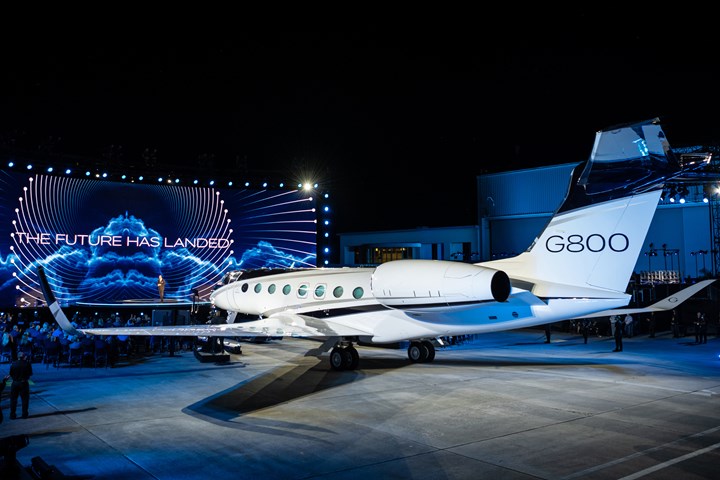
Photo Credit: Gulfstream
Gulfstream Aerospace Corp. (Savannah, Ga., U.S.) a wholly owned subsidiary of General Dynamics (Reston, Va., U.S.), unveiled two new aircraft — the ultra-long range G800 powered by Rolls-Royce Pearl 700 engines, and the G400, its new entrant to the large-cabin class with Pratt & Whitney Canada PW800 powerplant which uses titanium and composite materials — during an event livestreamed on YouTube from the company’s headquarters in Savannah, Ga. The live broadcast also featured a virtual tour of the new G400 and a live reveal of the first G800.
“For more than six decades, Gulfstream has led the business aviation industry with our commitment to continuous improvement and by consistently setting new standards for safety, performance, innovation and comfort,” said Mark Burns, president of Gulfstream, who served as the event’s emcee. “Today marks a major milestone and investment in our company’s future.”


The G800, which will eventually replace the G650ER, offers customers the longest range in the Gulfstream fleet with its 8,000-nautical-mile/14,816-kilometer range at Mach 0.85 and 7,000-nautical-mile/12,964-kilometer range at Mach 0.90. Powered by high-thrust Rolls-Royce Pearl 700 engines and the Gulfstream-designed wing and winglet introduced on the Gulfstream G700, the G800 also features enhanced fuel efficiency and more city-pair capabilities.
The G800 is designed to seat up to 19 passengers and offers up to four living areas or three living areas with crew compartment. It also features the signature Gulfstream cabin experience with 100% fresh, never recirculated air, quiet noise levels, low cabin altitude and 16 Gulfstream panoramic oval windows.
The G400, positioned between the super-midsized G280 and G500, offers a combination of long-range, high-speed performance, cabin comfort and environmental efficiency, according to Gulfstream.
It increases environmental performance by reducing fuel consumption, emissions and noise through its use of Gulfstream’s aerodynamic clean-wing design and advanced Pratt & Whitney PW812GA engines. The aircraft will fly 4,200 nautical miles/7,778 kilometers at its long-range cruise speed of Mach 0.85. Three floorplans are offered, with options for seating up to nine, 11 or 12 passengers, and the G400 also provides the signature Gulfstream cabin experience and 10 Gulfstream panoramic oval windows.
Pratt & Whitney Canada (Longueuil, Quebec) will deliver a fully integrated powerplant solution comprised of the PW812GA engine and nacelle system provided by Collins Aerospace (Charlotte, N.C., U.S.). The PW812GA extends the application of the PW800 architecture, with optimizations for the advanced requirements of the G400 aircraft including the latest full authority digital engine control, sophisticated technology to support engine health monitoring and the use of advanced materials such as titanium and composites to deliver superior performance and availability.
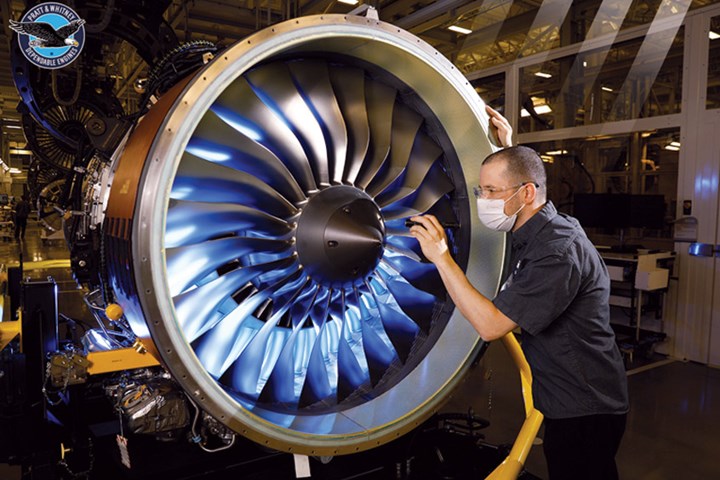
Twin PW812GA engines will power the new Gulfstream G400 aircraft. Photo Credit: Pratt & Whitney
“The G400 was conceived and designed with direct customer input,” said Burns at the live event. “The aircraft re-envisions this market segment with its maximum operational flexibility and enhanced cabin comfort.”
The G400 use composite materials in a number of areas, including WTBF panels; the nose radome; fuselage tail cone; HT skins; upper VT (“Bullet”) cone; upper VT skirt fairings; floor boards; flat pressure bulkhead (partial); aux pressure bulkhead; winglets; apron, nacelle; rudder; several of its access doors; and more. The G800 covers similar items, but retains a metallic aux pressure bulkhead instead of composite. Further, it has composite spoilers on the wing, and composite fixed trailing edges between the aileron and winglet and the inboard part of the flap and fuselage.
Both the G800 and G400 are equipped with the Gulfstream Symmetry flight deck featuring electronically linked active control sidesticks and 10 touchscreen displays.
Additional health and safety enhancements include a plasma ionizing clean air system neutralizing 99.9% of airborne bacteria, spores and odors; and its predictive landing performance system, providing pilots advanced warning of potential runway excursions so they can adjust approaches or go around.
G800 customer deliveries are anticipated to begin in 2023 and G400 deliveries are expected in 2025.


Related Content

Revolutionizing space composites: A new era of satellite materials
A new approach for high volumes of small satellite structures uses low-CTE, low-cost CFRP cellular core, robust single-ply skins and modular panel systems to cut lead time, labor and cost for reflectors, solar arrays and more.
Read More
KAI demonstrates thermoplastic and infused structures for future airframes
Korea Aerospace Industries advances its expertise through a welded TPC fuselage section and resin-infused wing skin module and torsion box demonstrators.
Read More
ASCEND program completion: Transforming the U.K.'s high-rate composites manufacturing capability
GKN Aerospace, McLaren Automotive and U.K. partners chart the final chapter of the 4-year, £39.6 million ASCEND program, which accomplished significant progress in high-rate production, Industry 4.0 and sustainable composites manufacturing.
Read More
Assembling the Multifunctional Fuselage Demonstrator: The final welds
Building the all-thermoplastic composite fuselage demonstrator comes to an end with continuous ultrasonic welding of the RH longitudinal fuselage joint and resistance welding for coupling of the fuselage frames across the upper and lower halves.
Read MoreRead Next

Daher composite-metal winglets enhance performance of new Gulfstream G-700 large-cabin bizjet
The winglets are manufactured at the Daher factory in Tarbes, France and assembled into the aircraft at the Gulfstream’s Savannah plant.
Read More
Post Cure: 3D printed plastic, composite mouthstick designs assist limited-mobility users
Three M Tool and Machine has used its in-house additive manufacturing capabilities to rethink medical devices like mouthsticks, which must be stiff, lightweight and comfortable enough for everyday use.
Read More
Advancing bonding, coating and sealing to 4.0 systems for composites, metals and more
Brighton Science uses decades of experience, 2-second surface measurements and a framework of data-based specs and KPIs to help manufacturers advance toward reliable, predictable bond quality for faster, high-performance production.
Read More


