
Evonik invests in modernized Rohacell foam production facility
The new plant, to begin production in April 2022, will ensure delivery reliability for future market demand and feature the latest technology and safety standards.


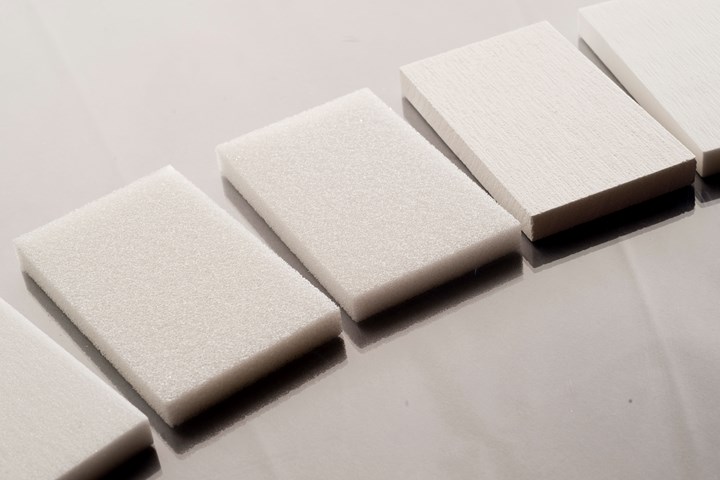
Photo Credit: Evonik
Evonik (Essen, Germany) is investing in a new, modern production facility for its high-performance Rohacell foams for fiber-reinforced composites manufactured in Darmstadt, Germany. At the same time, parts of the original production plant, which went into operation in 1972, will be shut down or extensively modernized. These measures will enable Evonik to continue to meet growing demand for its structural foams, such as from the aerospace industry.
Evonik’s original production facility in Darmstadt has been manufacturing Rohacell structural foam, which is used as a core material for sandwich composite materials, for 50 years. According to the company, the rigid polymethacrylimide foam plays a role in various industries, including medical and sports, with an increasing demand in high-frequency equipment for 5G networks as well as the growth of urban air mobility (UAM). Evonik expects to expand the product range soon.
With modern, state-of-the-art buildings and a production environment that meets the latest safety standards, Evonik says it is well equipped to meet growing customer demand and the high-quality requirements of industries such as aerospace and automotive. “With this contribution, Evonik continues on its path of investing in products that support sustainable solutions for our customers,” says Dr. Claus Rettig, head of Evonik’s Smart Materials Division. “Manufacturers in many industries want to efficiently produce high-performance lightweight components. Our high-performance foams for composites make this possible.”
Production will continue at the existing plant in Darmstadt during the construction and modernization phase. The first new production plant will start operation in April 2022, and further plants will follow over the course of the year.
Related Content
-
“Structured air” TPS safeguards composite structures
Powered by an 85% air/15% pure polyimide aerogel, Blueshift’s novel material system protects structures during transient thermal events from -200°C to beyond 2400°C for rockets, battery boxes and more.
-
Low-cost, efficient CFRP anisogrid lattice structures
CIRA uses patented parallel winding, dry fiber, silicone tooling and resin infusion to cut labor for lightweight, heavily loaded space applications.
-
JEC World 2024 highlights: Thermoplastic composites, CMC and novel processes
CW senior technical editor Ginger Gardiner discusses some of the developments and demonstrators shown at the industry’s largest composites exhibition and conference.


