
Customized production line optimizes Krempel prepreg quality and production
The automated production line for hotmelt impregnation integrates a range of features customized to Krempel’s requirements.


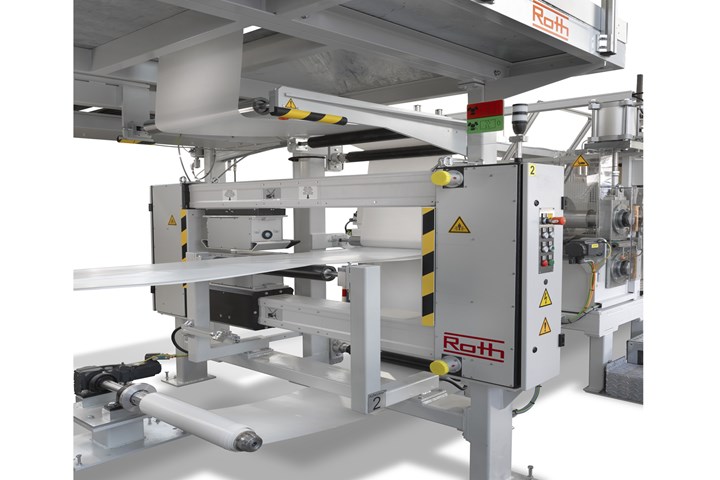
Photo Credit: Roth Composites Machinery
It was reported on Oct. 9 that Roth Composite Machinery GmbH (Steffenberg, Germany) developed a new production line for hotmelt impregnation, the Rothabow 600 Prepreg Production Line, for its customer, prepreg manufacturer, Krempel GmbH (Stuttgart, Germany).
Suitable for the processing of glass and carbon fiber, the automated production line is integrated with devices to enable the measurement of resin and prepreg surface weight. Said to work at a maximum application temperature of 300°C, the line also boasts a drive design of 10 meters per minute. Further, the line maintains a nearly backlash-free gap adjustment for the application system, the two calendars and the pulling station.


According to Roth, the coating unit used in the machine incorporated a special scraper system, and a fiber spreading unit enables fiber guiding on two levels. Rovings can be spread depending on requirements. Finally, the use of a double rewinder is said to enbale the cutting and rewinding of several tapes. In the heating elements area, the material web can also be lifted in case of production stops, to avoid heating the material too long during the process flow.
It is noted that the production line design is based on user-oriented advice Roth Composite Machinery provided Krempel. This advice comprised the sequence of individual production steps, the material selection and processing, the automation level and the increase in productivity up to the commissioning and instruction in the operation of the machine.
“By using the new prepreg production line, besides the optimized production speed, we can also achieve significant quality improvements for our high-quality prepregs,” said Thomas Mozer, principal product engineering at Krempel.
Related Content
-
Development of a composite liquid hydrogen tank for commercial aircraft
Netherlands consortium advances cryogenic composites testing, tank designs and manufacturing including AFP, hybrid winding, welding of tank components and integrated SHM and H2 sensors for demonstrators in 2025.
-
Cutting 100 pounds, certification time for the X-59 nose cone
Swift Engineering used HyperX software to remove 100 pounds from 38-foot graphite/epoxy cored nose cone for X-59 supersonic aircraft.
-
Low-cost, efficient CFRP anisogrid lattice structures
CIRA uses patented parallel winding, dry fiber, silicone tooling and resin infusion to cut labor for lightweight, heavily loaded space applications.


