
Recycled carbon veil designed to close carbon fiber lifecycle loop
CAMX 2023: Technical Fibre Products’ new nonwoven veil can be reused in composites, effectively closing the loop and providing a viable route for the recycling of fibers.


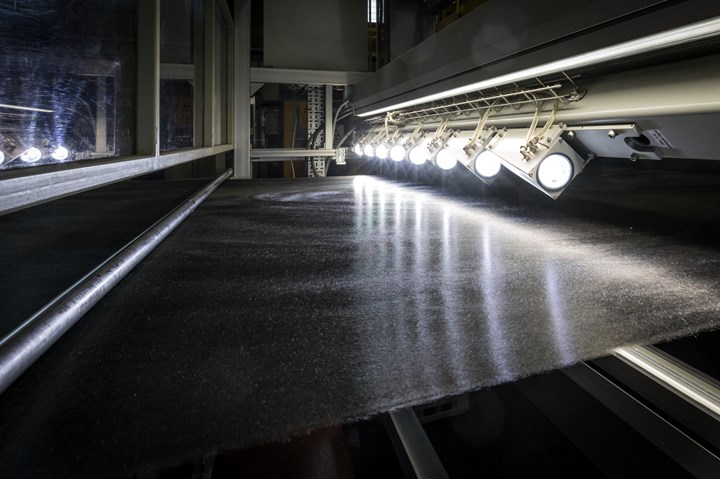
Photo Credit: Technical Fibre Products
Technical Fibre Products (TFP, Cheshire, U.K.), which is part of the James Cropper group, has been working with recycled carbon fiber for more than 15 years, developing the experience to manufacture a high-quality veil using fiber reclaimed from the composites manufacturing supply chain. The resulting veil can be reused in composites, effectively closing the loop and providing a viable route for the recycling of fibers previously considered as waste.
“Creating future focused and environmentally friendly solutions for the composites industry is a priority for TFP,” says Mike Campbell, VP of sales at TFP. “Our goal is to proactively help our customers achieve both their technical and sustainability goals, and our extensive experience in working with recycled carbon [fiber] has enabled us to do just that; we are delighted to introduce our new range of high-performance nonwovens made both from composites and for composites.”
The recycled carbon fiber veil is part of TFP’s sustainable nonwovens range, designed to improve the finish, fabrication or functionality of a composite while simultaneously enabling customers to demonstrate environmental responsibility without compromising on performance or quality. The veil can be used in a range of applications, such as aerospace interiors, sporting goods and automotive and advanced air mobility components, and has already been used to manufacture composite parts with excellent results, the company says.
Like its traditional Optiveil range, its recycled nonwovens can be integrated into a composite as a surfacing or semi-structural layer, providing a number of solutions. Typical properties include enabling a high-quality resin rich surface finish, as well as imparting electrical conductivity, and high temperature and chemical resistance.
Related Content
-
Composites end markets: Automotive (2025)
Composites manufacturing intelligence drives circular economy solutions as automotive industry balances technical demands with sustainability mandates.
-
Partners recycle A350 composite production waste into adjustable-length rods for MFFD
Herone, Spiral RTC, Teijin Carbon Europe and Collins Aerospace Almere recycle A350 thermoplastic composite clips/cleats waste into rods for the all-thermoplastic composite Multifunctional Fuselage Demonstrator’s crown.
-
Composites end markets: Sports and recreation (2025)
The use of composite materials in high-performance sporting goods continues to grow, with new advancements including thermoplastic and sustainability-focused materials and automated processes.


