
Coriolis introduces hybrid CPico AFP machine
This compact cell brings together 3D printing, AFP and milling aided by a comprehensive software program, further simplifying the manufacture of complex thermoplastic composite aerostructures in the future.


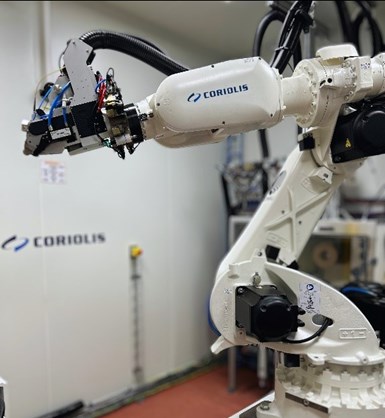
The hybrid CPico system. Photo Credit, all images: Coriolis Composites
Coriolis Composites (Quéven, France) has been designing and providing automated fiber placement (AFP) cells for the aerospace industry for more than two decades. For the last couple of years, Coriolis says it has pushed the boundaries of compact end effectors dedicated to the manufacture of complex parts, highlighted in the recently released CPico system.
The Coriolis CPico is a compact cell combining two different manufacturing technologies: AFP and additive manufacturing (AM). AFP brings high performance through the use of continuous carbon fiber while the system’s AM-related features bring complexity and functionalities into the part. CPico also enables the use of thermoplastic composites — for toughness, recyclability, repairability and temperature resistance — which is in line with recent developments in materials for aerospace.


CPico is made possible through the use of a Siemens-controlled six-axis robot combined with a two-axis positioner. The use of multiple axes enables true 3D trajectories and optimized robot postures for improved manufacturability, Coriolis notes. Four different processes are available on the cell and processes are swapped from one to the other thanks to an automatic toolchanger — these include two AM processes, fused filament fabrication (FFF) and fused granular fabrication (FGF), with AFP and potentially milling in the future. The heads are designed to process high-temperature polymers (PAEK family) at room temperature with in-situ consolidation standards (less than 1% porosity, high ILSS and crystallinity).
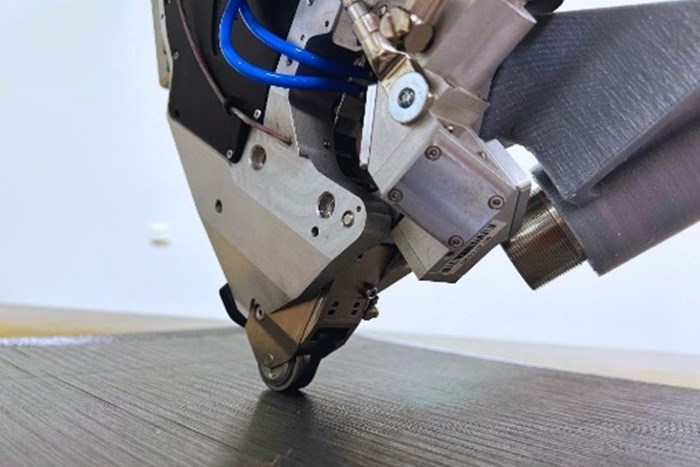
CPico AFP head.
The system’s AFP end effector is a compact, single-tape tool that can process several fiber widths ranging from 1 mm or 6.35 mm ( ¼"). While ¼" tows are used to make panels comparable to bigger machines (the Coriolis C1.2, for instance), 1-mm tows allow the user to make use of the potential of anisotropic carbon fiber and are used to provide localized and highly oriented additional reinforcement. From a manufacturing point of view, it can also achieve very tight steering radii. Moreover, a fiber tensioning device has been added to the head for certain applications such as filament winding.
The FFF and FGF end effectors have been designed with the same philosophy: providing in-situ consolidation with good adhesion and near-zero porosity. To do so, specific extrusion dies have been designed (ranging from 0.4-1.2 mm in diameter) to create polymer matrix flow. Moreover, localized heating is used to favorize molecular mobility for optimized adhesion between layers. The FGF end effector, while more complex than the FFF, is also reported to be higher performing; its high wear resistance makes it capable of processing carbon fiber-reinforced PEEK compounds with high fiber volume fraction (up to 35%). An automatic die-cleaning and tool center point measurement device is also provided in order to obtain flawless prints.
AM prints are usually not suitable for net-shape parts and need post-treatment with a milling machine to reach its required accurate geometry. To eliminate moving the part from additive to subtractive cells, a milling tool is embedded into the solution (expected 2024). This tool will be developed by robotic milling solutions supplier Creno (Annecy, France). It’s able to perform trimming, drilling and surfacing operations and incorporates a vacuum unit for switching between processes without intermediate cleaning.

An illustration of the different functions of SimuReal MP.
Moreover, to generate a single program for the different manufacturing processes, a dedicated path-planning CAM software has been developed:
- Advanced slicer engine for planar, multi-planar and curved (non-planar) slicing of geometries (mesh and parametric/exact shapes).
- Path-planner: Hybrid continuous fiber reinforcement (based on Coriolis’ knowledge of fiber placement path programming) and filament/pellet extrusion path generation (such as single-stroke continuous extrusion path planning). It also includes filament winding planning and machining operations planning, with manual path waypoints edition for local adjustments.
- Advanced motion planner for complex, robot-based kinematics programming and simulation with external devices (such as dual-axis rotational table/positioner), including collision-avoidance and toolpath smoothing optimization.
- NC-code machine simulation: A digital twin of the robotic machine, based on the Siemens NC Virtual Controller (Sinumerik Run My-VNCK and S-One), including collision detection and realistic material deposition simulation.
CPico has been developed to manufacture complex, multi-functional thermoplastic composite parts where conventional process are not suitable. It also aims to eliminate the need for additional manufacturing cells, such as welding. Application examples include filament-wound tanks, composite sandwich structures, hybrid AFP/AM parts with fixation devices and more. Several research projects funded by the European Union incorporating CPico are ongoing with aerospace Tier 1 suppliers.


Related Content

JEC World 2025 highlights: Trends in aerospace, new space and defense
CW editor-in-chief Scott Francis discusses trends in aerospace on display at JEC World — as the composites industry awaits a new single aisle aircraft program, the industry puts continued focus on new space, defense, UAM.
Read More
Laser cleaning in composites manufacturing
Laser cleaning technologies for cleaning production molds for composites offer alternatives to harsher, less-friendly methods with features like automation and higher power cleaning.
Read More
Zünd, Loop Technology partner on FibreLine preforming system
Pairing Loop Technology’s automation with Zünd digital cutters provides faster cutting, less stray fibers, higher ply accuracy and more precise preforms for composite aerostructure manufacturing.
Read More
Optimizing robotic winding of composite tanks and pipes
Pioneer in mandrel-based reinforced rubber and composite products, TANIQ offers TaniqWindPro software and robotic winding expertise for composite pressure vessels and more.
Read MoreRead Next

Coriolis highlights C1.2 compact AFP system for multi-material applications
New developments regarding productivity, maintenance and ergonomics make this enhanced composite placement system well suited for the production of complex parts.
Read More
Plant tour: Daher Shap’in TechCenter and composites production plant, Saint-Aignan-de-Grandlieu, France
Co-located R&D and production advance OOA thermosets, thermoplastics, welding, recycling and digital technologies for faster processing and certification of lighter, more sustainable composites.
Read More
Scaling up, optimizing the flax fiber composite camper
Greenlander’s Sherpa RV cab, which is largely constructed from flax fiber/bio-epoxy sandwich panels, nears commercial production readiness and next-generation scale-up.
Read More