
SPE announces 2019 ACCE Best Paper award winners
The three winning authors will present their papers at the SPE ACCE conference this week in Novi, Michigan.
.jpg;width=70;height=70;mode=crop;format=webp)


The organizing committee for the SPE Automotive Composites Conference & Exhibition (ACCE) has announced the Best Paper Award winners of the group’s nineteenth-annual show, which takes place Sept. 4-6 in Novi, Mich., U.S. The three winners will be honored for excellence in technical writing with a commemorative plaque during the SPE ACCE opening ceremonies today:
- Sara Andrea Simon, a Ph.D. candidate at the Polymer Engineering Center (PEC) at the University of Wisconsin-Madison (Madison, Wis., U.S.), won first place in this year’s competition,
- Dr. Xiaoming Chen, a technical expert at Ford Motor Co. (Dearborn, Mich., U.S.), won second place, and
- Dinesha Ganesarajan, a graduate student working on his Master of Science degree in the Chemical Engineering department at the University of Waterloo (Waterloo, Ontario, Canada), placed third in the competition.
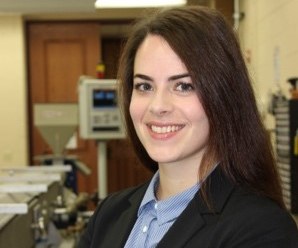
Sara Andrea Simon. Source | SPE
Sara Andrea Simon won first place for her paper titled “Direct Fiber Model Validation: Orientation Evolution in Simple Shear Flow.” The paper will be presented on Sept. 4 from 1-1:30 p.m. in the Advances in Thermoplastic Composites session at the conference. About this topic, the author says, “The ability to simulate the processing of fiber-reinforced composites has become indispensable for the automotive industry. Particle-level simulation, in specific, is a promising tool that can be employed in the improvement of commercial software. In this work, reliable fiber orientation evolution data was obtained to aid in the validation and development of our particle modeling approach for reinforcing fillers.”


Simon is currently working in collaboration with Volkswagen on a new physical foaming injection molding technique to advance lightweight automotive constructions.

Dr. Xiaoming Chen. Source | SPE
Dr. Xiaoming Chen won second place in the competition for her paper titled “Fatigue and Strength CAE and Test Results.” She will present her paper on Sept. 6 from 10:30-11 a.m.in the Opportunities and Challenges with Carbon Composites session at the conference. “The carbon fiber composite subframe design was CAE driven,” Chen says. The performance of the prototype subframe was verified by component and vehicle tests. The CAE predictions for the tests had various degrees of correlation with the physical test results.”
Chen holds a Ph.D. in mechanical engineering from Northwestern Polytechnical University in China and is an Alexander von Humboldt fellowship recipient. Chen started her career as a crash safety engineer at Ford Truck Operations and later joined the Lightweight Architecture Team of Research and Advanced Engineering. Her current projects are related to lightweight chassis systems and components using advanced high-strength steel, aluminum, magnesium and composites materials.

Dinesha Ganesarajan. Source | SPE
Dinesha Ganesarajan’s paper is titled “Latest Breakthroughs with Hybrid Reinforced Composites in Lightweight Applications.” Dr. Leonardo Simon, University of Waterloo and ACCE technical program co-chair, will present his paper on Sept. 5 from 10:30-11 a.m. in the Sustainable Composites session at the conference. “My work explores the utilization of hybrid composites in the automotive industry for body interior and under the hood applications," Ganesarajan says of his project. “The use of naturally-sourced filler material with the combination of glass fiber yields superior performance properties with a lightweighting initiative. This is a necessary intermediate step to achieve the ambitious goal of a circular economy just like the introduction of hybrid vehicles before the emergence of electrification.”
Ganesarajan is a graduate student pursuing a Master of Science degree at the University of Waterloo’s chemical engineering department. His thesis topic explores the use of naturally-sourced filler materials being combined with glass fiber to produce hybrid composites for body interior and under-the-hood applications in the automotive industry. He completed his undergraduate program at the University of Waterloo majoring in chemical engineering with an energy systems specialization.


Related Content

On the radar: Innovations in composite battery enclosures
A look at recently reported design, material and process innovations for composites-intensive battery enclosures, developed to support the ramp-up of EV and AAM vehicles.
Read More
ASCEND program completion: Transforming the U.K.'s high-rate composites manufacturing capability
GKN Aerospace, McLaren Automotive and U.K. partners chart the final chapter of the 4-year, £39.6 million ASCEND program, which accomplished significant progress in high-rate production, Industry 4.0 and sustainable composites manufacturing.
Read More
Bladder-assisted compression molding derivative produces complex, autoclave-quality automotive parts
HP Composites’ AirPower technology enables high-rate CFRP roof production with 50% energy savings for the Maserati MC20.
Read More
Co-molding SMC with braided glass fiber demonstrates truck bed potential
Prepreg co-molding compound by IDI Composites International and A&P Technology enables new geometries and levels of strength and resiliency for automotive, mobility.
Read MoreRead Next

Report: Composites and Carbon Fiber Use in Hydrogen Storage
A first-of-its-kind technical report that assesses the materials, manufacturing processes, market and energy trends driving use of carbon fiber composites in global hydrogen (H₂) storage applications for fuel cell-powered trucks, buses, trains and passenger vehicles.
Read More
Industrial ultrasonic NDT adaptation permits accessible composite bicycle inspection
Cycle Inspect's ASNT-aligned certification program employs affordable twin-crystal ultrasonic testing equipment and standardized inspection methods to detect damage in composite bicycle components.
Read More
Post Cure: 3D printed plastic, composite mouthstick designs assist limited-mobility users
Three M Tool and Machine has used its in-house additive manufacturing capabilities to rethink medical devices like mouthsticks, which must be stiff, lightweight and comfortable enough for everyday use.
Read More


