
Researchers explore biomimetic approach for making adhesives tougher
A team from Purdue University takes inspiration from sea creatures to produce stronger adhesives with weaker bonds.


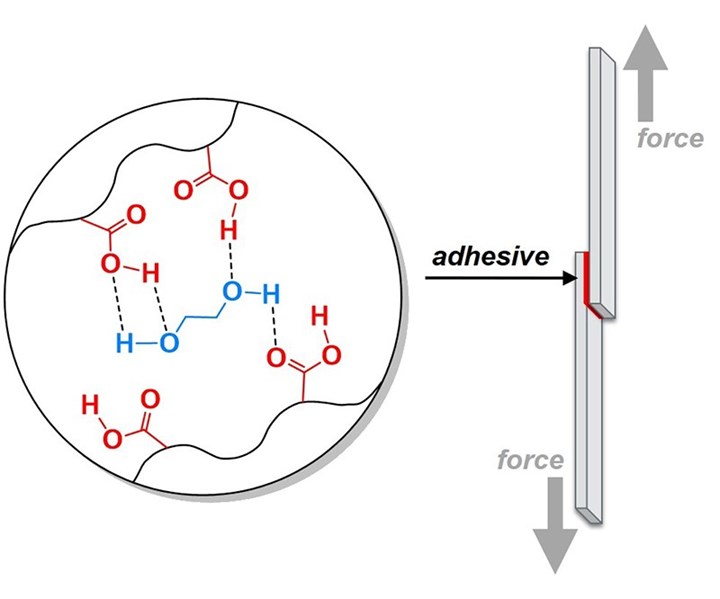
Purdue University researchers added bonds that are broken easily throughout the material to strengthen the adhesive. Source | Purdue University.


How do you make adhesives for electronics, vehicles and construction tougher? By making them weaker. That’s the proposed solution from a Purdue University (West Lafayette, Ind., U.S.) research team — well-known for its adhesive technology.
“We have been using inspiration from sea creatures to develop several new adhesives,” says Jonathan Wilker, a Purdue professor of chemistry and materials engineering, who helps lead the research team. The Purdue team added bonds that are broken easily throughout the material. When pressure or stress is applied to the glue, these sacrificial bonds are designed to absorb energy and break apart. Meanwhile, the rest of the larger adhesive system remains intact. The Purdue team’s work is published in the Journal of the American Chemical Society.
Managing how energy moves in adhesives
“The idea is somewhat similar to how a brick wall is made of bricks that are offset from each other,” says Wilker. “You stagger the bricks and cement so that a crack does not shoot right down through the cement lines. A crack hits the middle of a brick and the forces get spread out toward both sides, eventually decreasing to the point that the wall stays intact.”

Source | “Weak Bonds in a Biomimetic Adhesive …,” Journal of the American Chemical Society
“We added weak bonds within the adhesive so that mechanical forces and growing cracks lose energy by breaking these bonds instead of having the whole, larger material fracture. The idea is to manage how energy moves through the material. The overall adhesive system can become tougher and less likely to break apart when placed under mechanical stress.”
Wilker’s team tested this idea with several types of bonds. The ones that worked best were neither too weak nor too strong. He said that this technique for managing energy in adhesives might be a general phenomenon that could be applied to adhesives in industries ranging from consumer electronics to construction to manufacturing airplanes and automobiles.
Toxin-free adhesives
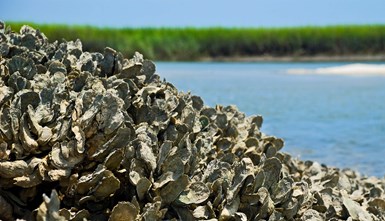
Oyster reef in the Baruch Marine Field Laboratory. Source | Jonathan Wilker/Purdue University
The team has hundreds of mussels and oysters growing in its laboratory for studying proteins used by the sea creatures attaching to rocks. After working to understand the nature of these natural adhesives, the researchers then generate several synthetic versions with different properties.
They have worked to patent several of their toxin-free adhesive systems with the Purdue Research Foundation Office of Technology Commercialization (OTC). The researchers are looking for partners to continue developing their technology. For more information on licensing and other opportunities, contact Joseph Kasper of OTC at jrkasper@prf.org.
Read the paper abstract below.


Related Content

Swedish parking garage to incorporate decommissioned wind blades
Architect Jonas Lloyd is working with Vattenfall to design the multistory building with a wind blade façade, targeting eco-friendly buildings and creative ways to remove blades from landfills.
Read More
GFRP Tech launches South African facility for GFRP rebar production
Said to be the first of its kind in this region, GFRP Tech will manufacture, test and supply flagship EnviraBar and EnviraMesh products to support South Africa’s infrastructure modernization.
Read More
3D printed CFRP forms speed construction of concrete nuclear reactor bioshield
In its first demonstration, Kairos Power and Oak Ridge National Laboratory tested the potential of AM and composites to enable fast, repeatable manufacturing for energy construction.
Read More
UNIST develops CFRP droplet-based electricity generator
Researchers have validated the S-FRP-DEG system’s ability to accurately convert the impact of falling rain into electrical signals, achieving an autonomous power source for drainage control.
Read MoreRead Next

Advancing bonding, coating and sealing to 4.0 systems for composites, metals and more
Brighton Science uses decades of experience, 2-second surface measurements and a framework of data-based specs and KPIs to help manufacturers advance toward reliable, predictable bond quality for faster, high-performance production.
Read More
Post Cure: 3D printed plastic, composite mouthstick designs assist limited-mobility users
Three M Tool and Machine has used its in-house additive manufacturing capabilities to rethink medical devices like mouthsticks, which must be stiff, lightweight and comfortable enough for everyday use.
Read More
Report: Composites and Carbon Fiber Use in Hydrogen Storage
A first-of-its-kind technical report that assesses the materials, manufacturing processes, market and energy trends driving use of carbon fiber composites in global hydrogen (H₂) storage applications for fuel cell-powered trucks, buses, trains and passenger vehicles.
Read More


