
RAMPF Composite Solutions receives $2.3 million Canadian government funding
The aerospace company aims to invest in automation and digitization, hire new employees and expand into emerging markets.
.jpg;width=70;height=70;mode=crop;format=webp)


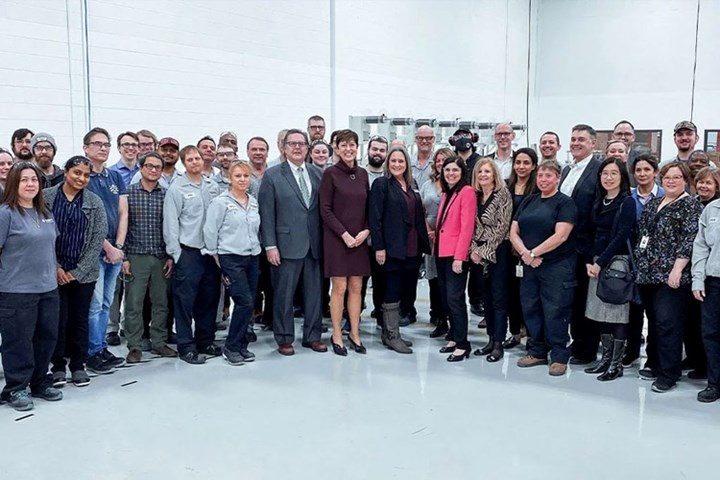
Photo Credit: RAMPF Composite Solutions
RAMPF Composite Solutions (Burlington, Ontario, Canada) has received $2.3 million from the Federal Economic Development Agency for Southern Ontario (FedDev Ontario) to foster the sustainable economic growth of Ontario’s aerospace sector.
In addition, the international RAMPF Group based in Grafenberg, Germany, which RAMPF Composite Solutions is part of, has announced that it will match the $2.3 million investment by FedDev Ontario over the next two years. With a total investment sum of $4.6 million, RAMPF Composite Solutions is pursuing three main objectives:
- Increase productivity by automating repetitive tasks
- Reduce cycle times to get products to customers faster
- Support higher production volumes
Larry Fitzgerald, CEO of RAMPF Composite Solutions, says, “[This investment] will allow us to win more business in our existing markets and take advantage of new exciting markets such as urban air mobility, unmanned aerial vehicles and electric aircraft. At the same time, we will reduce our environmental footprint and create a minimum of 15 additional new jobs in Burlington. By investing in automation and digitization, we will position RAMPF Composite Solutions to win new business as airframe manufacturers are increasing production rates and looking to develop new aerospace solutions that take advantage of lightweight composites. We are also proud that this investment will enable a future with less CO2 emissions — by designing and manufacturing lightweight composite components and structures, we are accelerating a reduction in fuel consumption today and creating solutions for hybrid and electric transportation in the future.”
Related Content
-
Development of a composite liquid hydrogen tank for commercial aircraft
Netherlands consortium advances cryogenic composites testing, tank designs and manufacturing including AFP, hybrid winding, welding of tank components and integrated SHM and H2 sensors for demonstrators in 2025.
-
“Structured air” TPS safeguards composite structures
Powered by an 85% air/15% pure polyimide aerogel, Blueshift’s novel material system protects structures during transient thermal events from -200°C to beyond 2400°C for rockets, battery boxes and more.
-
Ceramic matrix composites: Faster, cheaper, higher temperature
New players proliferate, increasing CMC materials and manufacturing capacity, novel processes and automation to meet demand for higher part volumes and performance.


