
Continuous Composites demonstrates CF3D technology for Lockheed Martin, AFRL WiSDM project
Continuous Composites carbon fiber wing spar structural performance achieves 160% design limit load with no damage detected, offers potential for aerospace-grade composite printing.


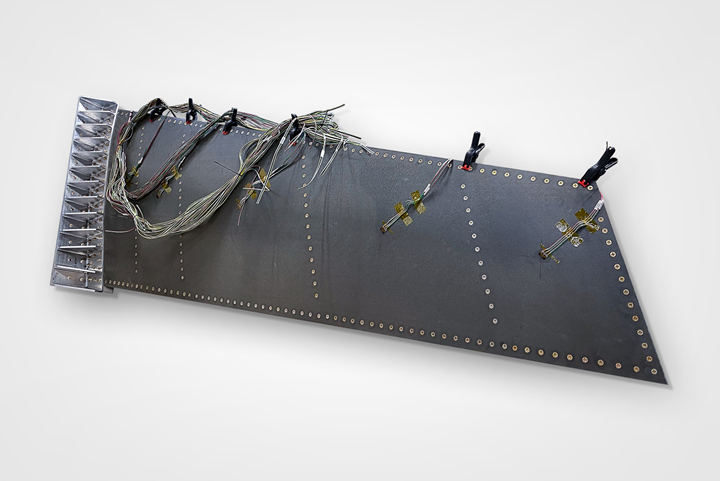
Photo Credit: Continuous Composites
Continuous Composites (Coeur d'Alene, Idaho, U.S.) announced on April 7 the successful completion of the U.S. Air Force Research Laboratory’s (AFRL) two-year Wing Structure Design for Manufacturing (WiSDM) contract through Lockheed Martin (Bethesda, M.D., U.S.) to manufacture a Low-Cost Attritable Aircraft (LCAA) wing. The project focused on a new structural design paradigm, when coupled with commensurate materials and manufacturing, to substantially reduce costs and lead times for attritable airframe structures. Continuous Composites says its patented Continuous Fiber 3D Printing (CF3D) technology successfully printed the structural carbon fiber spars of the wing assembly. Structural performance was demonstrated when the completed wing box was statically tested and achieved 160% design limit load (DLL) before the compression skin buckled. The spars did not fail.
“The successful work with Continuous Composites and AFRL’s focus on CF3D for this project not only advances new 3D printing technology but also offers the potential for aerospace-grade composite printing in high-performance industries,” says John Scarcello, senior manager, Lockheed Martin Skunk Works. “We recognize this process is paving the way for broader applications within both defense and commercial applications, and Lockheed Martin plans to be part of that future of advanced manufacturing.”


The program included a range of technologies focusing on innovative materials and manufacturing processes, including CF3D to print the spars, long fiber injection molding for ribs, additively manufactured (AM) tooling, automated fiber placement (AFP) for skins, autodrill and robotic assembly. More specifically, Continuous Composites printed two 8-foot-long, 4-pound, carbon fiber tapered C-channel spars. According to Continuous Composites, this novel approach to composites manufacturing features in-situ impregnation, consolidation and curing, resulting in significant cost and lead time reduction. The fully automated process features cutting and refeeding, enabling ply drops and variable part thickness within the structure.
The final wing assembly was delivered to the U.S. Air Force to undergo static load testing. The fully assembled wing was loaded to 160% of DLL. No measured or visual damage to the CF3D-printed spars was detected. The printed carbon fiber spars achieved a 60% fiber volume fraction with approximately 1% to 2% voids.
According to Ray Fisher, Air Force Research Laboratory program manager, “CF3D presents an innovative manufacturing technology that shows great promise to be both low cost and agile to the production rate and responsiveness requirements to realize attritable airframe structures. The success of this LCAA project shows great opportunity for additive manufacturing with customized CF3D material solutions that can orient structural fibers optimally. It is especially attractive to avoid expensive tooling in manufacturing aerospace structural parts. I look forward to additional opportunities to incorporate CF3D in increasingly complex structures that are further optimized for attritable enabling production.”
“This project is one application where CF3D showcases the significant cost reduction and design freedom while exceeding the stringent mechanical properties required for aerospace,” says Tyler Alvarado, CEO, Continuous Composites. “Our team is very appreciative to Lockheed Martin, the U.S. Air Force and other partners for including CF3D in this LCAA project. We are taking the next steps to select our long-term DoD prime partner while engaging the Air Force as evidenced by the upcoming announcements of our key involvement with the AFRL PiCARD program in parallel to a five-year CRADA.”


Related Content

Swiss researchers develop Matrix First concept for 3D printed continuous fiber ceramic structures
SNAPSHOT: Novel manufacturing approach designs internal channels within a 3D printed ceramic architecture for continuous fibers, rethinking how lightweight composite parts can be achieved.
Read More
Carbon fiber, bionic design achieve peak performance in race-ready production vehicle
Porsche worked with Action Composites to design and manufacture an innovative carbon fiber safety cage option to lightweight one of its series race vehicles, built in a one-shot compression molding process.
Read More
Active core molding: A new way to make composite parts
Koridion expandable material is combined with induction-heated molds to make high-quality, complex-shaped parts in minutes with 40% less material and 90% less energy, unlocking new possibilities in design and production.
Read More
Plant tour: Airbus, Illescas, Spain
Airbus’ Illescas facility, featuring highly automated composites processes for the A350 lower wing cover and one-piece Section 19 fuselage barrels, works toward production ramp-ups and next-generation aircraft.
Read MoreRead Next

Impossible Objects, Ricoh 3D partner to produce high-strength 3D-printed composite parts
New material options for industrial customers across Europe to remove barriers to printing parts for drones, aircraft, automobiles, athletic gear and more.
Read More
Commercializing UV-curable thermosets for continuous fiber 3D printing
Strategic partners Continuous Composites and Arkema/Sartomer are developing a library of photocurable resins for use in a variety of OOA, high-speed, high-performance composite applications.
Read More
Dialing in composites performance via dynamic digital twins
Sport Dynamics Lab uses Flexdynamics testing, digital models and AI tools to compare designs, materials and systems, enabling optimization with potential for propellers, drones and vibrational structures.
Read More


