
The Future of CFRP Pressure Vessels: Larger Sizes, Lightweighting, Data Centers and Space
Hexagon Composites discusses the largest Titan 510 Mobile Pipeline, use of thermoplastic composites for lightweighting modules, towpreg, Chinese carbon fiber and growth from data centers and space.


Source | Hexagon Composites
Hexagon Composites (Ålesund, Norway) is a pioneer in Type 4 composite pressure vessels, which use carbon fiber-reinforced polymer (CFRP) filament wound onto a plastic containment liner to provide lightweight storage of compressed natural gas (CNG/methane), hydrogen (H2), helium and other gases. These vessels and their integrated fuel systems provide lightweight, safe storage and transportation of clean alternative energies used in commercial mobility, bulk gas transportation and industrial applications. Building on 60 years of experience and innovation, Hexagon Composites has launched its largest commercial Type 4 composite cylinder manufactured to date, the Titan 510 Mobile Pipeline. It is reported to offer the highest capacity and operational efficiency for high-volume gas applications in industry, but also for energy, such as data centers.
Meanwhile, the company is re-entering the aerospace market, with its second $5+ million order for high-pressure tanks for space, and sees potential for growth over the next 5 years. CW discusses these latest developments, as well as wet winding versus towpreg, issues in designing new Type 4 and metal liner Type 3 pressure vessels, newly added winding capacity and potential for growth.


History of Mobile Pipeline

Source | Hexagon Composites, compilation by CW
Although Hexagon Composites was formed in 2000, its history in Type 4 composite pressure vessels goes back much further. In 2003, it acquired Raufoss Fuel Systems (Raufoss, Norway), which delivered its first Type 3 cylinders for CNG vehicles in 1992 (these switched to Type 4 in 2006). Hexagon then acquired what became Lincoln Composites (Lincoln, Neb., U.S.) in 2005. Founded in 1963 and previously part of Brunswick Defense and then General Dynamics, this facility produced filament-wound rocket motor cases and other defense components as well as composite-overwrapped pressure vessels (COPVs) for aerospace, including Skylab and the Space Shuttle. By 2010, Lincoln Composites had more than 180,000 Type 2, 3 and 4 pressure vessels in service, ranging in volume from 0.065 to 8,500 liters with operating pressures from 35 to 1,725 bar.
“In a lot of ways, that 60-year history and expertise from aerospace still drives our technology,” notes Chet Dawes, senior vice president of global engineering R&D for subsidiary Hexagon Agility (Costa Mesa, Calif., U.S.), the fuel systems supply division of Hexagon Composites (see Hexagon history infographic above). “Lincoln continues to develop our most advanced manufacturing processes, which have informed the newest facilities in Kassel, Germany and Salisbury, North Carolina. It’s also where Hexagon pioneered Mobile Pipeline.” In 2010, Hexagon Composites’ Lincoln campus commercialized the first Titan product — an 11.6-meter-long, 1.1-meter-diameter Type 4 pressure vessel operating at 250 bar with a water volume of 8,400 liters.
Before Titan, Hexagon had developed what are today termed multiple element gas containers (MEGC). “Those were relatively small capacity, such as a 20-foot container with 20 cylinders,” notes Dawes. “As we started to understand the worldwide demand, we pushed to develop the largest cylinder we could make that would fit in a 40-foot container. That led to the original Titan development, which was the largest pressure vessel in the market at that time. However, no codes or standards existed for a pressure vessel of that size, so we had to develop those as well, which resulted in an approval process and special permit by the U.S. DOT and Transport Canada, which then spurred the virtual pipeline industry.” Today, Hexagon has more than 2,250 gas distribution modules in operation worldwide.


Hexagon Mobile Pipeline global deployment and most recent products. Source | Hexagon Composites
Mobile Pipeline has since been through iterations of development, including a reduction in the amount of carbon fiber thanks to more efficient use, says Dawes. “In 2023, we launched our Titan 450 family of 46-inch-diameter cylinders using our latest state-of-the-art technologies for manufacturing at scale that we’ve continuously developed. We then again looked at how far we could go in size, which led to the Titan 510 — currently the largest Type 4 cylinder in production.” Launched in May 2026, the Titan 510 is optimized for 80,000-pound gross vehicle weight limits in the U.S. and Canada, also meeting the more restrictive bridge formulas in California.
Payload, simplicity, thermoplastic composite panels
The market driver for the Titan 510 was to maximize payload and to minimize length for maneuverability, explains Dawes. “The previous Titan 53 module, which used 42-inch-diameter cylinders, was challenging to maneuver due to its 53-foot trailer. That extra length is no problem on the road, but the 45-foot length of the Titan 510 helps when you have to turn and park in crowded industrial settings in order to defuel and decant or refill with gas.”


Hexagon’s Titan 510 Mobile Pipeline modules offer improved maneuverability and use thermoplastic composite (TPC) panels to cut nearly 2,000 pounds of weight for improved payload capacity. Source | Hexagon Composites
New composite cylinder developments were also integrated to help maximize payload while carbon fiber winding advancements improved manufacturability for this larger cylinder. “Plumbing, valves and connections were kept consistent so that customers can interchange modules and have no real difference in fueling/defueling operations,” notes Devin Flemming, lead system design engineer at Hexagon Agility. “We also minimize the number of cylinders in a module for simplicity, which is important for our customers operating fleets of hundreds of trailers.”
“It was very difficult at the beginning to meet all of the requirements,” he continues. “We’re fitting so much more tank into the space, so that adds weight as does the higher gas payload, and you need to distribute that properly across the axles. We looked at how to reduce weight in the steel frame yet still protect cylinders from factors like potential impact and UV radiation. We previously used a metal roof and sides, but for the Titan 510 we chose rigid composite panels. These are thermoplastic sandwich panels with glass fiber-reinforced skins that have an excellent strength-to-weight ratio, are very durable and save about 2,000 pounds.” Hexagon performs the assembly but sources the panels from a U.S. supplier.
In addition to static load testing, Hexagon completed hundreds of miles of dynamic testing on different roads and terrains. “We used more than 30 sensors to understand the full module and chassis system response and correlated that to our customers’ use of the modules,” says Flemming. “That helped us to better optimize other parts of the frame, and we’re continuing to gather data for future iterations of Titan products.”
“During this testing, they broke everything, including the tractor and trailer suspensions,” notes Dawes. “But the modules remained unfazed, showing the robustness we’ve achieved in this engineering and new design.”
Growth via data centers

Certarus is using Hexagon Mobile Pipeline modules to provide power for data centers to start operations, avoiding delays while waiting for pipelines and grid connections. Source | Hexagon Composites, Certarus
Hexagon’s development of the Titan 510 and further future products are part of its response to the growing market for energy to power data centers and industrial sites as the electrical grid struggles to keep up. “We anticipated the demand for high-capacity modules to increase,” says Dawes. Indeed, customers like Certarus Ltd. (Calgary, Canada and Houston, Texas, U.S.) started announcing data center contracts in September 2025. These include 50 megawatts (MW) of power for a hyperscale project until it can connect to a pipeline, support for 135 MW of power generation via 200 CNG transport trailers coming online in 2027 and primary CNG supply for a 60-MW data center in Utah. The gas Certarus and other Hexagon customers deliver powers turbines, microgrids or behind-the-meter plants, providing the electricity required, and can be deployed in months, not years. Once connections to pipelines or other infrastructure are achieved, a subset of modules can remain to provide a buffer fuel supply and redundancy to eliminate risk of downtime.
“Whether it’s a data center or a major industrial site, both demand high capacity,” Dawes continues, “as well as assurance of reliable energy supply, and that’s what our Mobile Pipeline products enable. We’re continuing to develop new Titan products, including an even shorter-length version that’s due out soon, and a next-generation [version] that will be even lighter with higher payload.”
Future Titan products, bespoke composites
Dawes notes that although liner materials and forming methods remain the same across different sizes of Titan cylinders, the composite laminate is bespoke to the specific length and diameter. “The 40-foot and 45-foot modules have a completely different composite laminate design to satisfy the service pressure and other requirements,” he explains. “But it’s also important to maximize the speed of production. For example, the speed of fiber payout, winding and resin impregnation of the fiber are also different depending on the size of tank we’re producing.”
“We have decades of experience learning how to build different size cylinders,” adds Flemming. “For example, there’s a certain amount of air that you need to put in during winding to ensure the liner doesn’t collapse. There are many things that we just understand, and we do different trials with design validation tanks when we’re building these new units.”
“With these larger tanks, we’re solving for issues we haven’t yet experienced on smaller-size cylinders,” says Dawes. “And we take those lessons learned and use them to better optimize the speed of manufacturing for our vehicular tanks for CNG buses and trucks. We’ve made all kinds of improvements in production and design from this kind of collective learning across the different applications for our cylinders.”
Manufacturing speed, towpreg, carbon fiber supply
Regarding speed of manufacturing, most new entrants to the Type 4 cylinder market are using towpreg — where the carbon fiber (typically 24K tow) is pre-impregnated with epoxy resin, heated to partial cure and then stored or shipped for winding — versus wet winding where dry fiber is pulled through a resin bath before being applied to the cylinder. These new tank producers claim that winding with towpreg is faster.
“Hexagon is the largest consumer of fiber for pressure vessels, and one of the top three direct buyers of industrial carbon fiber globally.”
“We’ve evaluated towpreg,” says Dawes. “For those new to filament winding, towpreg makes sense because you don’t have to figure out how to do the impregnation — that’s already been done. But when that towpreg is made, the speed with which they impregnate the fiber is still very slow. That process can also damage the fiber during unspooling, impregnating and rewinding back on a spool, with numerous touch points and bends that can break some of the thousands of filaments in the tow.”
“By using wet winding, we handle the fiber once — unspooling, impregnating and winding in one continuous process — which results in less damage. This means less knockdown in fiber properties and more efficient use of the carbon fiber in the cylinder laminate. It also allows us to tailor the speed of manufacturing to optimize the impregnation — which we’ve developed over decades — according to the tank size and requirements. But if you don’t have that experience, then you can start winding very quickly with towpreg. However, it’s also more expensive than buying unimpregnated 24K fiber.”
Regarding carbon fiber supply, Philipp Schramm, CEO of Hexagon Composites, notes that Hexagon is the largest consumer of fiber for pressure vessels, and one of the top three direct buyers of industrial carbon fiber globally. “We maintain relationships with all major carbon fiber suppliers to ensure access to the latest market developments and testing of new products. We source from multiple established suppliers of high-grade carbon fiber. While we do not currently source carbon fiber from China, we are closely monitoring developments there, which we see as a potential future market disrupter.”
Adding capacity for growth in CNG trucks
Hexagon Composites’ expertise in wet filament winding and Type 4 tank production has been developed mainly at its Lincoln, Nebraska, campus which includes three manufacturing plants: One is dedicated for Titan products, another has a wide variety of cylinder size and production capability and the third is a flexible production line featuring the latest in state-of-the-art technology. This, Dawes explains, is what the newest Hexagon Agility production in Kassel, Germany, was modeled after, which also influenced the new Hexagon Purus (Oslo, Norway) facility in Kassel (see CW’s plant tour) and an extension of that has recently been added in the Salisbury, North Carolina plant (see CW’s tour before winding capacity was added).

Type 4 CFRP cylinder production in Hexagon Composites’ Lincoln, Neb. (left) and for Mobile Pipeline in Kassel, Germany (top, bottom right). Source | Hexagon Composites
Automated composite cylinder production at Hexagon Purus in Kassel, Germany. One of two filament winding machines at right and cylinders being unloaded from an oven at left. Source | Hexagon Purus, CW 2025 tour article

As explained in CW’s plant tour of the Kassel facility, this flexible cylinder production line is set up in more of a circular or horseshoe shape to maximize production capability in the minimum footprint. “It also features two adjacent winding machines,” says Dawes, “with the rest of the plant optimized around those and operating as a single line. But it’s also expandable to be two complete production lines and there is space to add two more replicates — so a total of six winding machines could operate in Salisbury. However, that second and third line are not yet configured and could be larger or smaller, depending on what’s needed. So, we have invested in large-scale filament winding that is ready to scale with demand.”
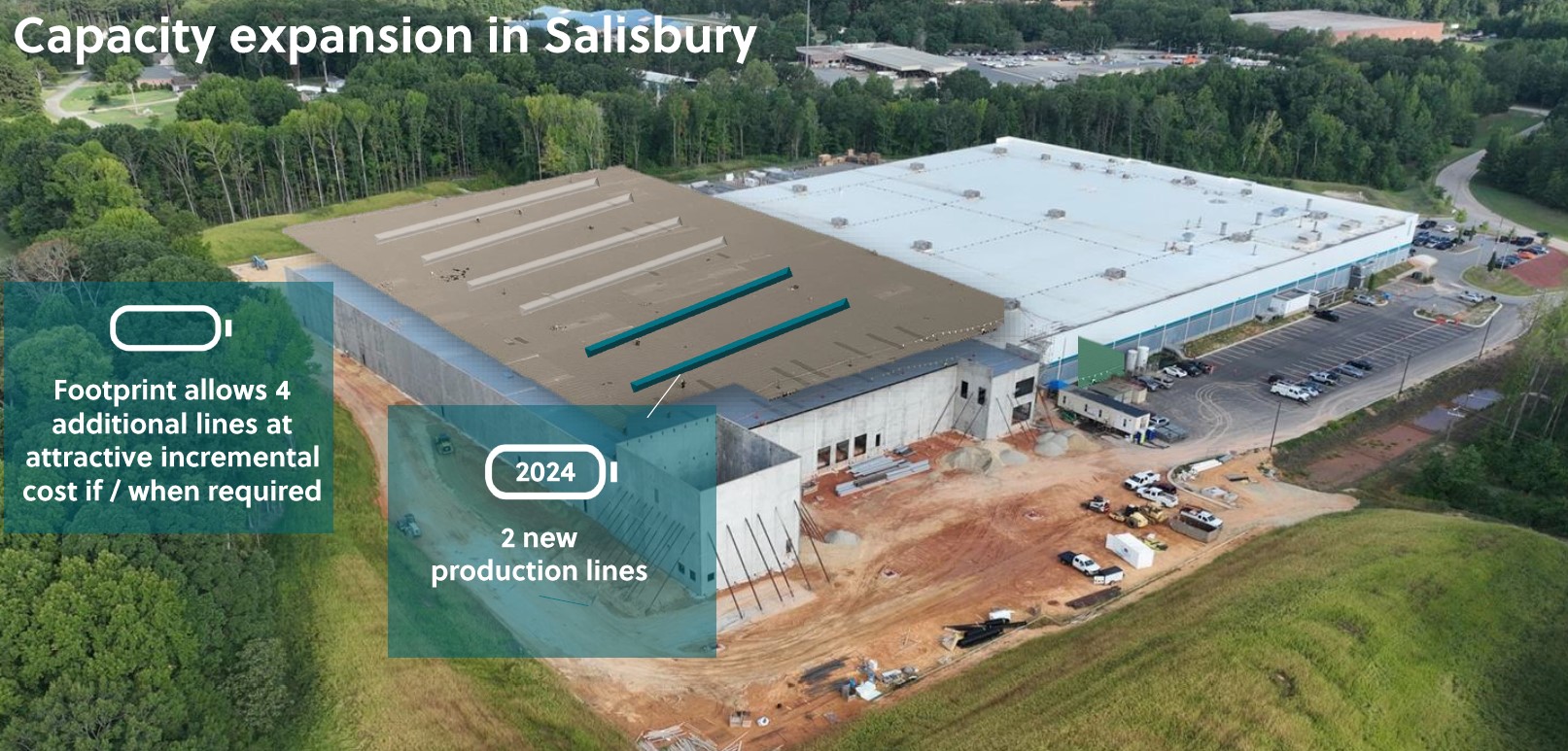
Source | Hexagon Composites, 2024 CW news

CNG/RNG fuel system for a refuse truck being installed at the Hexagon Agility facility in Salisbury, N.C., U.S. Source | Hexagon Composites
This new production will supply Type 4 cylinders for the Salisbury site’s integrated CNG and renewable natural gas (RNG/biogas) fuel systems for heavy- and medium-duty trucks. Although new natural gas vehicle (NGV) registrations declined by 15% in 2025, The State of Sustainable Fleets annual report notes new refuse truck registrations increased by 27% with a growing share powered by RNG/biogas.


Projected recovery in Class 8 trucks (top) along with growth in Mobile Pipeline and aerospace markets, supports Hexagon’s positive outlook for its addressable market to 2030 (bottom). Source | Hexagon Composites
“After years of growth, 2025 saw a cyclical downturn in our core markets,” says Schramm, “that was heightened by tariff volatility, unclear regulatory policy and macroeconomic uncertainty. The result was a 40% drop in our top line year-over-year. But our refuse truck and transit bus segments remained positive, thanks to trends that are continuing forward. Meanwhile, the heavy truck market is recovering.”
It’s also being driven by the Cummins (Columbus, Ind., U.S.) X15N engine, which entered full-scale production in late 2024. Sustainable Fleets 2026 noted that 71% of fleets using the CNG/RNG engine reported cost savings versus diesel and 38% intend to increase its use. Schramm notes that although less than 1% of the 300,000 Class 8 trucks sold annually in the U.S. use CNG, with the X15N, biogas and other trends, that is expected to increase to 8-10% over the next decade.
Hexagon Agility also launched a demonstration program in 2025, which has already resulted in an order for 100 CNG fuel systems for the largest trucking company in Mexico. Test trucks are outfitted with the X15N engine, matching the performance of traditional diesel engines but with up to 50% cheaper fuel costs. Hexagon has pilot programs with leading operators of 250,000-300,000 truck fleets including Walmart, UPS, Ryder and J.B. Hunt.
Growing market, reuse for tanks in space
“And now we’re again working substantially in the commercial aerospace field,” says Dawes, “and that’s also pushing the envelope of composite pressure vessel technology. The COPVs used here are under tremendous static and pressure loads, as well as dynamic and vibration loads during launch. If any one piece of that system doesn’t perform, the results can be disastrous.”
He notes that aerospace operates within a radically different design spectra. “A road trailer gets used for 15-plus years and cycled thousands of times, while space vehicle tanks have a much shorter life, even with reuse. The weight of Titan modules is indeed important, but nowhere near the emphasis it receives in aerospace. Also, we proof test every Titan at 1.5X its service pressure but it’s never operated near that. An aerospace COPV however, is constantly operating at 1.25X its service pressure and expected to rupture at 1.5X that. So, tanks for space are operating much closer to their limit than what is allowed for those in road trailers and vehicles, and they do this because every ounce you add creates a multiple in terms of energy required to launch.”

Falcon 9 flew 165 missions in 2025 with booster turnaround as fast as 13 days. New Glenn recovered its booster in Nov. 2025. Rocket Lab's Neutron and ULA's Vulcan SMART recovery are targeting first flights and partial reuse by 2026–2027. If Starship achieves full reuse, cost could fall below $500/kilogram — unlocking a 10X increase in small satellite deployments. Source | CW with assistance from AI using multiple references1.
But now with reuse, says Dawes, the holy grail in aerospace is to have durability in cycles and life expectancy closer to tanks for vehicular use, but yet retain the super lightweight, high performance needed for launch. “I do think there’s a growing market for COPVs in both commercial and defense aerospace, and they will need to be pressurized for longer periods of time. That will limit, to some extent, the loads they can maintain. If the pressure required is not high, then you’ll want to minimize the amount of carbon fiber used. So, the design problem is still very similar to what we face across all of our composite cylinders.”
“Meanwhile, the need for reliable quality becomes even more important with lower pressure, thin-wall tanks,” he continues. “The higher number of layers you have, the more tolerance you have for transmitting load from one layer to another. But if you only have a few plies, then it’s very important that they’re perfectly laid and have the utmost quality. And the same is true with the input materials like the fiber. Just because a fuel tank for a satellite thruster is lower pressure doesn’t necessarily mean it’s a lower challenge. A super thin-wall tank is fragile, meanwhile you don’t want to add any more weight than you absolutely have to.”
This is where Hexagon’s years and wide range of experience is valuable, says Dawes. “If you don’t have experience in a wide range of real-world applications, then you may not understand how the design drivers change, including resistance to impact, vibration, thermal and mechanical stresses, plus operating in a vacuum environment. Each of these has unique challenges, but the COPV must also function on the Earth’s surface during testing and filling, then survive launch and finally show reliability in orbit with no maintenance.”
Flemming adds that Hexagon’s design team is very adaptable with different types of requirements like this, including beyond the composite performance to gas flow or other operational aspects. “That system level expertise is needed to understand how to budget and control the amount of pressurized gas, whether that’s helium, H2, methane or others. We have a lot of experience in those areas across many different applications.”
Not done pushing boundaries

Source | Hexagon Composites
“We learned a lot with our early cylinders for aerospace and truck applications, which we then applied to larger-scale Titan products,” says Dawes. “Now, we’re taking our most recent developments with larger size cylinders and applying them in other markets, such as space, where rockets are getting larger and need higher gas capacity and durability while still maintaining high level of performance and reliability that aerospace demands.”
“We are building on the growing momentum across these markets,” adds Schramm, “from the largest Mobile Pipeline cylinder for the Titan 510 modules, to breakthroughs in aerospace. Our focus is squarely on applying our technology and expertise at the scale and speed required to help our customer also push boundaries.”


Related Content

Aerospace prepregs with braided reinforcement demonstrate improved production rates, cost
A recent time study compares the layup of a wing spar using prepreg with A&P’s TX-45 continuous braided reinforcement versus traditional twill woven prepreg.
Read More
Alef Aeronautics' composites-intensive flying car enters production phase
The Model A Ultralight — a drive-and-fly eVTOL designed to lift off directly from public roads — marks the first step toward full-scale Model A manufacturing.
Read More
On the radar: Innovations in composite battery enclosures
A look at recently reported design, material and process innovations for composites-intensive battery enclosures, developed to support the ramp-up of EV and AAM vehicles.
Read More
Composites end markets: Aviation and advanced air mobility (2025)
Despite persistent supply chain issues, markets were set for healthy growth before Trump policies and tariffs, yet long-term trends favor composites in new platforms. Meanwhile, advanced air mobility shakes out and moves forward.
Read MoreRead Next

Improving analyses of composite pressure vessels
Accurate geometry modeling and equivalent material property approximations captured by WoundSim will play a role in improving COPV analyses.
Read More
High-tension, vertical filament winding enables affordable flywheel energy storage system
French startup Energiestro’s prototype solar energy flywheel-based storage system aims to reduce costs with glass fiber composites and prestressed concrete.
Read More
The need for process modeling in filament winding applications
A discussion of how temperature, mandrel material and thickness, plus other factors affect the outcome of repeatable filament-wound composite shell manufacturing.
Read More


