
Cutting train doors with precision
GFMI Aerospace & Defense uses waterjet cutting technology to produce glass fiber/epoxy door panels for a major rail car manufacturer.
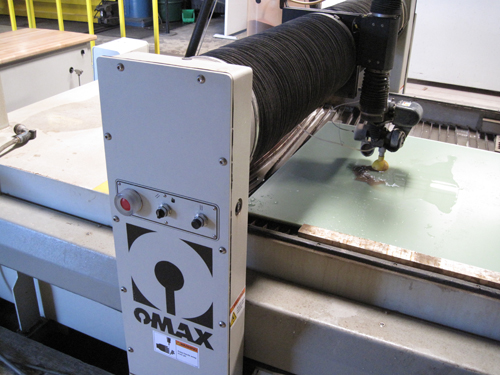
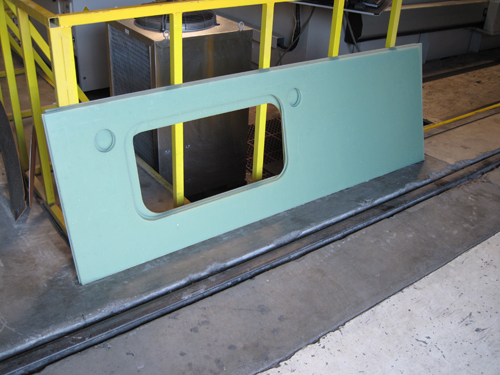


GFMI Aerospace & Defense (Fountain Valley, Calif.), as its name implies, is used to working with composites in high-performance applications, but occasionally it also handles the type of job that, although demanding, is targeted toward mass transportation markets. Such was the case recently when general manager Adrian Corbett was approached with task of cutting hundreds of glass fiber/epoxy panels for use in the manufacture of train doors for a global passenger rail car manufacturer.
The doors, comprised of two 7 ft by 2 ft (2.1m by 0.6m) panels that slide away from each other to allow passengers to get on and off the train, posed a challenge in that each one had to be cut to meet precise dimensions, before bonding to an aluminum exterior panel.
GFMI, says Corbett, chose as its raw material standard 5-mm/0.2-inch thick G10 glass fiber/epoxy panels provided by Interstate Plastics (Sacramento, Calif.) that measure 4 ft by 8 ft (1.2m by 2.4m). From each panel GFMI would cut two door halves, or one complete door. The question was how to cut it.
GFMI opted for waterjet cutting, and for the job has relied on its OMAX Corp. (Kent, Wash.) 60120 55,000 psi waterjet machine. The company stacks four sheets into its OMAX and cuts all simultaneously, starting with interior features first — 15-inch by 30-inch (381 mm by 762 mm) window and cutouts for door handles — before cutting perimeter features.
Corbett says the waterjet process provides door panels with clean edges at the cuts, with none of the dust associated with traditional composites machining. It takes GFMI about 3.5 hours to machine four sheets, after which GFMI makes and installs glass into the windows, bonds the composite to the aluminum and delivers finished product to the customer for final assembly.
As of January 2013, GFMI had manufactured about 400 door sets, with more on order.
Related Content
-
Henkel releases digital tool for end-to-end product transparency
Quick and comprehensive carbon footprint reporting for about 58,000 of Henkel’s adhesives, sealants and functional coatings has been certified by TÜV Rheinland.
-
Performance resins, putties and structural adhesives
CAMX 2025: Scott Bader illustrates its local and global materials supply availability backed by technical support, as well as a novel composite panels development with Armacell.
-
Belzona composite wrap restores corroded carbon steel pipeline
Two-part epoxy paste, epoxy structural adhesive, composite wrap and anti-corrosion coating prevent environmental and economic loss for customer.


