
Cost- and time-saving preform process used for propeller spinner
Carbon fiber/epoxy spinner uses pulp slurry preforming process combined with vacuum infusion molding.


The spinner is the aerodynamic nose cone that fits on the front of the propeller. Source: MIT
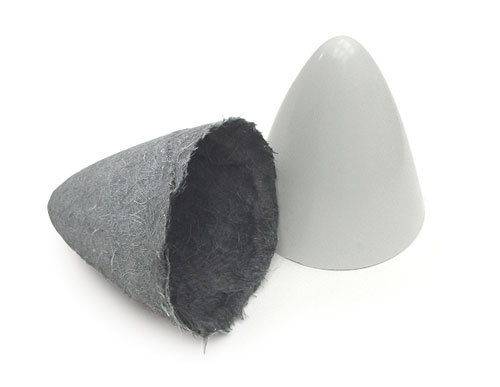
The spinner preform and finished part. Source: MIT


When light sport aircraft manufacturer JDT Mini-Max (Nappanee, Ind.) wanted to offer its customers a lighter alternative to its aluminum propeller spinner — the aerodynamically shaped conical “nose” of a single-engine aircraft that spins with the propeller — the company turned to composites manufacturer Materials Innovation Technologies (MIT, Fletcher, N.C.). MIT produced a demonstrator carbon fiber/epoxy spinner, using its patented 3-DEP pulp slurry preforming process combined with vacuum infusion molding.
The automated 3-DEP process begins by chopping fiber into 25-mm/1-inch lengths and combining the chop with water to form a slurry in a processing machine that features pumping mechanisms that keep the fibers suspended within a controlled flow field, explains MIT president James Stike. For the spinner, MIT used carbon fiber from Toho Tenax America Inc. (Rockwood, Tenn.), but the process is adaptable to any type and density of fiber or fiber blend.
A CNC-controlled, gimbaled support immerses a preform tool in the slurry. A vacuum is pulled, drawing water through the screen. Tool motion and slurry flow enable uniform fiber distribution and directed fiber patterns — in this case, a circumferential pattern that helps the spinner withstand centrifugal forces in service. When the tool is removed from the slurry, the vacuum extracts the remaining water (carbon fibers are mechanically entangled by a small percentage of proprietary binder fiber) and the preform is infrared dried and then removed. The one-piece, conical preform, measuring 10-inches/250-mm long and 9 inches/225 mm in diameter, with a wall thickness of ~0.050 inch/1.25 mm, reportedly was finished in minutes, with virtually zero fiber waste.
The spinner tool was made to JDT’s specifications. After application of an in-mold primer (Valspar Composites, Elkhart, Ind.) to the female tool, the preform was loaded into the tool cavity together with a flexible, reusable vacuum bag, then infused with epoxy resin (PTM&W Industries Inc., Santa Fe Springs, Calif.) and ambiently cured.
The preforming/molding process was more cost-effective than hand layup, notes Stike, while the lower mass and greater stiffness/fatigue resistance of the carbon/epoxy spinner, compared to aluminum, makes it an attractive option for general aviation OEMs and kit builders.
Related Content
-
Plant tour: Airbus, Illescas, Spain
Airbus’ Illescas facility, featuring highly automated composites processes for the A350 lower wing cover and one-piece Section 19 fuselage barrels, works toward production ramp-ups and next-generation aircraft.
-
Ceramic matrix composites: Faster, cheaper, higher temperature
New players proliferate, increasing CMC materials and manufacturing capacity, novel processes and automation to meet demand for higher part volumes and performance.
-
Active core molding: A new way to make composite parts
Koridion expandable material is combined with induction-heated molds to make high-quality, complex-shaped parts in minutes with 40% less material and 90% less energy, unlocking new possibilities in design and production.


