
Bombardier sheds light on Learjet 85 composites manufacturing
Bombardier composites expert Pierre Harter talked in detail at SAMPE Tech about where and how composites were used on the forthcoming Learjet 85.


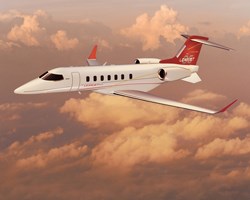
Pierre Harter, engineering manager – M&P, technology readiness and structural certification Learjet, was the featured speaker on the last day of SAMPE Tech (Oct. 20-24, Wichita, Kan., USA) and provided a great deal of information about the composite materials and manufacturing processes being used to fabricate aerostructures for the forthcoming Learjet 85 business jet.


Wing skins and spars for the plane are manufactured in Belfast, Ireland, using an in-autoclave resin transfer infusion (RTI) process. Fuselage and empennage are manufactured in Querétaro, Mexico, via an out-of-autoclave process. Harter reported that the plane, which is expected to make its first flight in the next few weeks, is the first FAR Part 25 aircraft with composites in the fuselage and wing. He also said that the Learjet 85’s use of composites was not driven chiefly by lightweight, but instead to significantly reduce part count by manufacturing large, integrated structures. In the process, Bombardier learned much about materials characterization, materials management, process development and certification.
Harter described the RTI process to make the wing skins and spars as using dry carbon fiber non-crimp fabric (NCF) that can be quickly cut (by Gerber machines) and placed. The NCF has a binder, which is used in preforming on a male tool, followed by infusion in a female tool. The tool is preheated, the part is bagged and the resin (Cytec’s Cycom 890, for resin transfer molding) is injected under autoclave cure. Stringers are co-cured with the upper and lower wing skins. Harter said the process/material combination is certified by the U.S. Federation Aviation Administration (FAA) for the application.
More challenging, said Harter, was the out-of-autoclave (OOA) material and process development for the fuselage. This was done in close cooperation with Cytec, which provided the resin (Cycom 5320) for this application as well; Harter described the company’s assistance as crucial to the plane’s development.
The fuselage is manufactured in three sections: the nose, the main fuselage and the tail. The main fuselage is 30 ft/9.1m long and represents one of the largest of its kind to be fabricated OOA. Challenges included the fact that the Bombardier facility in Querétaro is at an elevation of more than 6,000 ft/1,829m, which reduces available vacuum pressure compared to lower altitude locations. Further, although Bombardier is adept at developing composite material parameters for autoclave cure, Harter said OOA changed many of the company’s cure management assumptions. Compaction, air removal, resin flow and ply placement had to be adjusted, managed and fine-tuned much differently than they would have been for autoclave-based curing, he said. In addition, the OOA process proved uncommonly sensitive to difficult design features.
Bombardier also had to evaluate breathing methods, bulk and debulk cycles, dwell times and rheology to achieve desired porosity. If the part was cured too quickly, many small voids were generated in the composite. Combating porosity required perfecting the management of resin viscosity over time, Harter said, and was achieved only after extensive trial and error. “Legacy flow and gel times are not adequate,” he noted. Bombardier eventually developed an OOA manufacturing process that produced voids of less than or near 1 percent.
Harter related that after processes were optimized, Bombardier faced the daunting task of achieving FAA certification. Much like the Boeing 787 and the Airbus A350 XWB, intensive use of composites on the Learjet 85 meant Bombardier had to perform extensive testing to satisfy the FAA’s special conditions for certification. Much of this, Harter said, focused on in-flight flammability, post-crash flammability, crashworthiness, durability, toxicity in burn, damage tolerance and thermal expansion at interactions with metals. Results, across the board, were positive. In fact, noted Harter, composite materials on the Learjet 85 outperformed aluminum in flammability and crashworthiness tests — a fact that he believes needs to be emphasized more by the aerospace composites professionals. Composite readiness testing is now complete and certification testing has begun.
Bombardier has committed five full-size Learjet 85 aircraft for testing, which represents significant investment for the company. When asked why Bombardier was going to such effort and expense in regards to material and process development, and certification, Harter said, “Bombardier management knows that composites are the way to go. This is the future.”


Related Content

Industrial composite autoclaves feature advanced control, turnkey options
CAMX 2024: Designed and built with safety and durability in mind, Akarmark delivers complete curing autoclave systems for a variety of applications.
Read More
Plant tour: Airbus, Illescas, Spain
Airbus’ Illescas facility, featuring highly automated composites processes for the A350 lower wing cover and one-piece Section 19 fuselage barrels, works toward production ramp-ups and next-generation aircraft.
Read More
Uavos, Mira Composites perform test flight of ApusNeo HAPS aircraft
The highly composite 18-meter-wingspan platform successfully obtained imagery from 3,000-12,000-meter altitudes, supporting its progress toward use in high-altitude missions.
Read More
Advanced autoclaves, ovens provide efficiency, precision and intelligent control
CAMX 2025: Olmar is highlighting its next-gen autoclaves and industrial ovens for composites curing to improve throughput, scale production and achieve tighter quality control.
Read MoreRead Next

Industrial ultrasonic NDT adaptation permits accessible composite bicycle inspection
Cycle Inspect's ASNT-aligned certification program employs affordable twin-crystal ultrasonic testing equipment and standardized inspection methods to detect damage in composite bicycle components.
Read More
Report: Composites and Carbon Fiber Use in Hydrogen Storage
A first-of-its-kind technical report that assesses the materials, manufacturing processes, market and energy trends driving use of carbon fiber composites in global hydrogen (H₂) storage applications for fuel cell-powered trucks, buses, trains and passenger vehicles.
Read More
Post Cure: 3D printed plastic, composite mouthstick designs assist limited-mobility users
Three M Tool and Machine has used its in-house additive manufacturing capabilities to rethink medical devices like mouthsticks, which must be stiff, lightweight and comfortable enough for everyday use.
Read More