
DLR rocket flight in ATHEAt program demonstrates CMC nose, movable body flaps
Successful flight tests heat-resistant components and innovative sensor technologies.


Source | DLR (CC BY-NC-ND 3.0)
On Oct. 6, the German Aerospace Center (DLR, Braunschweig) launched a 13.5-meter-long research rocket for the Advanced Technologies for High Energetic Atmospheric Flight of Launcher Stages (ATHEAt) program from the Andøya launch site in northern Norway.
The experiment flew for ≈4 minutes, including 2 minutes of high-speed flight with the peak speed exceeding Mach 9, exposing the vehicle to gas temperatures exceeding 2000°C and extreme aerothermal loads on its structures and materials — similar to those encountered by spacecraft re-entering Earth’s atmosphere. During the flight, the research rocket reached a maximum altitude of more than 30 kilometers.


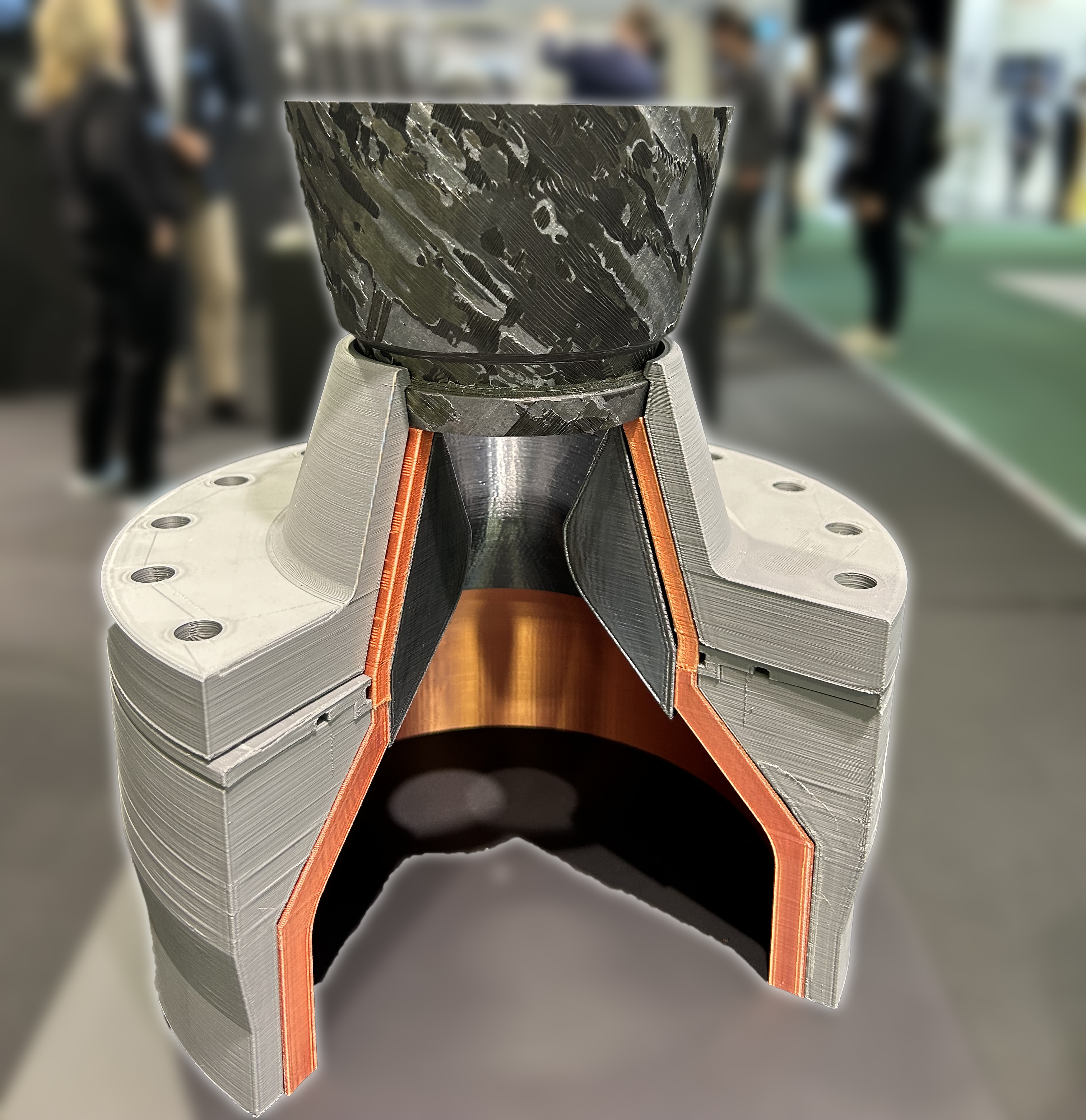
CMC rocket nozzle DLR exhibited at JEC World 2024. Source | CW
DLR exhibited a CMC rocket nozzle for the ATHEAt program at JEC World 2024. It was designed and produced for a hybrid engine using carbon fiber and a matrix of carbon and silicon carbide (C/C-SiC) aiming to increase nozzle efficiency by drastically reducing abrasion and component weight for reusability.
The shimmering gray nose cone of the rocket was made largely from a fiber- reinforced ceramic matrix composite (CMC) manufactured entirely at DLR using specially developed in-house processes.
This high-performance material not only withstands very high temperatures but is also strong and relatively lightweight. The scientific payload onboard the ATHEAt flight included two cooling experiments which researchers used to investigate how the extreme high temperatures at the nose of the rocket can be managed through active cooling.
The ATHEAt flight experiment’s front body also included four movable flaps made of DLR’s CMC which were successfully deployed during the flight and experienced very high temperatures. In the future, such flaps could be used to make space transportation vehicles more controllable.

The CMC nose cone and deployable body flaps on the ATHEAt first rocket. Source | DLR (CC BY-NC-ND 3.0). For more details, see ATHEAt flight experiment.
To achieve the highest possible temperatures, the research rocket flew along a specially planned, shallower trajectory, enabling it to fly at high Mach numbers for an extended period at relatively low altitudes. A newly developed DLR sensor network provided essential data to determine the precise moment of ignition for the second stage. This “sensor cube” uses a defined starting position and measures the acceleration and rotation rates in flight to calculate the position of the rocket in space. At the end of its flight, it splashed down safely in a designated and secure area of the Norwegian Sea.
Successful first flight
“With the ATHEAt flight experiment, we have succeeded in flying at high Mach numbers for much longer than in our previous projects,” says Ali Gülhan, ATHEAt project manager and head of the Supersonic and Hypersonic Technologies Department at the DLR Institute of Aerodynamics and Flow Technology. “We have now reached a new milestone and collected data for further R&D.”
This data harvest was made possible by the more than 300 sensors installed by the DLR team into the flight experiment. Also on board were miniaturized, noncontact sensors such as infrared cameras, laser scanners and radiation thermometers. A modular data acquisition system developed by DLR recorded the measurements and transmitted the processed data by radio to ground stations below.
“The conditions simulated in the ATHEAt flight experiment are comparable to those that thermal protection systems on future reusable space transport systems will have to reliably withstand during reentry into Earth’s atmosphere,” explains Gülhan. The reentry phase, with its extreme aerodynamic and aerothermodynamic conditions, is also a crucial point of development for the space industry. “With projects like ATHEAt, we are specifically working on closing this global technology gap.”
DLR combines flight experiments like ATHEAt and its predecessor projects, supported and continuously refined with sophisticated simulations, design processes and component testing on the ground.
ATHEAt program
Initiated in January 2022, the ATHEAt program seeks to test key technologies aimed to make future reusable space vehicles more reliable and cost-efficient, with an emphasis on reentry performance. The program is also developing a hybrid rocket booster for use as a future sounding rocket upper stage.
The technologies developed are being tested in ground tests and two space flights. This first flight was structured to test materials, cooling techniques, miniaturized nonintrusive sensors and the aerodynamic properties of the two-stage sounding rocket. The first stage was powered by a Red Kite booster developed by DLR in partnership with Bayern-Chemie, while the second stage was powered by a Canadian-built Black Brant Mark 4 booster.
A second launch, scheduled for 2026 from Esrange Space Center in Sweden, will mark the inaugural flight of the Alduina hybrid rocket booster. Powered by hydrogen peroxide and hydroxyl-terminated polybutadiene (HTPB), the booster is designed to enable throttleability and reignition while maintaining low system complexity.


Related Content

Orbital Composites wins AFWERX award for Starfighter drone fleet
Under the TACFI contract, Orbital is implementing the AMCM process to build 3D printed composite multi-mission UAS aircraft, surpassing $10 million in government awards.
Read More
CIRA qualifies CMC structures for the reusable Space Rider
Italian team designs, builds and tests multiple large, complex thermal protection system structures made from patented ISiComp C/C-SiC ceramic matrix composites.
Read More
SABIC composite hybrid battery cover enhances EV safety, efficiency
SABIC collaborated with Engel, Siebenwurst, Forward Engineering, Ensinger and Envalior to develop a thermoplastic composite EV battery cover, combining strong structural performance, flame retardancy and design efficiency.
Read More
Airbus outlines next-gen single-aisle aircraft technology focuses, revised ZEROe project roadmap
Outlined technology bricks — including foldable wings, more efficient engines and propulsion and composite materials — could support a planned single-aisle next decade, plus Airbus’s renewed commitment of a commercially viable H2 aircraft.
Read MoreRead Next

CIRA qualifies CMC structures for the reusable Space Rider
Italian team designs, builds and tests multiple large, complex thermal protection system structures made from patented ISiComp C/C-SiC ceramic matrix composites.
Read More
HyEnD e.V. uses Taniq software for lightweight carbon fiber engine
SNAPSHOT: Hybrid Engine Development’s successful liquid-fueled rocket engine features a lightweight fiber overwrap enabled by TaniqWind design software.
Read More
DLR exhibits full-scale CFRP liquid hydrogen tank test item for zero-emission aviation
The German Aerospace Center Institute for Lightweight Systems exhibits 1.9-meter autoclave infusion composite structure as part of LUFO UpLift project aiming for LH2 as part of short-haul aircraft propulsion by 2040.
Read More


