
Ashland unveils low-density, high-performance SMC
Ashland's new Arotran 771 sheet molding compound (SMC) offers a specific gravity of 1.2, with good mechanical and physical properties. The company is targeting 1.0 specific gravity, which would put SMC on par with aluminum in automotive applications.


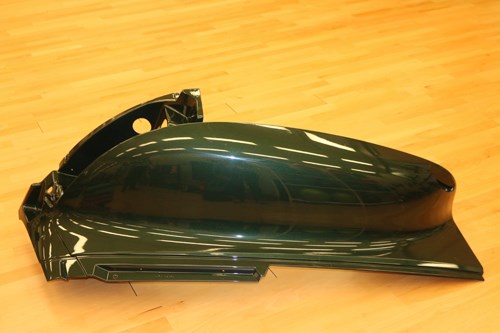
Ashland, to assess the performance of its new 1.2 specific gravity Arotran 771 SMC, fabricated an automotive panel to Ford Motor Co. specifications and then tested it for E-coat tolerance. The material showed no blistering, which is seen as key to winning a place on production cars and trucks.
Michael J. Sumner, group leader – gelcoat, SMC, marine resin, Ashland Performance Materials (Columbus, OH, US), reported at SPE’s Thermoset Topcon (April 19-20) on the development of Arotran 771, the company’s newest sheet molding compound (SMC), designed specifically for use in automotive applications. Prompted by customer demand for a tough, low-density, E-coat-capable, cost-effective SMC, Arotran 771 offers a specific gravity of 1.2, along with some impressive physical and mechanical properties.
Sumner walked attendees through the SMC’s development, with particular emphasis on the evaluation of resin performance. Ashland looked at various combinations of vinyl ester and unsaturated polyester resin (UPR), testing for finished part surface quality, mechanical performance, Tg and E-coat tolerance.


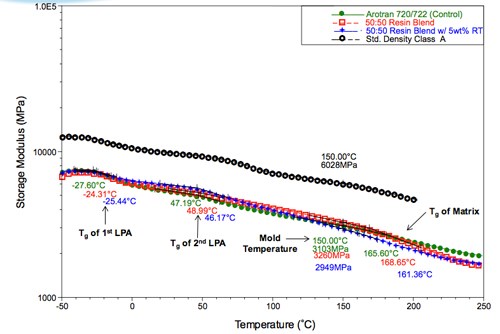
Tg of Ashland's new Arotran 771 SMC (50:50 blend, with 5 wt% resin toughener in legend). The material offers a specific gravity of 1.2, with good strength and toughness, along with the ability to tolerate the E-coat process.
Initial tests of surface quality, as measured by advanced laser surface analyzer (ALSA), showed that a 50:50 blend of vinyl ester and UPR was optimal, with an ALSA value of 64. Ashland added a 5 wt% reactive toughener to the mix and got very good mechanical values: tensile strength 85 MPa, tensile modulus 8,600 MPa, flex strength 182 MPa, flex modulus 8200 MPa and elongation 1.41%. Drop dart impact resistance is 3.1J.
Further testing, Sumner says, revealed that the selection of initiator system and mold temperature can influence part quality. Ashland conducted a series of tests, combining different initiators with mold temperatures of 121°C or 150°C and evaluated surface quality and mechanical properties. The best-performing combination included the reactive toughener and a mold temperature in the 121-150°C range (see table).
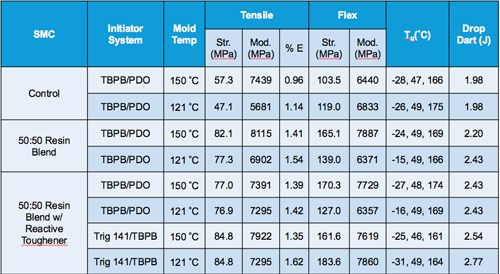
Mechanical properties of Arotran 771 SMC (50:50 blend with toughener) compared to
non-toughener and standard SMC at two mold temperatures, with different initiators.
To assess E-coat performance, Sumner says Ashland fabricated several SMC panels to a Ford Motor Co. specification and ran them through the Ford E-coat test protocol, involving exposure to 38°C/100°F and 100% humidity for 10 days, followed by short-term exposure to 200°C/392°F heat. The panels showed absorption of 2.25% with no blistering, the latter of which is required to pass the test.
Arotran 771 represents a substantial increase in SMC performance, comparable to the TCA Ultra Lite brand SMC — also 1.2 specific gravity — introduced in 2015 by Continental Structural Plastics (CSP, Auburn Hills, MI, US). Sumner says Ashland is trialing Arotran 771 with several customers involved in the automotive supply chain.
In the meantime, Ashland is not standing pat. Sumner reports that the company is already working on chemistries to help push SMC specific gravity down to 1.1 and, eventually, 1.0. And those products could come on the market relatively soon. “If we can get to 1.0,” Sumner asserts. “We can effectively compete with aluminum.”


Related Content

On the radar: Innovations in composite battery enclosures
A look at recently reported design, material and process innovations for composites-intensive battery enclosures, developed to support the ramp-up of EV and AAM vehicles.
Read More
Composites end markets: Automotive (2025)
Composites manufacturing intelligence drives circular economy solutions as automotive industry balances technical demands with sustainability mandates.
Read More
Co-molding SMC with braided glass fiber demonstrates truck bed potential
Prepreg co-molding compound by IDI Composites International and A&P Technology enables new geometries and levels of strength and resiliency for automotive, mobility.
Read More
Pultruded CFRP chassis enables 36% payload increase for specialized commercial vehicles
CarbonTT’s quadraxial NCF composite chassis adds 185-kilogram capacity to Borco Höhns’ 3.5-ton Fiat Ducato market vehicle.
Read MoreRead Next

Advancing bonding, coating and sealing to 4.0 systems for composites, metals and more
Brighton Science uses decades of experience, 2-second surface measurements and a framework of data-based specs and KPIs to help manufacturers advance toward reliable, predictable bond quality for faster, high-performance production.
Read More
Report: Composites and Carbon Fiber Use in Hydrogen Storage
A first-of-its-kind technical report that assesses the materials, manufacturing processes, market and energy trends driving use of carbon fiber composites in global hydrogen (H₂) storage applications for fuel cell-powered trucks, buses, trains and passenger vehicles.
Read More
Dialing in composites performance via dynamic digital twins
Sport Dynamics Lab uses Flexdynamics testing, digital models and AI tools to compare designs, materials and systems, enabling optimization with potential for propellers, drones and vibrational structures.
Read More


