
PlasmaBound raises funding to accelerate bonding technology adaptation
Irish Startup earned €3.1 million in 2022 to brings its controlled polymer ablation (CPA) technology for composite materials to mass-market applications.


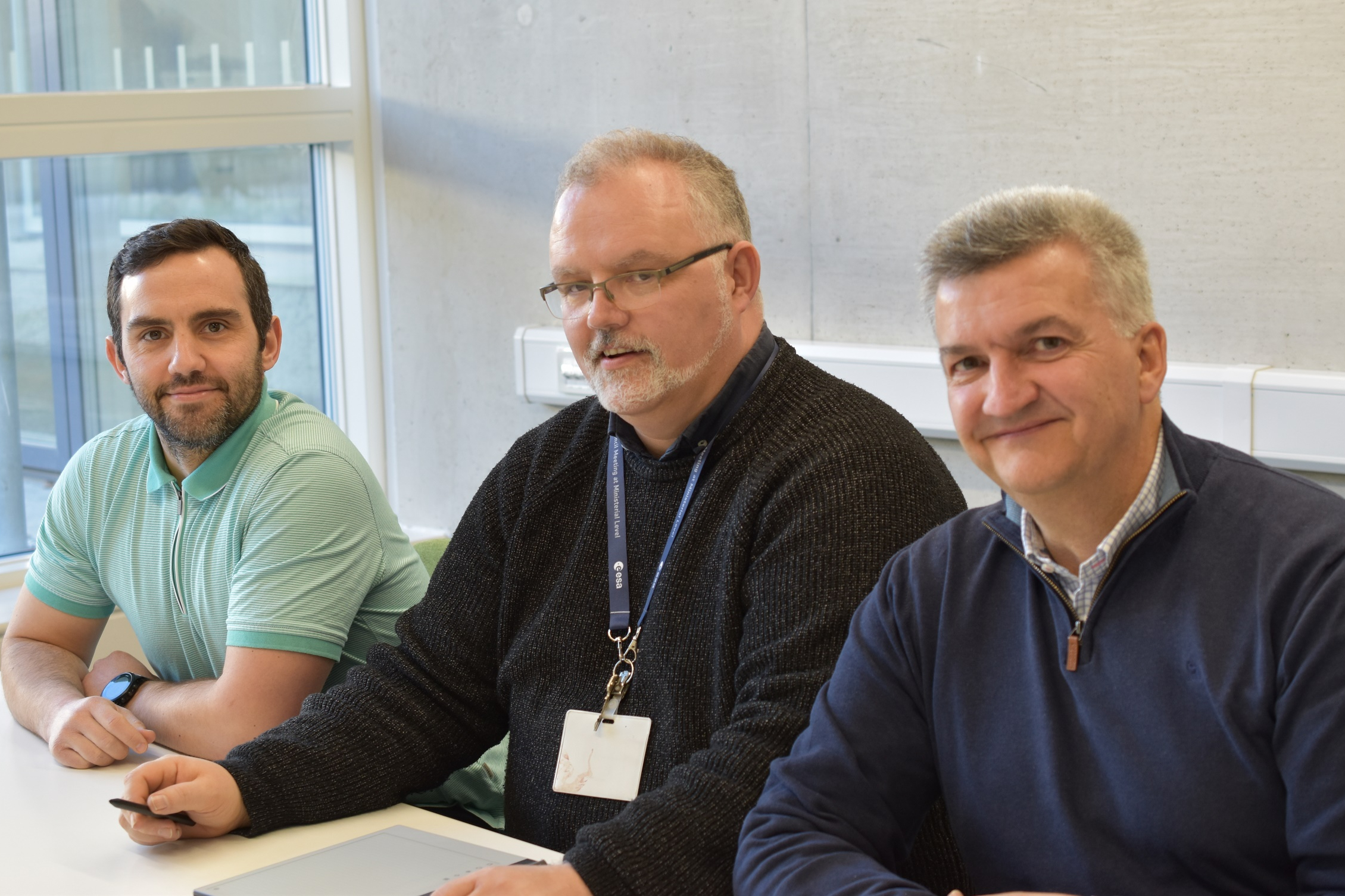
Pictured left to right at NovaUCD are PlasmaBound founders, Dr James Nicholas Barry, Alan Barry and Xavier Montibert. Photo Credit: PlasmaBound
Irish startup PlasmaBound (Dublin) secured a €750,000 investment from Business Venture Partners (BVP) in December 2022, in addition to previous funding from Act Venture Capital, Atlantic Bridge and Enterprise Ireland. This brings total funding to €3.1 million, which will be used to advance PlasmaBound’s vision to make lightweight composite materials affordable for low- to mid-range vehicles.
PlasmaBound has developed controlled polymer ablation (CPA), an environmentally friendly, high-speed and low-cost bonding technology for composite materials. The company anticipates that its technology will help move the drive toward lower CO2 emissions and longer electric vehicle (EV) range into mass-market applications.
PlasmaBound, a University College Dublin (UCD) spin-out company, was co-founded in 2017 by Dr. James Nicholas Barry, Alan Barry and Xavier Montibert. It was recently selected as one of five startups to win access to the Hyundai Motor Co. and KIA Corp. sponsored 2022 Accelerate the Future Challenge. PlasmaBound is headquartered at NovaUCD.
“We are delighted to have secured this investment from BVP. It will help PlasmaBound bring about a further positive impact to the environment with the adaption of our CPA technology in manufacturing process throughout various sectors, with a particular focus on automotive, aerospace and space, along with consumer electronics, and sports and eisure,” Alan Barry, CEO, PlasmaBound, says.
Related Content
-
Sulapac introduces Sulapac Flow 1.7 to replace PLA, ABS and PP in FDM, FGF
Available as filament and granules for extrusion, new wood composite matches properties yet is compostable, eliminates microplastics and reduces carbon footprint.
-
Carbon fiber, bionic design achieve peak performance in race-ready production vehicle
Porsche worked with Action Composites to design and manufacture an innovative carbon fiber safety cage option to lightweight one of its series race vehicles, built in a one-shot compression molding process.
-
Active core molding: A new way to make composite parts
Koridion expandable material is combined with induction-heated molds to make high-quality, complex-shaped parts in minutes with 40% less material and 90% less energy, unlocking new possibilities in design and production.


