
Orbex secures $24 million funding round for U.K. space launch
New funding secures roadmap to first launch of composites-intensive Orbex Prime rocket from Sutherland spaceport in Scotland.


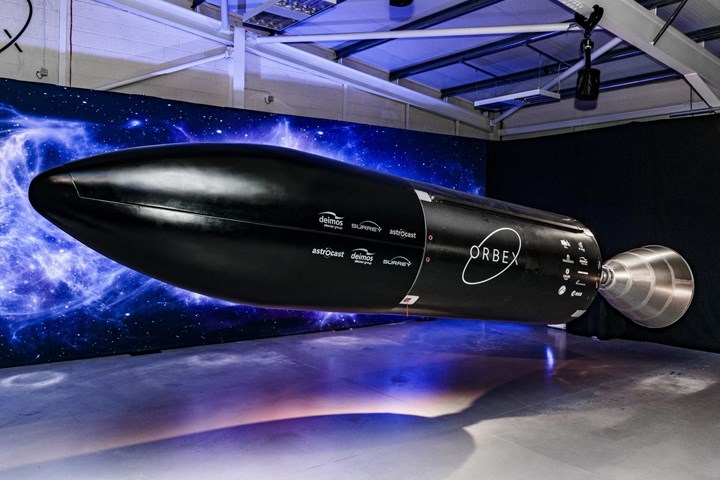
All photo credit: Orbex
Orbex (Forres, U.K.), the innovative European space launch company, reported on Dec. 10 that it has secured $24 million in a funding round led by BGF (London), what is said to be the U.K.'s most active investment company, and Octopus Ventures (London), one of the largest venture capitalists in Europe.
The new investments secure the roadmap to the first launch of Orbex’s vertical launch vehicle, Orbex Prime, from the Space Hub Sutherland spaceport in Scotland. Incorporating a wide range of advanced materials for its development, the launch vehicle boasts a 3D-printed rocket engine manufactured in a single piece without joins in partnership with additive manufacturer SLM Solutions (Lübeck, Germany). The vehicle is also built out of graphene-enhanced carbon fiber composites for the main structures and tanks.
BGF and Octopus Ventures have joined existing investors High-Tech Gründerfonds (Bonn, Germany), Heartcore Capital (Copenhagen, Denmark) and Elecnor S.A. (Spain) — parent company of the multi-national space firm Deimos Space (Tres Cantos, Spain) — in a new funding round for the orbital launch services company.
“Orbex is an impressive U.K. company which is developing a strongly differentiated and innovative launch solution for the rapidly-growing small satellite market. In Europe, they are a recognized leader with an experienced team, substantial institutional support, a growing customer list and patented technology,” says Keith Barclay, investor at BGF. “The private space sector remains a key future industry for both Scottish and U.K. governments and we’re very excited to be backing one of the most compelling examples of this evolving sector.”
Conceived and developed as an environmentally sustainable launch system, the Orbex Prime rocket, unlike other commercial launch vehicles, uses bio-propane, a renewable biofuel that cuts CO2 emissions by 90% compared to traditional kerosene-based rocket fuels. Designed to be recoverable and re-usable, Orbex Prime is intended to leave no debris in the ocean or in orbit around the Earth. The company is constructing the rocket vehicle at factories in Forres, near Inverness in Scotland, and Copenhagen in Denmark.
“Orbex is creating a highly innovative launch solution that is rapidly gaining market traction with very serious customers. We’re delighted to be part of the future of the company and are excited about what they’re looking to achieve, including the first ever vertical launches from U.K. soil,” says Simon King, partner at Octopus Ventures.
The announcement by Orbex will reportedly bring significant new investment in high technology employment opportunities and large-scale production facilities in the Highlands region of Scotland.
Orbex has already confirmed six commercial satellite launch contracts, with the first launches expected in 2022. The company’s preferred launch site will be the Sutherland spaceport on the northernmost coast of Scotland, which was granted planning permission in mid-August 2020.
“This financing round is an important step forward for Orbex. It helps us maintain our rapid pace and allows us to move forward with certainty towards our first launch from the Sutherland spaceport. With BGF and Octopus Ventures, we have found significant strategic partners who recognize our vision, and who have the capability to support our development through both the early flights and into subsequent growth and production,” adds Chris Larmour, Orbex CEO.
Further, the announcement by Orbex will reportedly bring significant new investment in high technology employment opportunities and large-scale production facilities in the Highlands region of Scotland, close to the launch site at the A’Mhoine peninsula in Sutherland. The A’Mhoine site was granted planning permission in August 2020 and is expected to begin construction in 2021.
“This is great for Forres, Moray and the Highlands and marks further strong progress for Orbex,” says Scottish Minister for Trade, Investment and Innovation Ivan McKee. “Our aim is for Scotland to secure a £4 billion slice of the global space market by 2030 — an ambitious but realistic target. The Scottish space sector has a unique selling point — using space as a force for good — designing lighter, more efficient rockets, developing clean burning and renewable fuel and using satellite data to combat climate change and promote scientific discovery. This investment will help Orbex take a significant step towards their goal of placing small satellites into orbit from Space Hub Sutherland, and help build an innovative new industry for Scotland’s economy.”
The funding round is completed by a €2.5 million grant from the European Horizon 2020 SME Instrument programme — the first for a U.K. space-sector company — to support the development of patented coaxial tanking technology. Orbex previously won £5.5 million in grant funding from the U.K. Space Agency’s Launch UK programme in 2018.


Related Content

First Airbus A350 crash confirmed in Haneda
Shortly after touch-down, a JAL A350-900 aircraft recently collided with a De Havilland Canada Dash 8. Exact circumstances are still unknown.
Read More
Combining multifunctional thermoplastic composites, additive manufacturing for next-gen airframe structures
The DOMMINIO project combines AFP with 3D printed gyroid cores, embedded SHM sensors and smart materials for induction-driven disassembly of parts at end of life.
Read More
Automated robotic NDT enhances capabilities for composites
Kineco Kaman Composites India uses a bespoke Fill Accubot ultrasonic testing system to boost inspection efficiency and productivity.
Read More
Plant tour: Aernnova Composites, Toledo and Illescas, Spain
RTM and ATL/AFP high-rate production sites feature this composites and engineering leader’s continued push for excellence and innovation for future airframes.
Read MoreRead Next

Graphene 101: Forms, properties and applications
Graphene-enhanced composites find new applications across end markets as the supply chain continues to mature.
Read More
Next-gen fan blades: Hybrid twin RTM, printed sensors, laser shock disassembly
MORPHO project demonstrates blade with 20% faster RTM cure cycle, uses AI-based monitoring for improved maintenance/life cycle management and proves laser shock disassembly for recycling.
Read More
Scaling up, optimizing the flax fiber composite camper
Greenlander’s Sherpa RV cab, which is largely constructed from flax fiber/bio-epoxy sandwich panels, nears commercial production readiness and next-generation scale-up.
Read More