
Mubea to collaborate on production of carbon fiber exoskeletons
Automotive supplier Mubea has entered into an agreement with robotic exoskeleton producer German Bionic on production of Cray X carbon fiber composite power suits.
.jpg;width=70;height=70;mode=crop;format=webp)


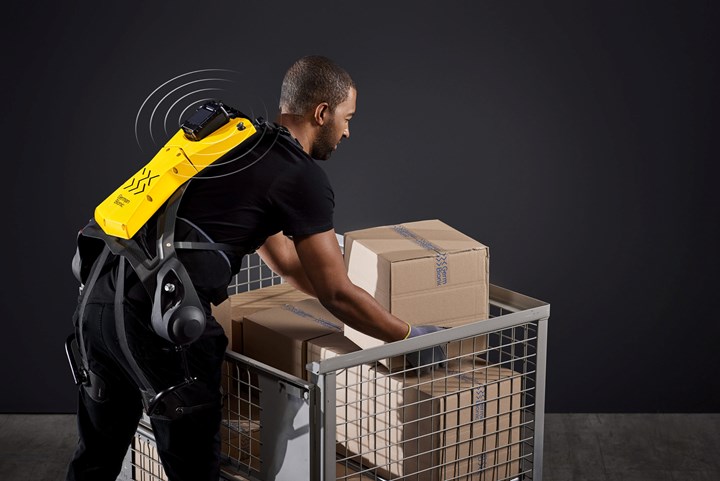
Automotive supplier Mubea (Attendorn, Germany) has entered into a cooperation agreement to commence production of robotic exoskeletons for smart power suits developer German Bionic (Augsburg, Germany).
Mubea, an owner-managed family business headquartered in Attendorn, Germany, with 44 additional locations in 20 countries, specializes in the development and manufacture of innovative lightweight products and manufacturing technologies. Per this agreement, Mubea says it is tapping into a sector with a projected market volume of $12.5 billion by 2030.


German Bionic’s Cray X power suits, which feature carbon fiber composite frames, aid workers when lifting heavy loads by actively amplifying their movements and thus protecting the lower back from excessive strain.
“Mubea is a specialist in high-quality lightweight components and is a ‘hidden champion’ world market leader with many of its products,” says Dr. Thomas Muhr, managing partner of Mubea. “Over the past decades, we have developed into a leading supplier for the automotive industry with our products for body, chassis and powertrain. Together with German Bionic, we are now expanding our new micromobility business area to include the future field of robotic exoskeletons.”
“German Bionic, much like Mubea, is a successful German company with high-tech products that are in high demand worldwide, albeit at an earlier stage. Nonetheless, our smart Cray X power suit is already the most advanced robotic exoskeleton on the market,” says Armin G. Schmidt, CEO and co-founder of German Bionic. “In line with the increased global demand for our cutting-edge ‘Made in Germany’ technology, we are now scaling production for the growth markets of the U.S., Europe, and Japan together with our partners at Mubea.”
German Bionic unveiled the fifth generation of its successful Cray X robotic exoskeleton at CES in Las Vegas at the beginning of the year, which also marked its entry into the U.S. market.
Since then, the company says it has enjoyed steady growth in North America. With additional locations in Japan and, more recently, the U.K., the company is focusing on Western industrialized countries that are suffering from a structural shortage of skilled workers for demographic reasons, particularly in the area of manual labor. It is here that the smart power suits are designed to improve working conditions and prevent the occurrence of excessive strain along with associated subsequent injury and illness. Particularly high demand for German Bionic’s exoskeletons exists in sectors such as logistics, production and healthcare.
Related Content
-
“Structured air” TPS safeguards composite structures
Powered by an 85% air/15% pure polyimide aerogel, Blueshift’s novel material system protects structures during transient thermal events from -200°C to beyond 2400°C for rockets, battery boxes and more.
-
Development of a composite liquid hydrogen tank for commercial aircraft
Netherlands consortium advances cryogenic composites testing, tank designs and manufacturing including AFP, hybrid winding, welding of tank components and integrated SHM and H2 sensors for demonstrators in 2025.
-
MFFD longitudinal seams welded, world's largest CFRTP fuselage successfully completed
Fraunhofer IFAM and partners have completed left and right welds connecting the upper and lower fuselage halves and sent the 8×4-meter full-scale section to ZAL for integration with a cabin crown module and testing.


