
Cevotec fiber patch placement improves storage efficiency of composite tanks
Cevotec’s solution is to apply carbon fiber patches to the dome areas of Type IV pressure vessels, which reportedly yields 15% in material, weight and cost savings.


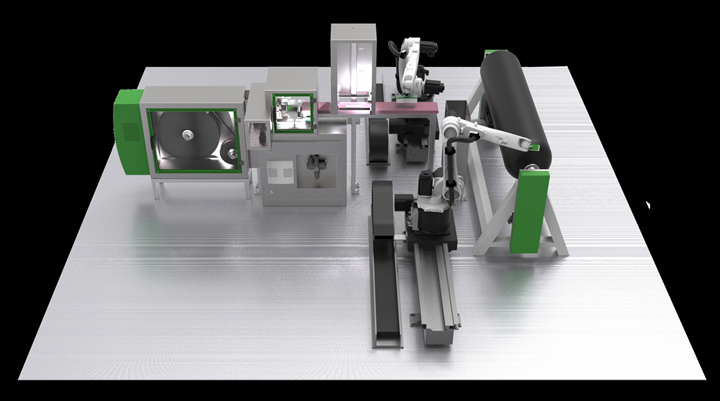
Cevotec fiber patch placement process for composite tanks. All photo credit: Cevotec
Cevotec (Unterhaching, Germany) reports that it has developed an industrial solution to improve the storage efficiency of Type IV composite tanks in hydrogen-powered electric vehicles (EVs), reducing the amount of carbon fibers consumed by up to 15% while maintaining equivalent mechanical properties.
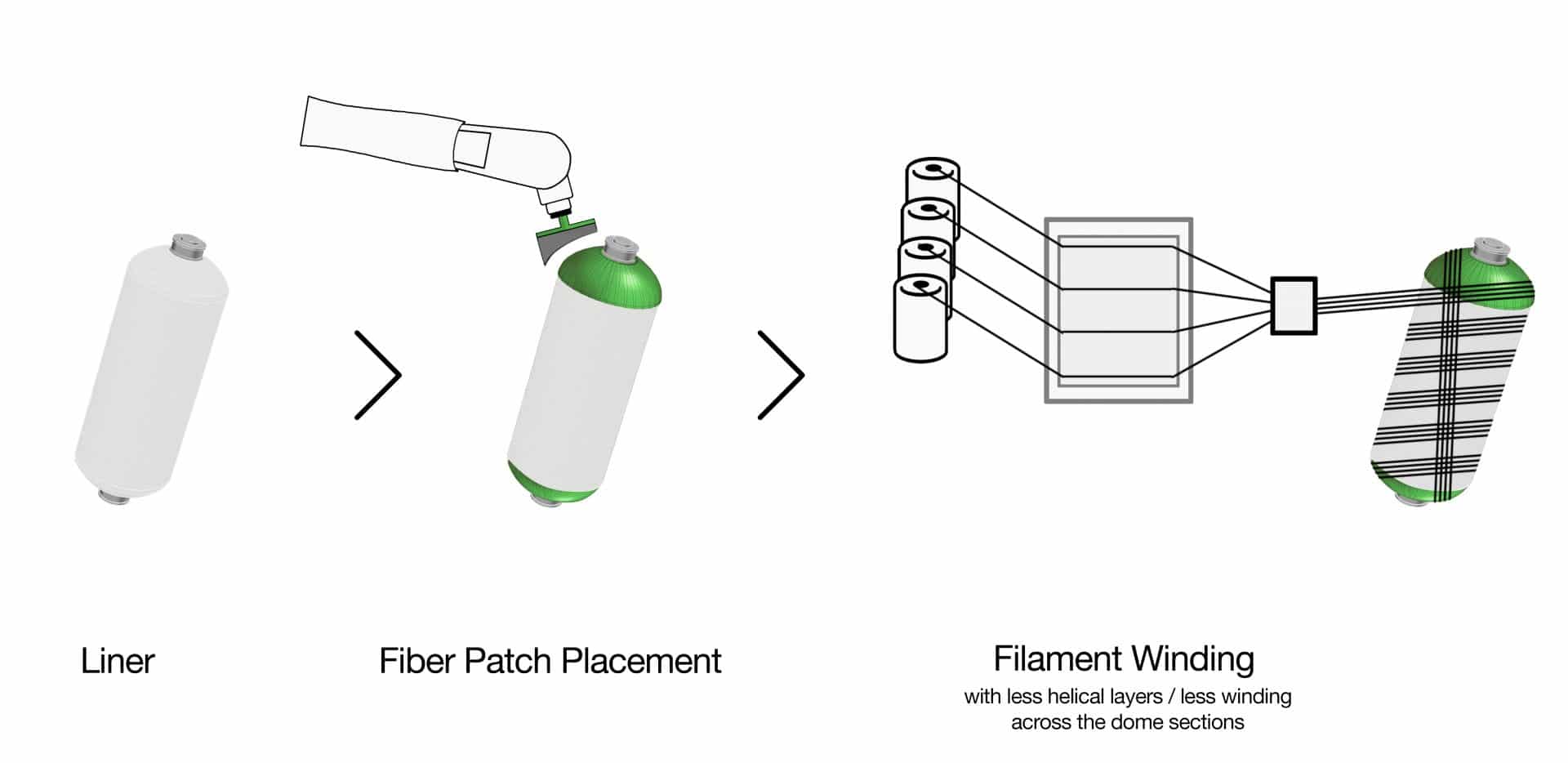
Cevotec’s solution is to apply carbon fiber patches in the tank’s dome areas, thereby replacing the high-angle helical layers (HAHL) in a typical filament winding pattern. Reinforcing a tank’s dome area with its fiber patch placement (FPP) technology reportedly yields 15% in material, weight and cost savings, and shortens total manufacturing time by 20%. By using FPP dome reinforcements, Cevotec says that manufacturers need less material in the subsequent filament winding process.
Cevotec’s fully automated, quality-controlled SAMBA FPP system first places the reinforcing fiber patches at the dome area directly on a standard liner. Then the patched liners are transferred over to the filament winding process; SAMBA requires no additional post-processing. The winding process is then adjusted to leave out the HAHL layers, for a faster, less material-intensive process, increasing overall line capacity for tanks, which further improves ROI and production economics
Related Content
-
Cutting 100 pounds, certification time for the X-59 nose cone
Swift Engineering used HyperX software to remove 100 pounds from 38-foot graphite/epoxy cored nose cone for X-59 supersonic aircraft.
-
Composites end markets: New space (2025)
Composite materials — with their unmatched strength-to-weight ratio, durability in extreme environments and design versatility — are at the heart of innovations in satellites, propulsion systems and lunar exploration vehicles, propelling the space economy toward a $1.8 trillion future.
-
Exel Composites adopts bio-based UPR resin at commercial scale
Purchase of Polynt bio-based resin delivers 20% cut in CO2 footprint for composites manufacturers, builds Exel’s efforts to give customers more sustainable options.


