
AnalySwift receives $800,000 contract to improve composites simulation
The Phase II STTR contract from NASA, adding on to the company’s two Phase I programs in 2022, enables AnalySwift to develop and release DATEC, a design tool for engineers to design and analyze tailorable composite structures.


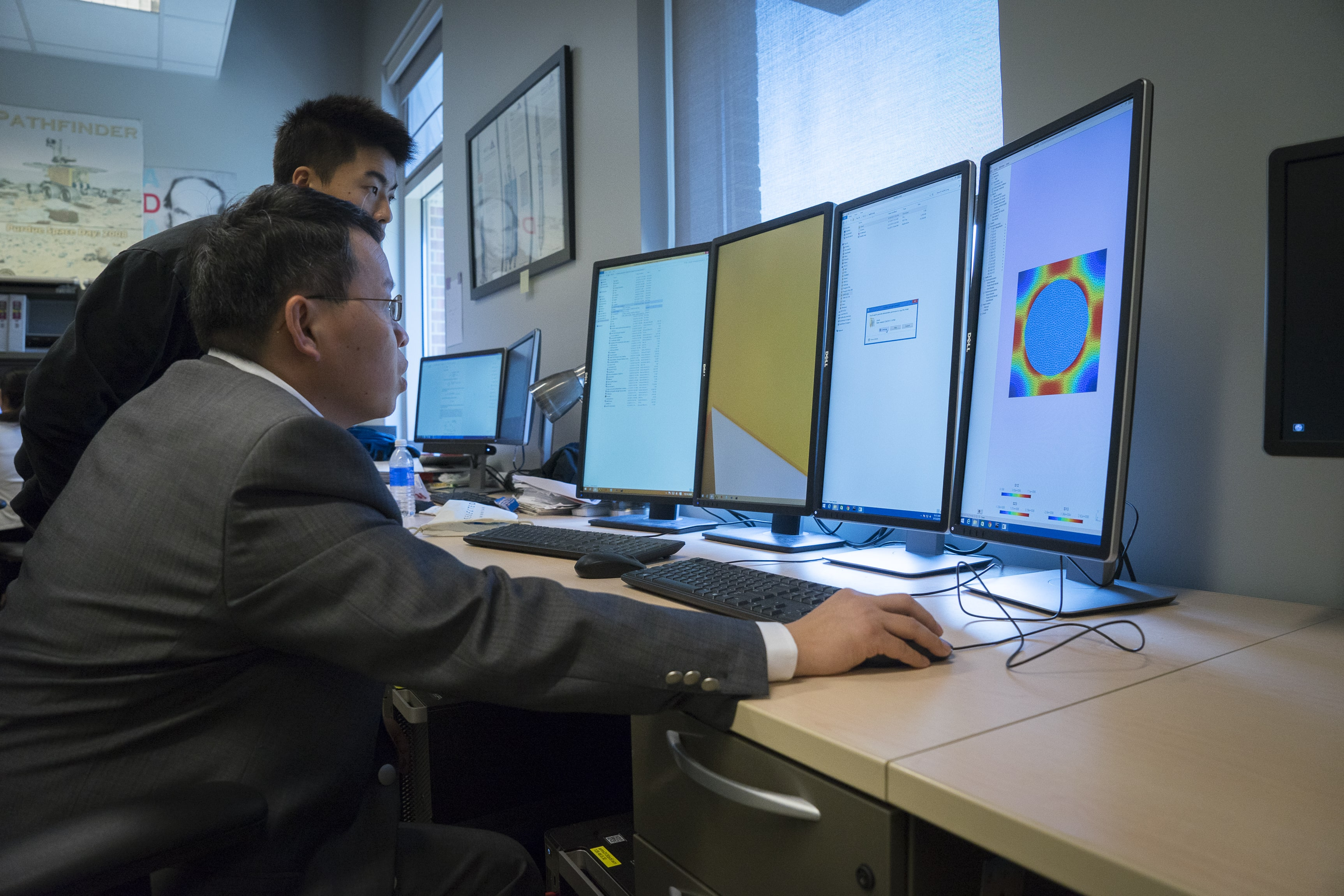
Wenbin Yu, professor in Purdue University’s School of Aeronautics and Astronautics, is seen on left. Photo Credit: Purdue University
NASA (Washington, D.C., U.S.) has awarded a $799,954 Phase II Small Business Technology Transfer (STTR) contract to AnalySwift LLC (West Lafayette, Ind., U.S.) a Purdue University-affiliated commercial software provider. The company will develop DATC (Design tool for Advanced Tailorable Composites), and launch it at the end of the 2-year contract.
Allan Wood, AnalySwift president and CEO, says advancements in simulation capabilities have not always kept pace with those in manufacturing techniques. He believes that DATC will significantly improve NASA’s capabilities to design and analyze aerospace structures made from advanced tailorable composites.


“DATC will be used to design next-generation aerospace structures, such as hybrid/blended wing bodies, space launch vehicles, space habitats and payload attach fittings,” Wood details. “These structures made from advanced tailorable composites will be lightweight and have enhanced performance.”
“Besides NASA, other related government agencies and industries will be benefit from using DATC to design better engineering systems with reduced experiments and further adjustments.”
Traditional composites consist of straight fibers in a matrix, which make predicting their properties more straightforward. According to Wood, advanced tailorable composites are not limited to straight fibers.
“These materials include tow-steered composites, in which fibers are steered along curvilinear paths instead of traditional straight paths, and variable thickness composites in which layers, often called plies, vary in thickness or drop off altogether. The materials can be reinforced with either continuous or short fibers,” Wood explains. “This customization can facilitate drastic reductions in structural weights and/or improvements in the load-bearing capacity, though the increased complexity renders it much more difficult to accurately predict their properties.”
Moreover, having a simulation tool for these materials will avoid engineers from having to rely on costly and time-consuming physical experiments instead of supplementing them with virtual testing and design.
AnalySwift will integrate several tools to create DATC. “DATC will be based on mechanics of structure genome, or MSG, and its companion code SwiftComp, which was developed at Purdue University,” Wood says. “It will also include third-party structural solver tools, a general-purpose optimizer and a machine learning package. These tools will be integrated into a unified and intuitive design framework.”
Wenbin Yu, a professor in Purdue’s School of Aeronautics and Astronautics, is the principal investigator on the development of DATC. Su Tian of AnalySwift and professor Xin Liu of the University of Texas at Arlington are co-investigators.
AnalySwift expects to complete DATC when the Phase II project ends in December 2024. “We plan to release DATC to NASA engineers and others interested in this product,” he adds. “Engineers can use DATC to create innovative, lightweight solutions for systems critical for national security, the environment, transportation, the economy and more. Besides NASA, other related government agencies and industries will be benefit from using DATC to design better engineering systems with reduced experiments and further adjustments, which lowers engineering time and cost.”
In 2022, AnalySwift received two Phase I STTR contracts from NASA, a 1-year contract for $120,000 and a 13-month contract for $156,000. The company licenses Purdue University intellectual property through the Purdue Research Foundation Office of Technology Commercialization. This work was also supported by Elevate Ventures and the Indiana Economic Development Corp.


Related Content

Generative Orthoses project to reshape orthopedic care
CRP Technology, MHOX and Istituto Ortopedico Rizzoli, one of the winners of the WORTH Partnership Project II, have developed bespoke orthoses using generative design, Windform GT fiberglass materials and PBF.
Read More
Next-gen fan blades: Hybrid twin RTM, printed sensors, laser shock disassembly
MORPHO project demonstrates blade with 20% faster RTM cure cycle, uses AI-based monitoring for improved maintenance/life cycle management and proves laser shock disassembly for recycling.
Read More
Modular approach to material card development of composites
Forward Engineering GmbH walks through a modular testing and simulation approach for automotive/aviation composites enabling more accurate material selection earlier in the design phase.
Read More
Collier Aerospace HyperX optimizes X-59 composite nose cone
Swift Engineering relied on the CAE software’s structural sizing, analysis and test validation capabilities to deliver flight hardware for NASA’s supersonic QueSST aircraft early, under budget and with 25% weight savings.
Read MoreRead Next

3D-printed CFRP tools for serial production of composite landing flaps
GKN Aerospace Munich and CEAD develop printed tooling with short and continuous fiber that reduces cost and increases sustainability for composites production.
Read More
Purdue opens $41 million Hypersonics and Applied Research Facility
A dedicated 65,000-square-foot building is home to Mach 8 and HYPULSE wind tunnels to advance hypersonic evaluation and testing, and the HAMTC for materials and manufacturing work with partners.
Read More
Post Cure: 3D printed plastic, composite mouthstick designs assist limited-mobility users
Three M Tool and Machine has used its in-house additive manufacturing capabilities to rethink medical devices like mouthsticks, which must be stiff, lightweight and comfortable enough for everyday use.
Read More


