
DLR Augsburg integrates sixth frame to upper half fuselage test shell for MFFD
Clean Sky 2 thermoplastic composite demonstrator advances toward full assembly.


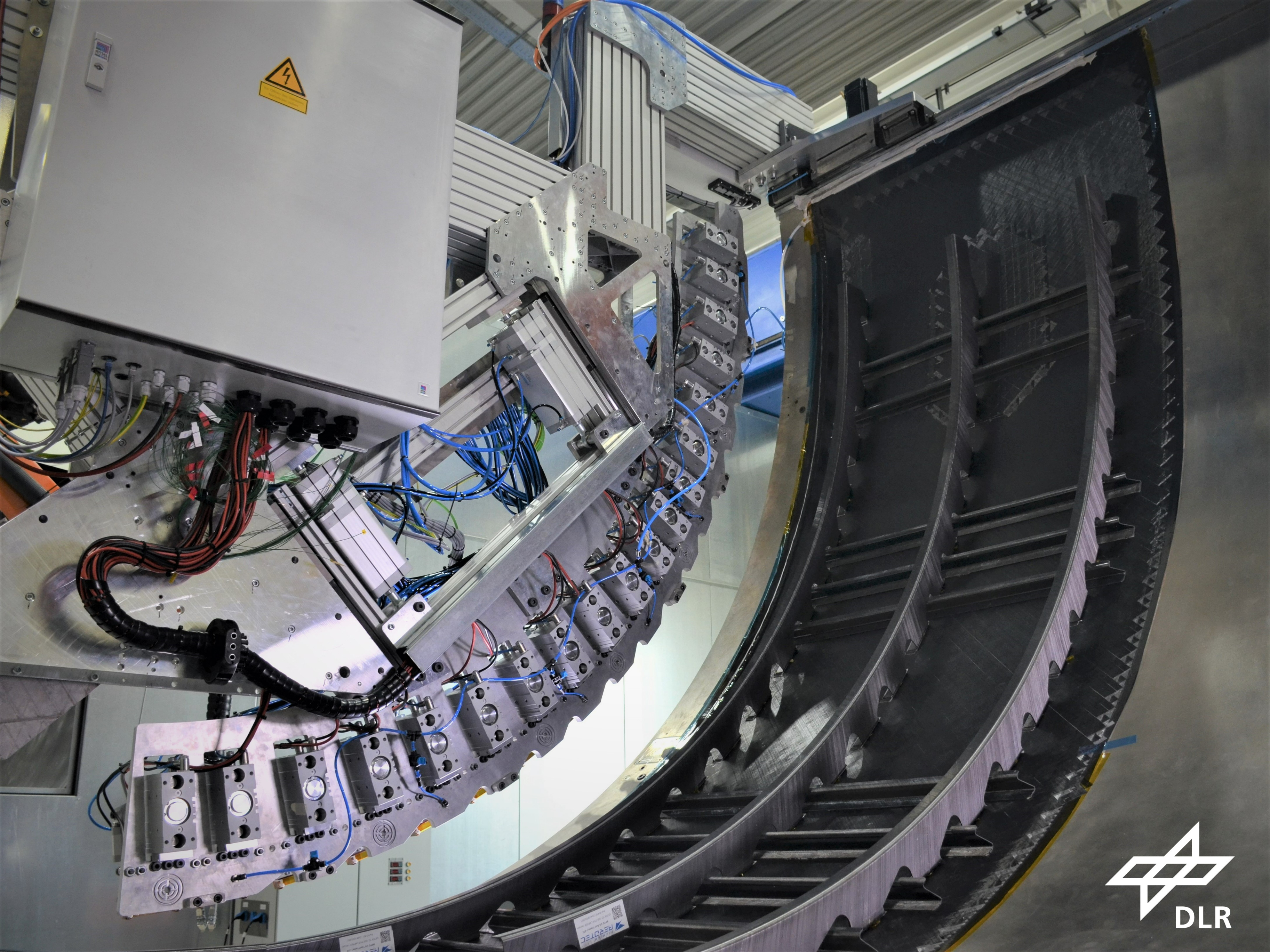
Photo Credit: DLR
The DLR Institute of Structures and Design in Augsburg, Germany, has completed the production of a full-scale upper fuselage half test shell for the Clean Sky 2 Multifunctional Fuselage Demonstrator (MFFD). Together with partners Airbus (Toulouse, France), Premium AEROTEC (Augsburg) and Aernnova Aerospace (Miñano, Spain), DLR will deliver the completed demonstrator upper shell for the 8-meter-long MFFD later this year.
The now completed test shell was produced to successfully validate all the production technologies for thermoplastic composites required to produce the MFFD upper shell.


A new lightning strike protection (LSP) film supplied by Toray Industries (Nijverdal, Niederlande) was used as first ply for the skin layup, streamlining fuselage production through function integration.
Continuous ultrasonic welding was leveraged to weld stringers onto the in-situ consolidated thermoplastic composite skin — said to be a world first (see “Welding thermoplastic composites”).
Resistance welding — matured by DLR with Premium AEROTEC for an A320 aircraft rear pressure bulkhead (see “Premium AEROTEC displays thermoplastic CFRP pressure bulkhead” and “Automated aerocomposites production: Liquid molded or welded thermoplastic?”) — was employed to join the C-frames to the skin with a special tooling (“welding bridge”). This welding technology has the potential for integrating fuselage frames to skin in five minutes.
“We are very happy to have achieved this major milestone and are grateful to be part of this all-European community striving to mature thermoplastic composites for a holistically optimized fuselage of tomorrow,” says DLR project manager, Frederic Fisher.
For more information, visit DLR MFFD.
Related Content
-
Otto Aviation launches Phantom 3500 business jet with all-composite airframe from Leonardo
Promising 60% less fuel burn and 90% less emissions using SAF, the super-laminar flow design with windowless fuselage will be built using RTM in Florida facility with certification slated for 2030.
-
Low-cost, efficient CFRP anisogrid lattice structures
CIRA uses patented parallel winding, dry fiber, silicone tooling and resin infusion to cut labor for lightweight, heavily loaded space applications.
-
Assembling the Multifunctional Fuselage Demonstrator: The final welds
Building the all-thermoplastic composite fuselage demonstrator comes to an end with continuous ultrasonic welding of the RH longitudinal fuselage joint and resistance welding for coupling of the fuselage frames across the upper and lower halves.


