
DYNAPIXEL: automated, reconfigurable molds
CAD-driven system cuts time for design iterations, enables cost-effective customized jigs and molded parts.


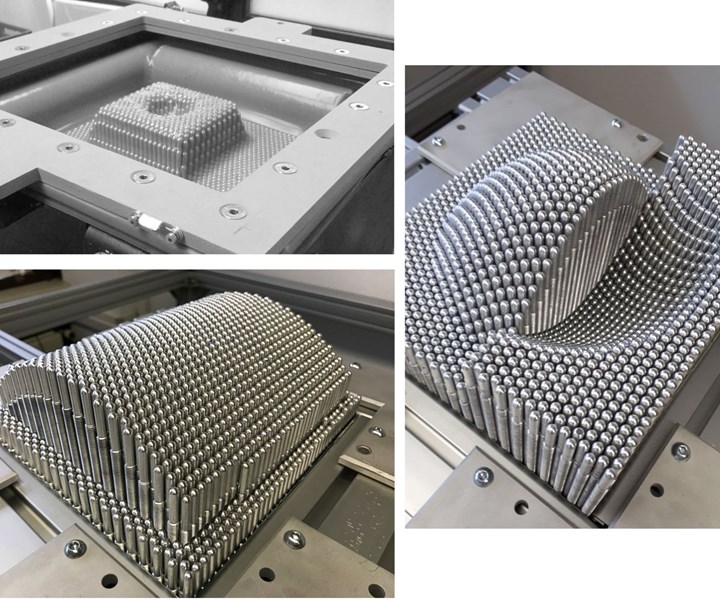
SOURCE for all images | CIKONI
CIKONI (Stuttgart, Germany) is an engineering company that specializes in composites design, simulation, automation and process innovation. CW has reported on a number of the company’s developments, including its use of 3D-printed cores and 3D filament winding to produce lightweight truss structures (see “Filament winding, reinvented”) and its work with preforming, including draping simulations and tension devices to prevent wrinkles and other defects (see “Preforming goes industrial: Part 2”). The latter is actually how DYNAPIXEL originated.
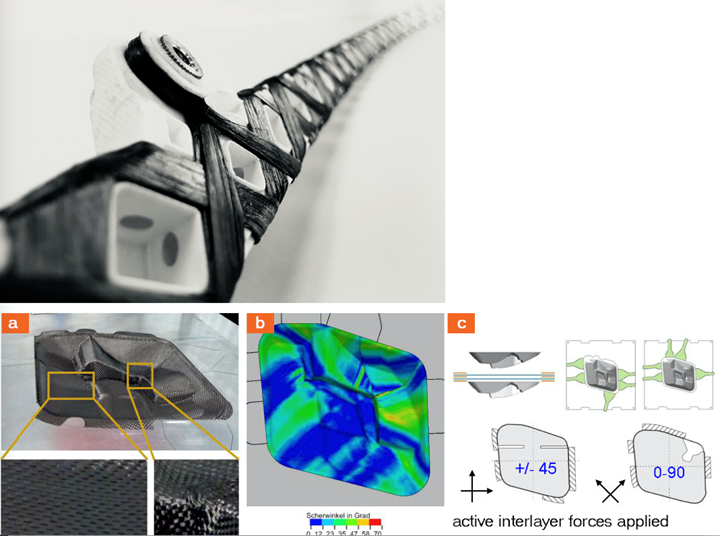
Examples of CIKONI’s composites developments include (top) 3D filament winding carbon fiber onto 3D-printed plastic core for a lightweight automotive truss and (bottom) draping simulation for automotive preforming. SOURCE for all images | CIKONI.
“We do a lot of draping simulations,” says Farbod Nezami, one of CIKONI’s co-founders. “The OEMs have good material data, but we always need a mold to validate the simulation. We wanted a system that would allow us to iterate designs on a daily basis.” The conventional process chain for molds takes weeks: part design, mold design, quotation and purchase process, machining/production of the mold, surface preparation and delivery. “With DYNAPIXEL, we simply use the CAD data to generate the mold surface,” says Nezami. “Now, if we have a draping issue, we change the CAD geometry and have the ability to produce a small prototype in a couple of hours.”


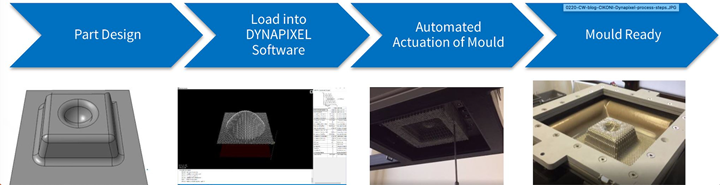
Automated system for reconfigurable molds
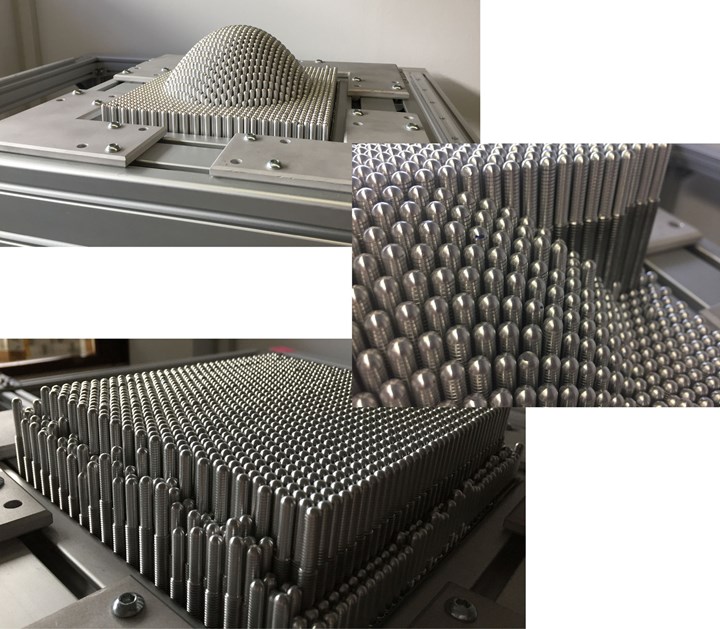
“There is no manual manipulation,” Nezami explains. “The process starts with the digital data from the part design, which is loaded into the DYNAPIXEL software. The software then generates the control array for actuating the pins and managing the parameters.”
The idea of using actuated pins to provide a reconfigurable mold has been used for decades in metalworking and recently adapted for composites by Adapa adaptive moulds (Aalborg, Denmark), discussed in CW’s 2017 feature on reconfigurable tooling. How is DYNAPIXEL different?
Nezami explains that because Adapa’s main applications are architecture and thermoforming glass, plastic and foam, they are producing bigger geometries and more continuous curves. “Compared to DYNAPIXEL, they use a smaller number of larger-sized actuators. Between these, the surface is interpolated and molded using a silicone sheet on top. Our system can produce sharp corners and more complex geometries. We also use a different estimation method. So, which technology fits depends on the application.”
Nezami points out that DYNAPIXEL also uses a silicone membrane, which can be used as a laminating surface and with molding processes up to 180°C. For double-diaphragm forming, you would enter the CAD data, let the software actuate the mold geometry, apply vacuum to drawn down the silicone surface on top, laminate the composite plies, close the matched mold with second membrane and complete cure.
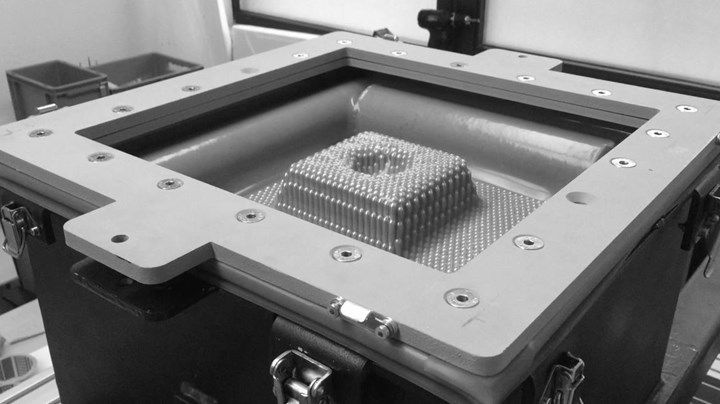
For composite parts production, DYNAPIXEL uses a silicone membrane as a laminating surface for molding processes (e.g. double diaphragm forming) up to 180°C.
“We have a golfball-type surface texture, but using a thicker membrane will alleviate this,” he adds. CIKONI uses three membrane thicknesses: 0.5, 1 and 3 millimeters. “The thickest gives a smoother surface but less detail,” Nezami observes, “while the 0.5-millimeter membrane gives a more accurate realization but a lower-quality surface finish.”
Surface finish has not been a driving issue because DYNAPIXEL was developed as a tool to speed R&D. “Our goal was to produce additional molds and design iterations without much additional cost,” says Nezami. “Once you freeze the part design, you would then switch to CNC-machined metal molds. You can also use this as a preforming tool.”
New applications
CIKONI is now developing additional uses for DYNAPIXEL, including flexible automotive jigs for bonding/adhesive joining and production of tailored, individualized helmets and protective apparel/structures. It also has an R&D project for customized orthotics. “We see value for this type of reconfigurable tooling where you need shapes tailored to each patient,” Nezami says. “Connection to the human body must match precisely to avoid irritation and sores. There is a lot of R&D into 3D printing for this type of application, but typically the material costs are high. Using DYNAPIXEL, you can significantly cut molding costs for individualized parts.”
To learn more about DYNAPIXEL, visit CIKONI at JEC World 2020 (Mar 3-5, Paris, France) in Hall 6, N72.


Related Content

Proving thermoplastic composites match carbon fiber/epoxy performance in road bikes
CDCQ, LxSim, Addcomp and Argon 18 collaborate to optimize a carbon fiber/PA6 bike seat post, democratizing AFP and demonstrating materials and process for future designs and production.
Read More
Carbon fiber, bionic design achieve peak performance in race-ready production vehicle
Porsche worked with Action Composites to design and manufacture an innovative carbon fiber safety cage option to lightweight one of its series race vehicles, built in a one-shot compression molding process.
Read More
Troubleshooting thermoplastic composite stamp forming
Understand the basic science of TPC stamp forming, a manufacturing process steadily gaining momentum in aerospace and mobility applications thanks to its rapid forming, short cycle times and automated methods.
Read More
Aurora reveals latest SPRINT X-Plane design concept
An Aurora and Boeing team advances its high-speed, vertical lift concept to the preliminary design phase, which features three lift fans, a more refined composite exterior and an uncrewed cockpit.
Read MoreRead Next

Composite trends gaining industrial traction for 2026
Startups & Investors topics over the last year show the industry is rapidly gaining maturity while benefiting from macro-trends in circularity, AI and TPC and high-rate manufacturing, all potential gains for investors.
Read More
From PMCs to sandwich composites: Tracing the path of test method standardization
Over the decades, progression of PMC and sandwich composite test method development and standardization has been shaped by the requirements of the composites industry.
Read More
Cutting engine weight via thermoplastic composite guide vanes
Greene Tweed replaces metal stator vanes with its DLF material co-molded with a metal leading edge that meets performance, cost and high-rate production targets while cutting 4 kg per engine.
Read More