
The future of carbon fiber manufacture
Later this month, CW’s 25th anniversary Carbon Fiber Conference promises to be among the most important as dynamic market forces are putting unusual pressure on the carbon fiber supply chain.

Share
Read Next


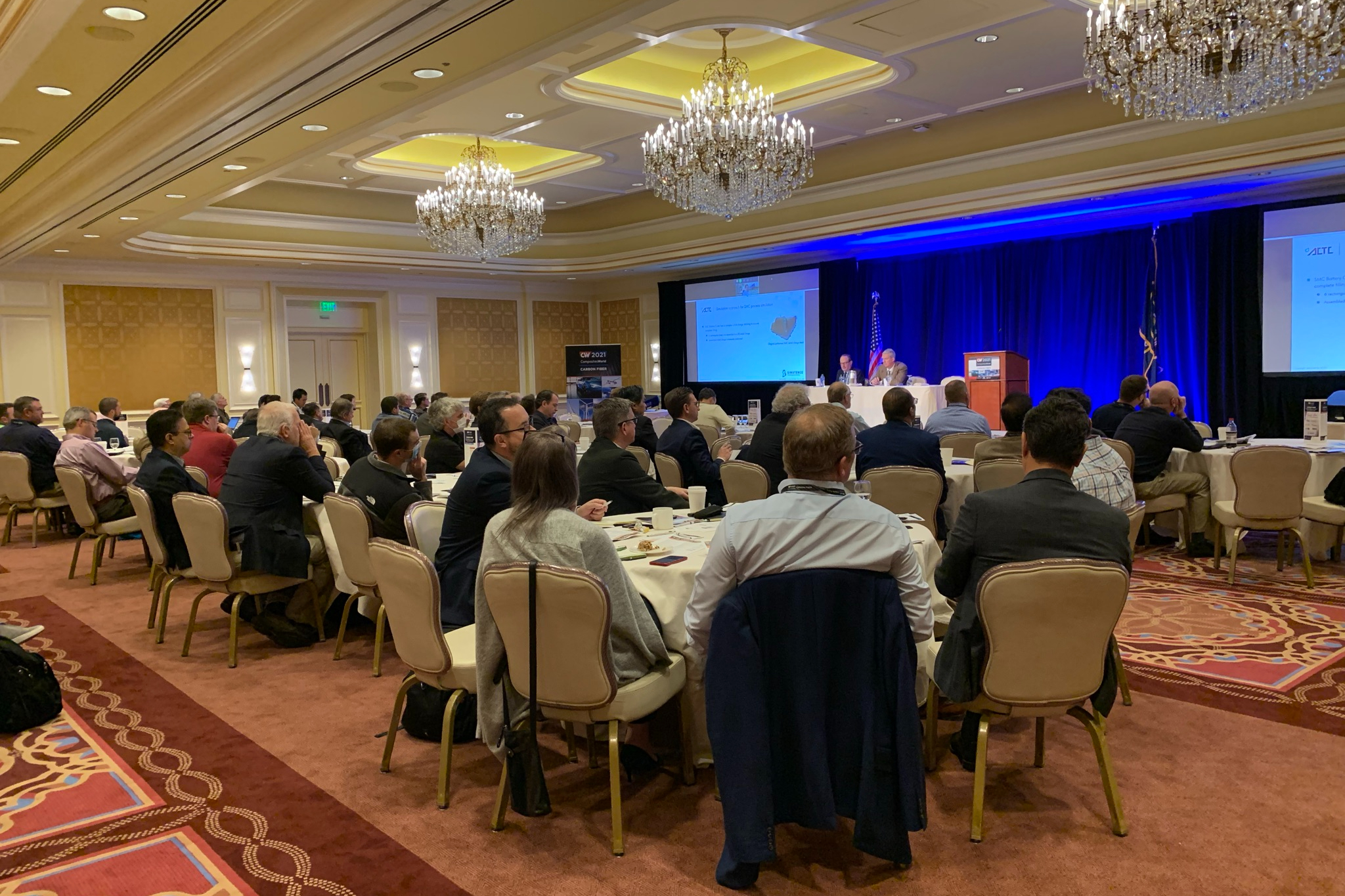
The 2021 Carbon Fiber Conference. Photo Credit: CW
CompositesWorld is hosting the 25th annual Carbon Fiber Conference this month from Nov. 15-17, 2022 in Greenville, S.C., U.S. The conference is, as the name implies, highly focused on the exploration of carbon fiber composites manufacturing. This business/technical event includes an examination of the entire carbon fiber value chain, from supply of carbon fibers to processing of intermediates to fabrication of finished parts.
Every Carbon Fiber Conference features a pre-conference seminar, during which we provide an in-depth, market-by-market analysis and forecast of the global supply and demand of carbon fibers. This year, as has been the case for the last several, this forecast is being presented by Tony Roberts and Dan Pichler, both of whom are industry veterans and possess extensive carbon fiber expertise.


This supply and demand outlook is always interesting as it provides the industry’s most comprehensive overview of where carbon fiber is most needed and how carbon fiber manufacturers are responding. There are, of course, several variables involved here. Different end markets and applications demand carbon fibers with very specific properties. For example, carbon fibers targeted toward the wind energy market are very different from the carbon fibers targeted toward the commercial aerospace or defense markets.
Part of what we’ll be doing at the Carbon Fiber Conference is helping the supply chain sort through these market signals and determine where and how growth will come.
There is also the issue of geography. Because carbon fiber export is often restricted or tightly controlled, where it’s manufactured is important — and, by extension, where it’s not manufactured.
Tony and Dan do a great job putting these variables in context as part of their presentation. This year, however, they will have their hands particularly full: The carbon fiber supply chain is, arguably, at the most pivotal point in its history. There are several reasons for this:
Commercial air travel recovery. Through much of 2020 and into 2021, COVID-19 caused a large drop in carbon fiber demand as commercial air travel suffered a massive slowdown. As the pandemic winds down and as commercial air travel begins its recovery, demand for carbon fiber in aerostructures is surging.
Longer wind turbine blades. In 2010, the average wind turbine rotor diameter was 115 meters, and at this size, there was not great need for the lighweighting and strength properties of carbon fiber. However, in 2021, the average rotor diameter was 128 meters (and rising). These longer blades have driven demand for carbon fiber in pultruded spar caps, which are used in almost every blade made today. This has made the wind energy industry by far the largest consumer of carbon fiber in the world. As wind turbines are refitted with longer blades, and as offshore wind expands, carbon fiber demand in this sector will only increase.
Emerging markets. There are two markets that, if they come to fruition as hoped, could put unprecedented pressure on the carbon fiber supply chain. One of these markets is filament-wound pressure vessels for hydrogen storage. The other is the advanced air mobility (AAM) market. Each is nascent, dynamic and fast-growing, but also surrounded by uncertainty about the pace and timing of their maturation. This makes the forecast of their future demand for carbon fiber, right now, unusually difficult to calculate.
The bottom line is that there is a global carbon fiber shortage. And, if these markets evolve as their advocates expect, demand will not only increase, but increase substantially.
Given this, it makes sense that carbon fiber manufacturers expand capacity, right? Yes and no. Carbon fiber manufacturers face unusual challenges that prevent them from easily and quickly expanding capacity to meet demand.
First, a new carbon fiber line costs at least $50 million and requires a dependable supply of polyacrylonitrile (PAN) precursor, which is also expensive and difficult to source. Second, a new carbon fiber line takes about two years to construct and commission. Third, not all carbon fiber is alike, thus a given carbon fiber line is designed to produce a specific carbon fiber with specific properties, which makes it suitable for specific applications. Such a targeted capital outlay means that a carbon fiber manufacturer needs strong signals and strong commitments from its customers to justify capacity expansion.
Part of what we’ll be doing at the Carbon Fiber Conference is helping the supply chain sort through these market signals and determine where and how growth will come. I hope you will join us in Greenville to be a part of this effort. Visit www.carbonfiberevent.com to learn more.


Related Content

Plant tour: Teijin Carbon America Inc., Greenwood, S.C., U.S.
In 2018, Teijin broke ground on a facility that is reportedly the largest capacity carbon fiber line currently in existence. The line has been fully functional for nearly two years and has plenty of room for expansion.
Read More
Bladder-assisted compression molding derivative produces complex, autoclave-quality automotive parts
HP Composites’ AirPower technology enables high-rate CFRP roof production with 50% energy savings for the Maserati MC20.
Read More
Combining multifunctional thermoplastic composites, additive manufacturing for next-gen airframe structures
The DOMMINIO project combines AFP with 3D printed gyroid cores, embedded SHM sensors and smart materials for induction-driven disassembly of parts at end of life.
Read More
Composites end markets: New space (2025)
Composite materials — with their unmatched strength-to-weight ratio, durability in extreme environments and design versatility — are at the heart of innovations in satellites, propulsion systems and lunar exploration vehicles, propelling the space economy toward a $1.8 trillion future.
Read MoreRead Next

Post Cure: CFRP mainframe, modern manufacturing techniques pioneer next-generation rigid airships
Advanced composites enable the revival of rigid airships in LTA Research's 400-foot-long Pathfinder 1.
Read More
Sentherm conductive polymers match aluminum thermal performance, cut weight
Tailored filler networks, anisotropic material design and manufacturing process control achieve hybrid polymers for EVs, batteries and other automotive-related electronics with 95% of aluminum’s thermal performance and 25-45% reduced component weight.
Read More
Kaneka BMI material attains >25% lead time, >20% tool cost reductions in Janicki evaluations
Process evaluations find that novel BMI polymer chemistry addresses longstanding manufacturing challenges of BMI tooling prepregs while maintaining high temperature performance and durability.
Read More