
SAMPE Summit 19 Paris
SAMPE Europe hosted its annual summit at Pullman Hotel Paris Tour Eiffel on March 11, prior to JEC World 2019.


View from the Pullman Hotel Paris Tour Eiffel, where the SAMPE Summit was held on March 11, 2019.
CW photo | Scott Francis
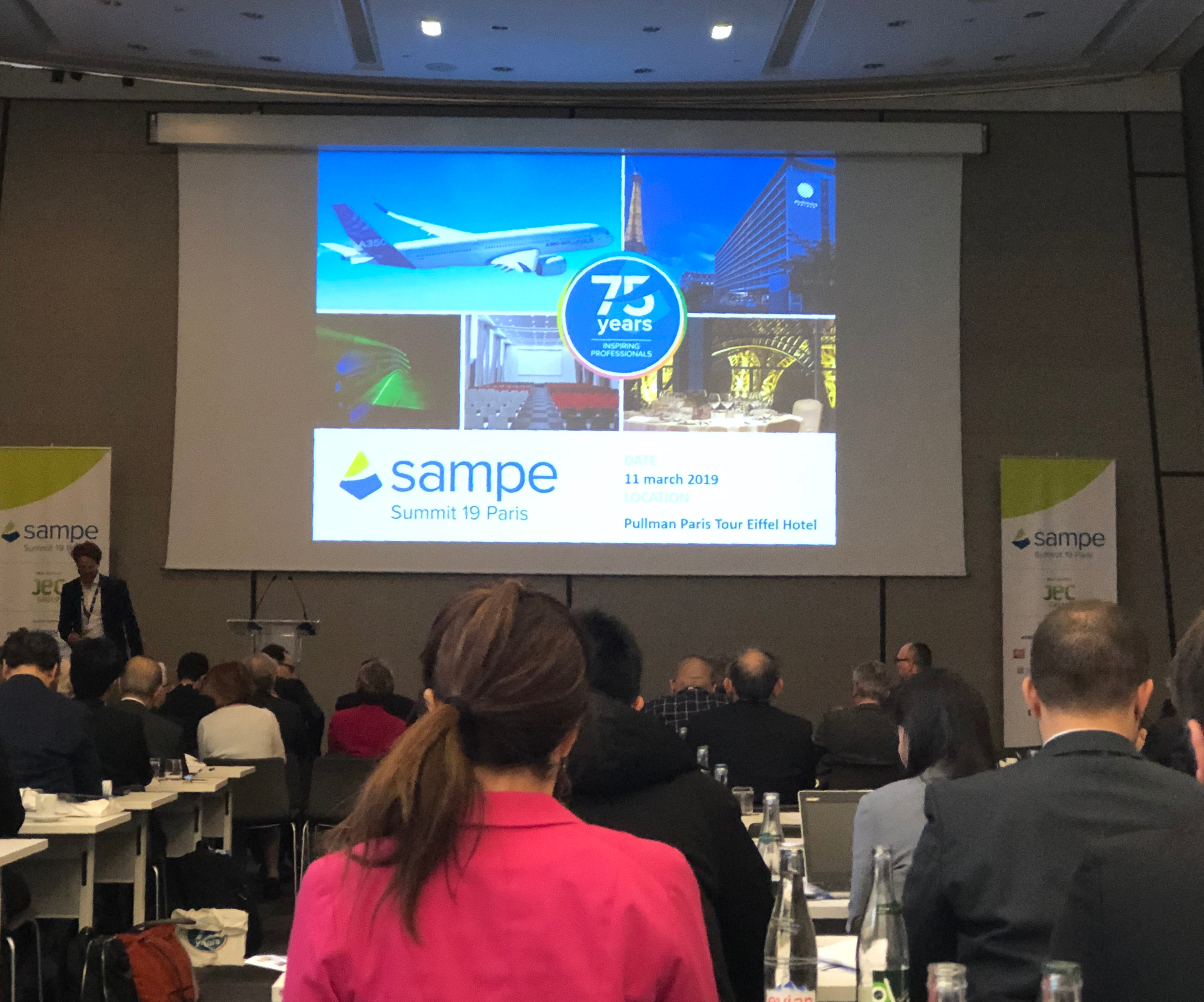
SAMPE celebrates its 75th anniversary this year.
CW photo | Scott Francis
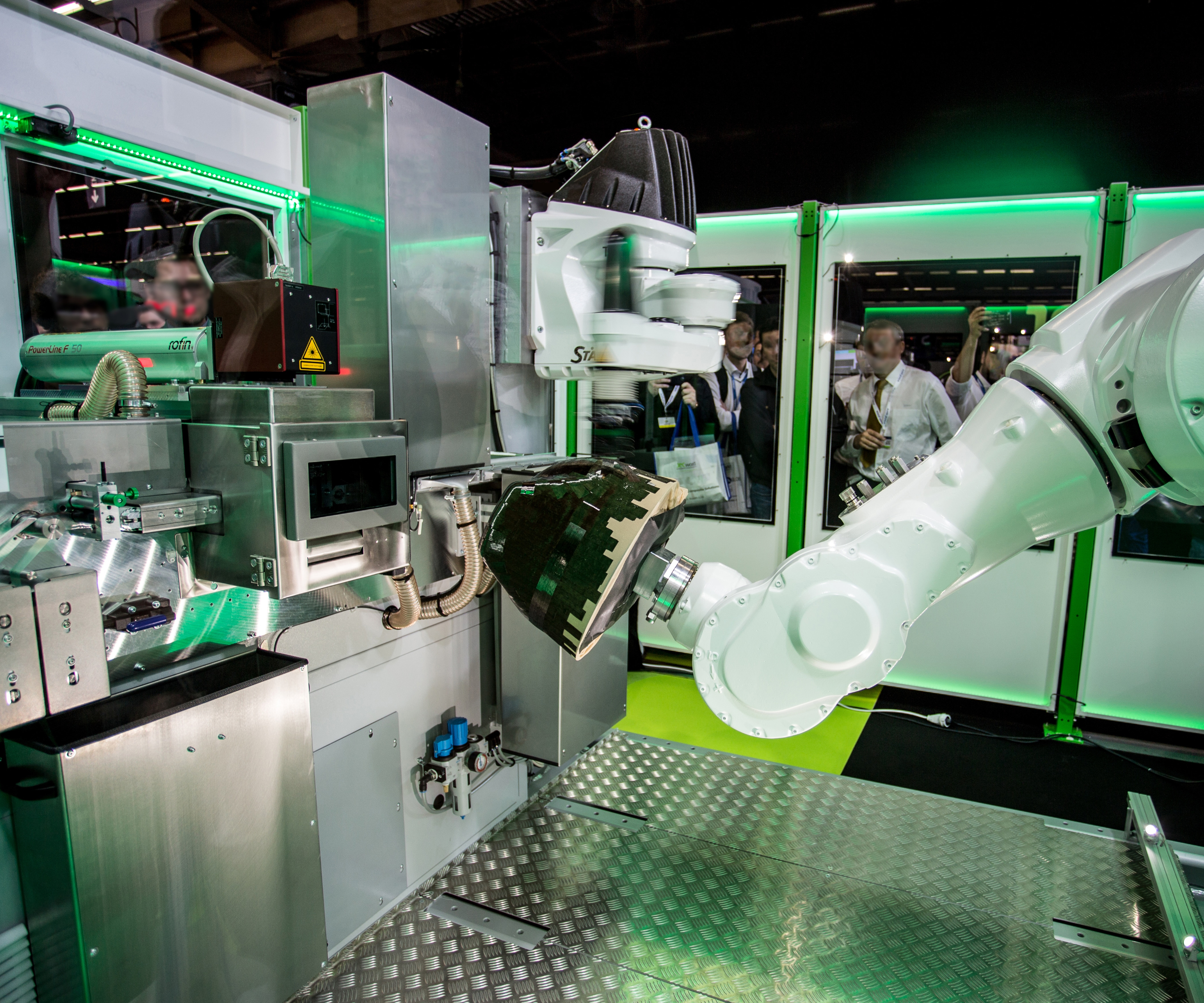
Cevotec SAMBA fiber patch placement technology on display at JEC World
Source | Cevotec


SAMPE Europe (Oerlingen, Switzerland), the European chapter of the Society for the Advancement of Material and Process Engineering (SAMPE, Diamond Bar, Calif., U.S.), hosted its annual summit at Pullman Hotel Paris Tour Eiffel (Paris, France) on March 11, prior to JEC World 2019. Around 160 attendees gathered to hear 12 speakers cover a range of topics including materials & processes, automotive, mass transport and aerospace. Speakers included:
- Dr. Sansan Ding of CRRC Qingdao Sifang Co. (China), who spoke about CFRP for rail vehicles. The CRRC is exploring the future application of composite materials in the sector driven by the expectation that China will exceed 30,000 km of high-speed rail (HSR) and more than 3,800 sets of high-speed trains by 2020. The CRRC is working to develop next-generation carbon fiber metro trains and anticipate a 30 percent reduction in weight of train by using carbon fiber-reinforced polymer (CFRP).
- Dr. -Ing. Thomas Henke of BMW Group (Munich, Germany) who addressed recent development in the field of CFRP in automotive applications. He indicated that most opportunity for composite structures within automotive seems to lie in the lightweighting of electrified vehicles and autonomous vehicles, which leads to improvements in range of the vehicle.
- Thorsten Gröne of Cevotec (Munich, Germany) who discussed the company’s fiber patch placement additive 3D fiber lay-up technology for complex composites, which enables high-complexity parts with cost-efficiency and volume capabilities. (Learn more about the technology in “Cevotec extends Fiber Patch Placement to sandwich structures, large aerostructures and enables combining with AFP” by Ginger Gardiner).
- Chantal Fualdes, head of Airframe Certification at Airbus (Toulouse, France), who discussed the efficiency of aerospace composite structures manufacturing. According to Fualdes today’s 80 percent reduction in fuel burn and CO2 correlates with increased use of composites.
- Dr. Emiliano Frulloni, Group CTO, Gurit, Switzerland (Zurich, Switzerland) who discussed a new low heat release epoxy for mass transport applications.
- Dr. Andreas Erber, Head of Aerospace SGL Carbon, Germany who discussed fiber placement materials & processes to address high volume production.
- Dr. Leslie Jay Cohen, HITCO Carbon Composites Inc. (Gardena, Calif., U.S.) who discussed non-destructive testing with relation to the digital thread.
- Prof. Dr. Takashi Ishikawa, National Composite Center Japan, Nagoya University (Nagoya, Japan) who discussed the development of a car chassis using LFT-D carbon/thermoplastics and welding technology.
- Axel Seifert, Plastic Omnium New Energies, Belgium who discussed hydrogen storage for Fuel Cell Electric Vehicles (FCEVs).
- Per Mårtensson, CSO Bcomp (Fribourg, Switzerland) who discussed natural fiber composite opportunities in automotive.
- Rob Lokate, Pontis Engineering (Amsterdam, Netherlands) who discussed development of a lightweight bike for the Dutch Olympic team.
- Mr. Oleksandr DONETS, president, ANTONOV State-owned Enterprise (Ukraine) who discussed composites in freight aeroplanes.
This year’s event also celebrated SAMPE’s 75th anniversary and included a film about SAMPE’s history and its role in the industry featuring testimonials from industry experts as well as up-and-coming advanced materials talent.


The conference keynote was delivered SAMPE North America president Karin Anderson, who shared highlights from the SAMPE Materials Forecast Forum which was conducted by SAMPE North America during 2018. Timed with SAMPE’s 75th anniversary, the study involved representatives from OEMs, government organizations, academia, research facilities and young professionals and was aimed at gaining insight into what the materials community might look like in the future.
Learn more at nasampe.org.


Related Content

Advancing the Thermoplastic Composite Battery Enclosure into Production
Having achieved its first few commercial series successes, Kautex Textron explains the design process for its Pentatonic battery enclosure platform, which comprise glass fiber/PP or PA6 and injection overmolding a compression molded laminate.
Read More
Polestar 5 takes aesthetics and circularity approach to biocomposite seatback design
The 2026 Polestar 5 expands the company’s use of sustainable materials design in the interior, including flax fiber/thermoplastic seatbacks that save 7 kilograms of weight and reduce overall plastics use.
Read More
Swancor applies EzCiclo recycling resin to Liux EV prototype
Cooperation with Spanish automotive startup has achieved automotive parts comprising EzCiclo RH512 thermoset resin and linen fiber that can be fully separated, adjusted and returned into circularity.
Read More
BMW’s patented flat storage system uses CFRP tanks for iX5 hydrogen
Seven 700-bar Type 4 tanks connected in parallel store 7 kilograms of H2 extend range up to 750 kilometers and fit into same space as battery-electric option for multi-powertrain vehicle architecture.
Read MoreRead Next

Dialing in composites performance via dynamic digital twins
Sport Dynamics Lab uses Flexdynamics testing, digital models and AI tools to compare designs, materials and systems, enabling optimization with potential for propellers, drones and vibrational structures.
Read More
Industrial ultrasonic NDT adaptation permits accessible composite bicycle inspection
Cycle Inspect's ASNT-aligned certification program employs affordable twin-crystal ultrasonic testing equipment and standardized inspection methods to detect damage in composite bicycle components.
Read More
Report: Composites and Carbon Fiber Use in Hydrogen Storage
A first-of-its-kind technical report that assesses the materials, manufacturing processes, market and energy trends driving use of carbon fiber composites in global hydrogen (H₂) storage applications for fuel cell-powered trucks, buses, trains and passenger vehicles.
Read More


