
IBEX 2009 Show Preview
As they weather the continuing recessionary storm, boatbuilders will dock in Miami to chart a course for the opportunities that await them in the storm’s wake.

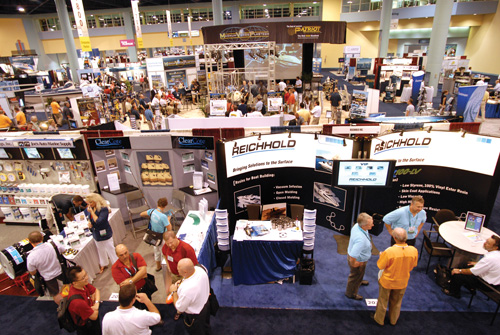
The Composites Pavilion at IBEX conveniently gathers many composites-related suppliers into one area of the show floor. Source: IBEX
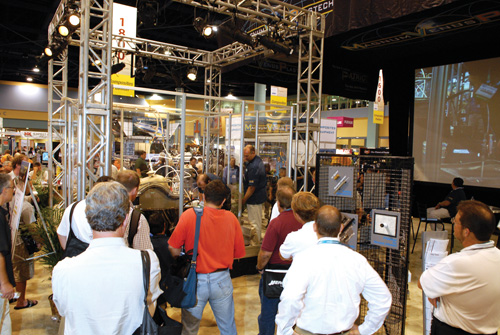
Source: IBEX


In its 19th year, the International Boatbuilders Exhibition and Conference will be held Oct. 12-14 at the Miami Beach Convention Center in Miami Beach, Fla. Although the economic downturn has been unkind to the boatbuilding industry, the show’s organizers — Professional BoatBuilder magazine and the National Marine Manufacturers Assn. (NMMA) — emphasize that the materials and manufacturing technologies used to produce boats continue to evolve. The times demand that boatbuilding, repair and design professionals keep up to speed and be prepared to take advantage of market opportunities when the industry returns to vigorous growth. This show offers boatbuilders an opportunity to do exactly that, seeing and learning about the latest in composites uses, in a variety of marine applications.
Many of the traditional IBEX events are back for 2009, including an opening night reception, the Industry Awards Breakfast, pre-conference workshops, technical seminars, exhibitor workshops and outdoor demonstration areas. The reception, Oct. 12 at 6:30 p.m., features a presentation by marketing strategists Al and Laura Ries, who promise to provide valuable marketing and public relations insights. Tickets are required for the event and cost $25 each. The Industry Awards Breakfast will be held the last day of the show, Oct. 14, from 8:00 a.m. to 10 a.m. At the event, the NMMA will present the Hall of Fame Award, the Alan Freedman Award, and the IBEX Innovation Awards judged by Boating Writers International. Tickets for the event also are $25 each.


Learning opportunities
Well-known for its historically high-quality technical workshops and seminars, IBEX aims to live up to its reputation again this year. For attendees who want to come a day early, the Pre-Conference Workshops on Oct. 11 offer several tracks, including one from 9 a.m. to 3 p.m. that will focus on core infusion processing. Presented by DIAB Americas LP DIAB Technologies, a recently created customer services business unit of core material manufacturer DIAB Inc. (DeSoto, Texas), the workshop will explain the details of the process, including discussion of infusion concepts, manifold options, vacuum bag sealing, materials, flow simulation, troubleshooting and shop setup. The cost, which includes lunch, is $85 per person.
The following day, IBEX offers the first of a slate of 51 seminars, many of which will address the use of composites. First-day seminars feature a heavy dose of technical composites material and processing information, including “Composite Mast Design: Engineering and Materials,” presented by Bruce Marek of Marek Yacht & Design Consultants (Wilmington, N.C.) and Taco Rison of SStructural Composites Inc. Europe BV, the new European arm of U.S. based Structural Composites (W. Melbourne, Fla.). They will review current trends in composite mast design and introduce attendees to ISO 12215-9 “Rig Attachments” and Germanischer Lloyd’s 2002 guidelines for the “Design and Construction of Large Modern Rigs.” They’ll also discuss the use of rule-of-mixtures calculations and carpet plots for determining composite modulus of elasticity.
In “Specifying Reinforcements,” presenters will review composite laminate specification software options and explore the strengths of each program. “Epoxy Repairs,” a panel discussion that will feature boat repair professionals, will delve into the structural and cosmetic aspects of epoxy repairs, from start to finish, on boats built with polyester and vinyl ester resins. “Optimizing Infusion,” on Monday afternoon, looks at the variables that influence the quality of products produced via infusion and assesses the impact of each. Case studies will be used to demonstrate the need to balance cost, quality, weight, stiffness and other variables.
Tuesday morning, “Powerboat Scantlings: Rules of Thumb” offers the basics of calculating stringer spacing, frame dimensions, numbers of plies of laminate, core thicknesses, and bulkhead or web-frame spacing for boats built in the U.S. The goal is to help designers understand basic requirements of a structurally sound hull design. “Vacuum Bagging” provides a practical review of the hallmarks of quality vacuum bag preparation for vacuum infusion operations. Presenters will teach attendees how to take advantage of the benefits and avoid the stumbling blocks of bagging.
On Tuesday afternoon, “Process Materials” will discuss a range of composites processing aids: perforated release film, surfacing products and Mylar flashbreaker tapes for tooling and release treatments. This session also will provide a review of process materials that are popular with aircraft and aerospace fabricators and explain some of the aerospace processing tweaks that are finding their way into the marine industry.
On Wednesday morning, the presenters of “From Open- to Closed-Molding” will describe the systematic changes that helped their companies realize the environmental, health and safety benefits of resin infusion. Additionally, they’ll detail the documented process advantages of weight reduction and improved structural performance. “Caulks, Sealants, and Adhesives” will review information needed to make the best choices when selecting and applying caulks, sealants and adhesives.
“Pre-Pregs,” Wednesday afternoon, introduces this high-performance composite material and evaluates if and how it can be used in marine applications. The session will encompass insights from custom builders in New Zealand and Australia and production builders in the U.K., and from the U.S. perspective. “Sandwich Construction with Wood” looks at the challenge of combining wood with carbon/epoxy composite laminates and provides data of tests performed on wood-composite constructions for marine applications. Finally, “Styrene and the Boatbuilder: A Health and Safety Update” addresses concerns about the use of styrene in marine composites applications and will review scientific studies that show that styrene is not a carcinogen.
The always popular outdoor demonstrations are back again for IBEX 2009. DIAB Technologies, in line with its mission specialties (process and component auditing, laminate engineering, process optimization, training, and material testing) will demo how DIAB uses flow simulation for vacuum infusion processing. For its part, Gibco Flex-Mold (Ft. Worth, Texas) will demonstrate a process that enables boatbuilders and repair companies to repair or re-pattern damaged production-mold parts.
Finally, Professional BoatBuilder and WoodenBoat magazines, with Gougeon Brothers Inc. (Bay City, Mich.), will host a invitation-only tribute to Meade and Jan Gougeon, honoring their 40 years in epoxy development and production. For more information, call (866) 937-8797 | E-mail: glo@gougeon.com.


Related Content

Bladder-assisted compression molding derivative produces complex, autoclave-quality automotive parts
HP Composites’ AirPower technology enables high-rate CFRP roof production with 50% energy savings for the Maserati MC20.
Read More
Watch: A practical view of sustainability in composites product development
Markus Beer of Forward Engineering addresses definitions of sustainability, how to approach sustainability goals, the role of life cycle analysis (LCA) and social, environmental and governmental driving forces. Watch his “CW Tech Days: Sustainability” presentation.
Read More
Composites end markets: Sports and recreation (2025)
The use of composite materials in high-performance sporting goods continues to grow, with new advancements including thermoplastic and sustainability-focused materials and automated processes.
Read More
Scaling up thermoplastic composites recycling
Thermoplastic composites are always said to be “recyclable.” Netherlands-based recycler Spiral RTC discusses the process, challenges, applications and opportunities to building a real recycling ecosystem.
Read MoreRead Next

Ceramic matrix composites: Faster, cheaper, higher temperature
New players proliferate, increasing CMC materials and manufacturing capacity, novel processes and automation to meet demand for higher part volumes and performance.
Read More
Scaling up, optimizing the flax fiber composite camper
Greenlander’s Sherpa RV cab, which is largely constructed from flax fiber/bio-epoxy sandwich panels, nears commercial production readiness and next-generation scale-up.
Read More
Next-gen fan blades: Hybrid twin RTM, printed sensors, laser shock disassembly
MORPHO project demonstrates blade with 20% faster RTM cure cycle, uses AI-based monitoring for improved maintenance/life cycle management and proves laser shock disassembly for recycling.
Read More