
STRUCTeam extends composites support for wave energy convertor
Joined by Ocean Energy and sustainability partners 3A Composites Core Materials and Sicomin to cut weight of OE12 Buoy by 30-50% via bio-based resins, recyclable polymer foam.


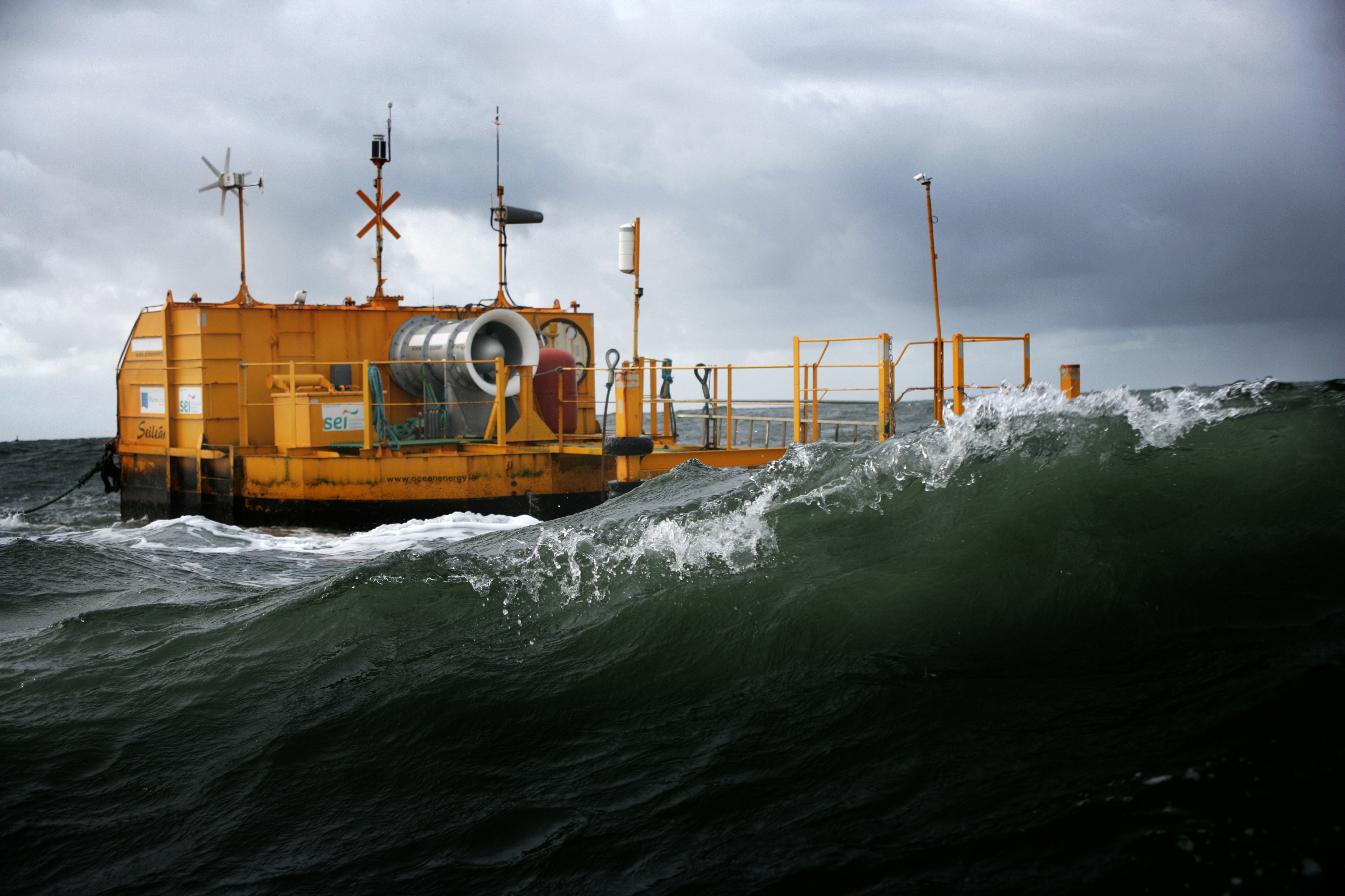
OE 12 Buoy steel structure in Galway Bay, Ireland. Photo Credit: STRUCTeam
STRUCTeam Ltd. (Cowes, U.K.), an independent composite engineering consultancy that has supported wind turbine and blade manufacturers for over a decade, is now extending its strategic insights to the application of composites in wave power with renewables company, Ocean Energy (Cork, Ireland), and technical partners 3A Composites Core Materials (Sins, Switzerland) and Sicomin (Châteauneuf les Martigues, France).
Ocean Energy approached STRUCTeam for support with a Horizon European Framework Programme, an EU funding initiative. The overarching objective of the proposal is to secure a sustainable and competitive energy supply through renewable applications.


The proposition centers around the development of an Oscillating Water Column (OWC), named the “OE12 Buoy.” The wave energy convertor is designed to glide on the ocean surface and extract power from the motion of the water. This power is then converted into electricity (see other examples of these types of technologies from CorPower Oceans and ACS-A).
The current OE 12 Buoy prototype is manufactured from steel and does not incorporate any composite materials. However, as the project has evolved, STRUCTeam says the the desire to achieve weight savings in the steel structure’s design has become a key objective. Currently, the device weights 28 tonnes and measures 12 x 6 meters. STRUCTeam estimates a 30-50% reduction in weight could be possible through careful engineering and materials selection, in addition to potential CO2 emission reduction, durability, reduced Levelized Cost of Energy (LCOE) and materials circularity. Collaboration with technical partners, 3A Composites Core Materials and Sicomin, will provide a supply of recycled core materials and bio-based epoxy resins to facilitate the lightweighting process.
Each of the technical partners place a strong emphasis on the circularity of materials in the projects they undertake. “After being contacted by Ocean Energy, our choice to bring these companies together was very deliberate,” Julien Sellier, managing director of STRUCTeam, highlights. “We each recognize our responsibility to improve the world around us and the urgent need to adopt sustainable practices were possible. STRUCTeam, 3A Composites Core Materials and Sicomin all possess extensive knowledge in the development and adoption of lightweight materials for large structures that transfers perfectly to this project.”
Each partner has proposed technologies and design solutions to successfully replace traditional material choices in the buoy structure. Sellier continues, “Composites are still considered novel technologies by many end users. A number of our customers have little or no experience designing, selecting and handling these materials in real-life applications. They can easily get lost in the complexities.” This is where STRUCTeam comes in, Sellier notes, which has years of experience “specifying composites for the most demanding wind and marine environments.”
Epoxy formulators, Sicomin, have developed a range of environmentally enhanced green epoxy systems derived from natural origins. The Greenpoxy range incorporates “InfuGreen 810,” a two-component product, specially formulated for resin transfer processes such as injection and infusion.
Similarly, 3A Composites Core Materials, part of the 3A Composites Group, has developed AIREX T92, a closed-cell, thermoplastic and recyclable polymer foam with high mechanical properties, and proposed its use throughout the composite buoy. AIREX T92 is said to have good resistance to fatigue, is chemically stable, UV resistant and has negligible water absorption, making it ideal for marine applications. The core material is suitable for a wide variety of lightweight sandwich structures that are subject to static and dynamic loads.
All parties anticipate a successful funding bid and look forward to developing the preliminary specifications of the composite structure. STRUCTeam will then initiate a pre-study analysis, conduct a first assessment, and finalize design requirements.
“Our wave devices have virtually no environmental impact, so to extend their sustainability credentials in manufacture, installation and service is a crucial factor. STRUCTeam and their partners 3A Composites Core Materials and Sicomin have guided us through the initial design phase and made valuable recommendations,” Sean Barrett, senior project engineer at Ocean Energy, concludes.


Related Content

Development of a composite liquid hydrogen tank for commercial aircraft
Netherlands consortium advances cryogenic composites testing, tank designs and manufacturing including AFP, hybrid winding, welding of tank components and integrated SHM and H2 sensors for demonstrators in 2025.
Read More
Carbon fiber, bionic design achieve peak performance in race-ready production vehicle
Porsche worked with Action Composites to design and manufacture an innovative carbon fiber safety cage option to lightweight one of its series race vehicles, built in a one-shot compression molding process.
Read More
Plant tour: Airbus, Illescas, Spain
Airbus’ Illescas facility, featuring highly automated composites processes for the A350 lower wing cover and one-piece Section 19 fuselage barrels, works toward production ramp-ups and next-generation aircraft.
Read More
Composites end markets: New space (2025)
Composite materials — with their unmatched strength-to-weight ratio, durability in extreme environments and design versatility — are at the heart of innovations in satellites, propulsion systems and lunar exploration vehicles, propelling the space economy toward a $1.8 trillion future.
Read MoreRead Next

Composite trends gaining industrial traction for 2026
Startups & Investors topics over the last year show the industry is rapidly gaining maturity while benefiting from macro-trends in circularity, AI and TPC and high-rate manufacturing, all potential gains for investors.
Read More
Cutting engine weight via thermoplastic composite guide vanes
Greene Tweed replaces metal stator vanes with its DLF material co-molded with a metal leading edge that meets performance, cost and high-rate production targets while cutting 4 kg per engine.
Read More
From PMCs to sandwich composites: Tracing the path of test method standardization
Over the decades, progression of PMC and sandwich composite test method development and standardization has been shaped by the requirements of the composites industry.
Read More