
Middle River Aerostructure Systems expands MRO capabilities for jet engine nacelles
A dedicated, 60,000-square-foot MRO workshop will accommodate the processing of large nacelles and thrust reversers, including complex composite and metallic repairs, and bonding.


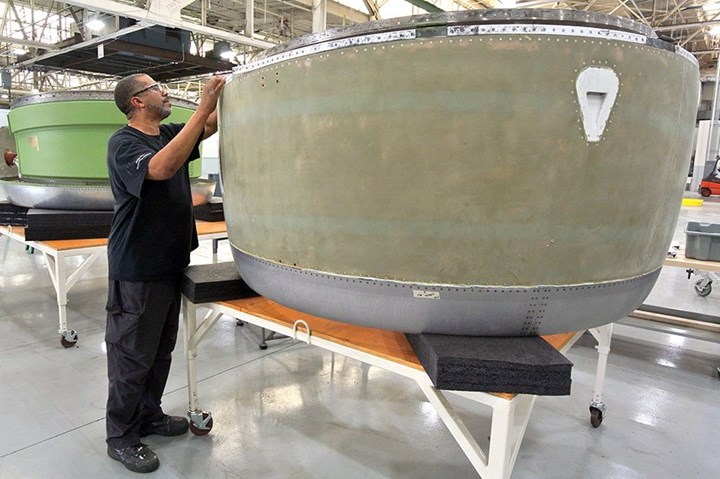
Photo Credit: MRAS
Middle River Aerostructure Systems (MRAS, Baltimore, Md., U.S.), a manufacturer of composite aerostructures for commercial and military applications, and subsidiary of ST Engineering (Singapore), reports that it is enlarging its maintenance, repair and overhaul (MRO) capabilities for jet engine nacelles by developing a dedicated 60,000-square-foot workshop at the company’s Middle River, Md., U.S. headquarters, with additional room available to accommodate further business growth.
Backed by a multi-million-dollar investment in tooling, machinery and systems, this step marks a significant evolution of the MRO capabilities that MRAS performs under the authority of its Federal Aviation Administration/European Union Aviation Safety Agency (FAA/EASA) Part 145 Repair Station Certificate, including complex composite and metallic repairs, as well as bonding.


Beginning with a complete floor-to-ceiling refurbishment of the dedicated MRO shop area — from installation of smart lighting to new electrical wiring and heating — the company says it is building out the MRO operation with acquisition of such equipment as a hydraulic test stand for thrust reverser deployment, functional testing, paint and power wash booths, component lift stands and a vertical carousel for parts.
Further, large-scale systems such as a 30-foot-wide sanding booth and a 32 x 25 x 16-foot blasting booth will accommodate the processing of nacelles and thrust reversers from the largest, highest thrust engines, according to Jeremy Tschaepe, MRO leader at MRAS.
“We’re unique in co-locating these MRO resources under the same roof as our one million-square-foot design, development and manufacturing operation at Middle River,” says Tschaepe. “This enables us to fully benefit from MRAS’ know-how through our decades of nacelle and aerostructures production for aircraft and engine manufacturers like Boeing, Embraer, Bombardier, GE Aviation and CFM International.”
Current MRO activity at MRAS covers nacelle systems for the CFM International (Cincinnati, Ohio, U.S.) CFM56-5B, CFM56-7B and International Aero Engines’ (East Hartford, Conn., U.S.) V2500, which power two widely used single-aisle jetliners: Boeing’s 737NG and the Airbus A320 family.
For the CFM56-5B, CFM56-7B and V2500, these MRO capabilities encompass the full nacelle system, from inlet and fan cowl to the thrust reverser. As part of its overall MRO investment, MRAS has sets of CFM56-7B and V2500 nacelle components for exchange, enabling rapid-reaction swap-out.
According to the company, its location in Baltimore, Md., also places it at the heart of the U.S. East Coast air corridor served by large fleets of Boeing 737NGs, and strategically positions MRAS to support airlines that operate A320s across North America.
Included in MRAS’ Repair Station Certificate’s MRO authority is the composite thrust reverser transcowl it produces under contract to Safran Nacelles (Paris, France) for the Airbus A320neo family. The company also has initiated nacelle repairs on GE Aviation (Cincinnati, Ohio, U.S.) Passport engines that equip Bombardier’s (Montreal, Canada) Global 7500, with this activity picking up as more of these large-cabin business jets enter service worldwide.
King Thompson, the senior sales and customer support manager for MRO business at MRAS, says the company’s expansion of its MRO resources comes as airlines strive to minimize expenses and streamline supply chains.
“Whether the airlines are large, medium-sized or small, they all want to keep their aircraft available for the operation to the maximum extent possible, while reducing the number of MRO service providers to a key group of core suppliers,” Thompson explains. “With MRAS, we’re at MRO shop offering full capabilities in a single location and providing complete service solutions through long-term relationships as a single vendor.”
Thompson adds that the MRO shop’s enlargement at MRAS significantly increases the company’s capacity for MRO work on nacelle systems covered by its Repair Station Certificate, while also opening new opportunities, including with nacelles that equip high-thrust engines.


Related Content

Co-molding SMC with braided glass fiber demonstrates truck bed potential
Prepreg co-molding compound by IDI Composites International and A&P Technology enables new geometries and levels of strength and resiliency for automotive, mobility.
Read More
Advancing mold release technology for aerospace composites manufacturing
Chem-Trend’s water-based, silicone-free mold release agent eliminates release curing time and provides easy tool cleanup.
Read More
Ceramic matrix composites: Faster, cheaper, higher temperature
New players proliferate, increasing CMC materials and manufacturing capacity, novel processes and automation to meet demand for higher part volumes and performance.
Read More
KAI demonstrates thermoplastic and infused structures for future airframes
Korea Aerospace Industries advances its expertise through a welded TPC fuselage section and resin-infused wing skin module and torsion box demonstrators.
Read MoreRead Next

A digital approach to automation
One aerostructures manufacturer’s journey from hand layup to AFP.
Read More
Report: Composites and Carbon Fiber Use in Hydrogen Storage
A first-of-its-kind technical report that assesses the materials, manufacturing processes, market and energy trends driving use of carbon fiber composites in global hydrogen (H₂) storage applications for fuel cell-powered trucks, buses, trains and passenger vehicles.
Read More
Post Cure: 3D printed plastic, composite mouthstick designs assist limited-mobility users
Three M Tool and Machine has used its in-house additive manufacturing capabilities to rethink medical devices like mouthsticks, which must be stiff, lightweight and comfortable enough for everyday use.
Read More


