
EU-funded GENEX project to develop digital twin framework for aircraft lifecycle tracking
Novel digital framework to enable holistic and comprehensive data capture through the entire aircraft lifecycle, supporting composite component/structure manufacture optimization and maintenance.


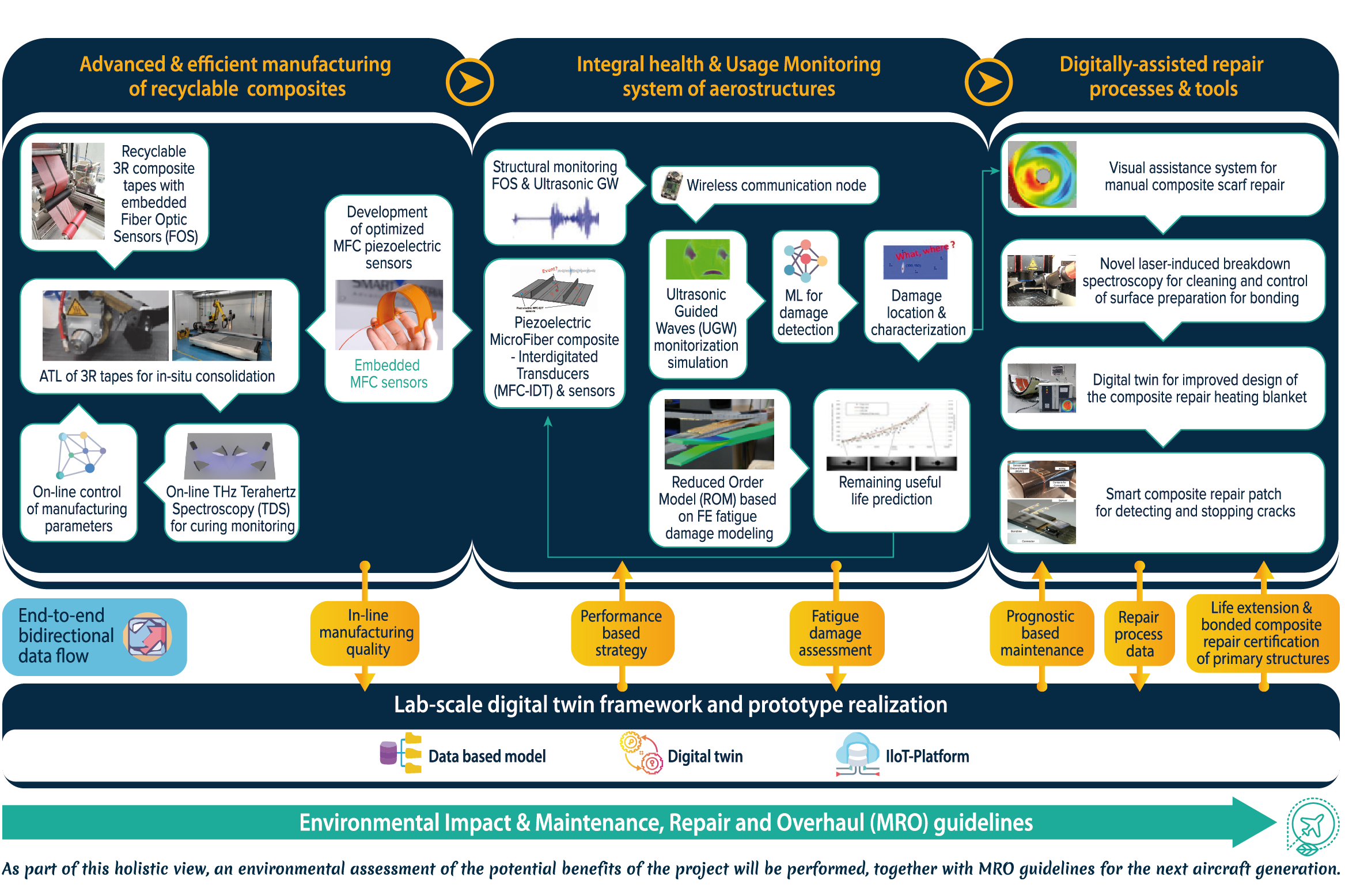
Photo Credit: genex-project.eu/about/consortium
Launched on Sept. 1, 2022, GENEX is a 42-month, 5.7 million Horizon Europe collaborative research project seeking to develop an end-to-end digital twin-driven framework for optimized manufacturing and maintenance of next-generation composite aircraft structures. Enhanced computational models will embed interdisciplinary knowledge of aircraft components and manufacturing/repair processes to support their optimization as well as enable data management and monitoring across the entire life cycle of the aircraft’s operation.
GENEX runs until February 2026. Its team, consisting of 16 partners from nine different countries, is being coordinated by Dr. Andrea Calvo-Echenique from ITAINNOVA – Technological Institute of Aragon (Zaragoza, Spain).


The core of the GENEX project is based on three technological blocks focused on different facets of the aircraft use life, which, eventually, will be integrated into a fourth to form the multidisciplinary digital twin. Each block is as follows:
- Block 1: Manufacturing Process Digital Twin: An automated tape laying (ATL) process and THz-based in-situ monitoring, coupled with hybrid-twin simulation methods, will be developed for the eco-efficient and advance manufacture of recyclable thermoplastic composites.
- Block 2: Product Usage Digital Twin: Data- and physics-based machine learning (ML) algorithms for damage detection and location, combined with high-performance computing (HPC)-based multi-physics and AI-powered digital twin tools for fatigue life prediction, will be implemented. This will help to predict the remaining useful life of a structure, after the information is received from embedded sensors.
- Block 3: MRO Digital Twin: Augmented reality tools, together with novel laser-assisted methods for surface cleaning and monitoring, smart monitoring and in-situ tailored heating of composite repair blankets, will be further developed to provide additional assistance in manual scarf repair operations, increasing the reliability of the repair process, while supporting the modification and virtual certification of MRO practices.
- Block 4: Cognitive Digital Twin: Combined integration of blocks 1-3 for the realization of a digital twin-drive framework implemented into a common industrial internet of things (IIoT) platform.
“The aviation industry is facing a two-fold challenge — targeting carbon neutrality while also adopting the digitalization of next-generation aircraft,” Dr. Calvo-Echenique says. “In GENEX, we hope to provide the needed technological impulse to optimize composite components manufacturing, and operation and repair processes using digital twin strategies.”
“The technologies that will be developed in GENEX are transversal and applicable to all composites structures, but mainly focused on the specifications of aviation (e.g., requirements and operational conditions),” she continues. “Although the demonstration will be on the primary structure of a mid-range aircraft, the scalability is something of interest for [project] partners, and applicability of the solutions to other sectors (i.e., urban air mobility or wind turbines) will definitely be taken into account.”
Related Content
-
Combining multifunctional thermoplastic composites, additive manufacturing for next-gen airframe structures
The DOMMINIO project combines AFP with 3D printed gyroid cores, embedded SHM sensors and smart materials for induction-driven disassembly of parts at end of life.
-
MFFD longitudinal seams welded, world's largest CFRTP fuselage successfully completed
Fraunhofer IFAM and partners have completed left and right welds connecting the upper and lower fuselage halves and sent the 8×4-meter full-scale section to ZAL for integration with a cabin crown module and testing.
-
Composites end markets: New space (2025)
Composite materials — with their unmatched strength-to-weight ratio, durability in extreme environments and design versatility — are at the heart of innovations in satellites, propulsion systems and lunar exploration vehicles, propelling the space economy toward a $1.8 trillion future.


