
ElectraFly, AnalySwift win U.S. Air Force STTR grants
Winning concept proposals include CBAM fabrication of aircraft parts, use of an infusion process for larger parts and development of an integrated computational blade engineering (ICBE) framework.


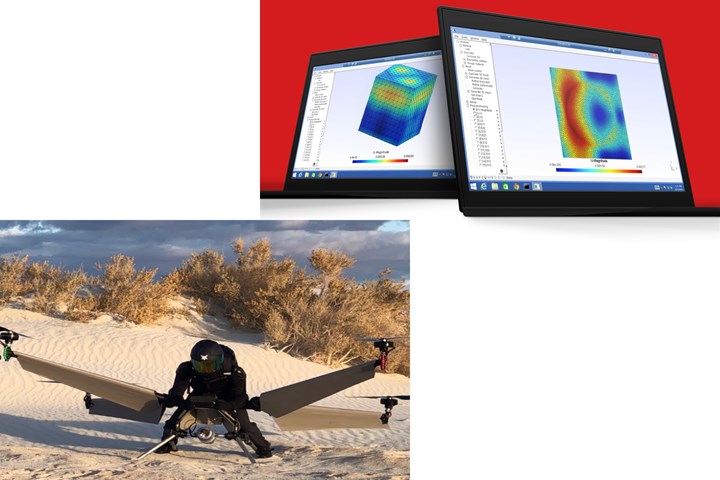
Photo Credit: UAMMI
It was reported on Oct. 28 that two Utah composite materials companies, ElectraFly (Salt Lake City, Utah, U.S.) and AnalySwift (West Jordan, Utah, U.S.) recently won three Small Business Technology Transfer (STTR) grants from the U.S. Air Force (USAF) for the company’s innovative concepts which aim to solve defense-related problems.
The winning proposals were developed with the help of the Utah Advanced Materials and Manufacturing Initiative (UAMMI, Kaysville, Utah, U.S.) and focus on composite material innovations for drones and advanced air mobility (AAM) aircraft that can benefit USAF and also be commercially developed.


ElectraFly, which is developing personal-flight-aircraft (advanced mobility aircraft; see “UAMMI, ElectraFly to make 3D-printed UAM aircraft parts”), submitted two winning proposals. The first is the fabrication of aircraft parts using a Carbon-Based Additive Manufacturing (CBAM) 3D printer provided by its partner Impossible Objects (Northbrook, Ill. U.S.). The parts will then reportedly be tested by Weber State University’s composites lab.
ElectraFly’s second proposal is to use an infusion process to create carbon fiber aircraft parts that are too large for the CBAM 3D printer. These parts will be created with project partner Hexcel (Stamford, Conn., U.S.) and tested at Brigham Young University’s (BYU) composites lab.
According to UAMMI, the third winning proposal was submitted by AnalySwift, a multi-physics modeling company with technology that is said to reduce engineering time and provides virtual testing of composite material structures, such as rotor blades, earlier in the design process (see “AnalySwift launches VABS software on Altair Partner Alliance platform”). The company’s proposal is to develop an integrated computational blade engineering (ICBE) framework for rapid insertion of high-performance composite rotor blades into ElectraFly’s aircraft. The framework will lead to prototyped parts developed by project partner Hexcel and then tested by the Weber State University composites lab.
“We congratulate these companies on their proposals and grant wins,” says Dr. Tulinda Larsen, executive director, UAMMI. “These wins position Utah as a leader in composites research for advanced mobility aircraft, which is the fastest growing market in aviation.”
Each winning grant will be awarded a maximum of $150K in this first of a three-phase program, says UAMMI. The objective of Phase 1 is to determine scientific, technical and commercial merit as well as feasibility of the innovations. Phase 1 projects are to be completed over the next six months with the possibility of follow-on funding for Phase 2 and 3 up to an additional $750K.
According to UAMMI, the grant program is a result of a 2014 review of the United States’ national defense strategy, in which it was determined that the U.S.’ military advantage over its adversaries and peer competitors was steadily eroding and that innovation would be a key tactic to correcting this. Accordingly, under the 2017 National Defense Authorization Act (NDAA) Congress authorized the Defense Commercial Solutions Opening (CSO) program allowing defense contracting officers to acquire innovative commercial items, technologies, or services which could close capability gaps.
The objective of the program is to provide potential technological advancements to the Department of Defense, incentivize small business commercialization of cutting-edge research, strengthen small businesses’ role in meeting DoD research and development needs and fortify the United States’ industrial base.


Related Content

Aerospace prepregs with braided reinforcement demonstrate improved production rates, cost
A recent time study compares the layup of a wing spar using prepreg with A&P’s TX-45 continuous braided reinforcement versus traditional twill woven prepreg.
Read More
Prepreg compression molding supports higher-rate propeller manufacturing
To meet increasing UAV market demands, Mejzlik Propellers has added a higher-rate compression molding line to its custom CFRP propeller capabilities.
Read More
Otto Aviation launches Phantom 3500 business jet with all-composite airframe from Leonardo
Promising 60% less fuel burn and 90% less emissions using SAF, the super-laminar flow design with windowless fuselage will be built using RTM in Florida facility with certification slated for 2030.
Read More
Bladder-assisted compression molding derivative produces complex, autoclave-quality automotive parts
HP Composites’ AirPower technology enables high-rate CFRP roof production with 50% energy savings for the Maserati MC20.
Read MoreRead Next

Industrial ultrasonic NDT adaptation permits accessible composite bicycle inspection
Cycle Inspect's ASNT-aligned certification program employs affordable twin-crystal ultrasonic testing equipment and standardized inspection methods to detect damage in composite bicycle components.
Read More
Advancing bonding, coating and sealing to 4.0 systems for composites, metals and more
Brighton Science uses decades of experience, 2-second surface measurements and a framework of data-based specs and KPIs to help manufacturers advance toward reliable, predictable bond quality for faster, high-performance production.
Read More
Report: Composites and Carbon Fiber Use in Hydrogen Storage
A first-of-its-kind technical report that assesses the materials, manufacturing processes, market and energy trends driving use of carbon fiber composites in global hydrogen (H₂) storage applications for fuel cell-powered trucks, buses, trains and passenger vehicles.
Read More


