
CCS developing composite wings for Eviation electric aircraft
Announced at the Paris Air Show, Composite Cluster Singapore has designed the wing and belly fairings for the Alice all-electric aircraft.
.jpg;width=70;height=70;mode=crop;format=webp)


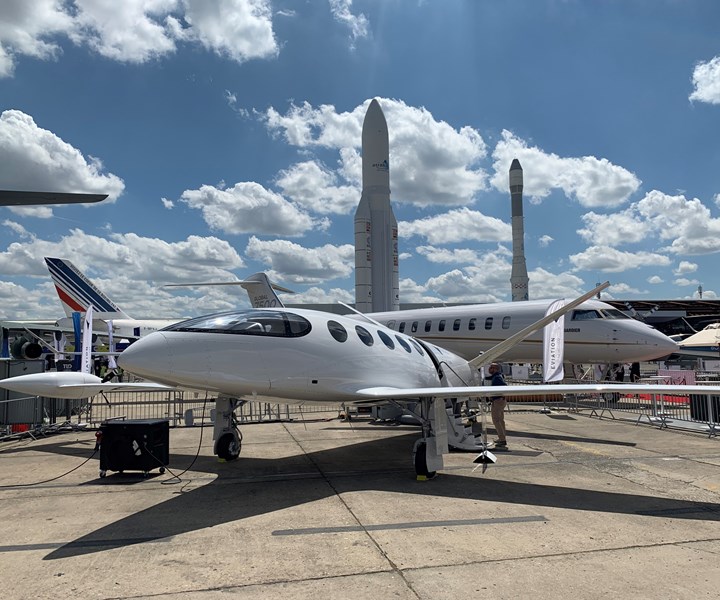
CW photo | Jeff Sloan


Composite Cluster Singapore (CCS) has announced that it is working with Eviation Aircraft on the wing development of Eviation’s fully electric aircraft Alice, which debuted this week at the Paris Air Show in Le Bourget, France.
CCS has designed the wing and belly fairings specifically for Eviation, has delivered the first shipset for assembly to Vannes, and is currently working on the second prototype.
CCS says it is continuing to expand its activities in the electric propulsion aircraft, urban air mobility and unmanned vehicles sectors. Leveraging the Composite Application Center (CAC) consortium announced in 2018, CCS is spearheading high-impact projects, such as the wing development for Alice.
Alice is a battery-electric passenger aircraft currently under development by Eviation Aircraft. Built 95% from composite materials, it will be controlled by fly-by-wire and powered by three electric engines, in a wingtip and pusher configuration. The nine passenger aircraft, said to have a range of 640 miles (1,000 kilometers) at a cruise speed of 240 knots, will reportedly have much lower direct operating costs than turboprop aircraft.
Carboman Group also recently announced its partnership with Eviation on the development of Alice’s carbon fiber composite fuselage.
Related Content
-
“Structured air” TPS safeguards composite structures
Powered by an 85% air/15% pure polyimide aerogel, Blueshift’s novel material system protects structures during transient thermal events from -200°C to beyond 2400°C for rockets, battery boxes and more.
-
Combining multifunctional thermoplastic composites, additive manufacturing for next-gen airframe structures
The DOMMINIO project combines AFP with 3D printed gyroid cores, embedded SHM sensors and smart materials for induction-driven disassembly of parts at end of life.
-
Low-cost, efficient CFRP anisogrid lattice structures
CIRA uses patented parallel winding, dry fiber, silicone tooling and resin infusion to cut labor for lightweight, heavily loaded space applications.


