
Cannon Ergos collaborates with Boeing to mold thermoplastic aircraft sidewall panels
Mold trials study the feasibility of using recycled carbon fiber, whether impregnated with diverse resins, or already integrated within a thermoplastic matrix.

Share


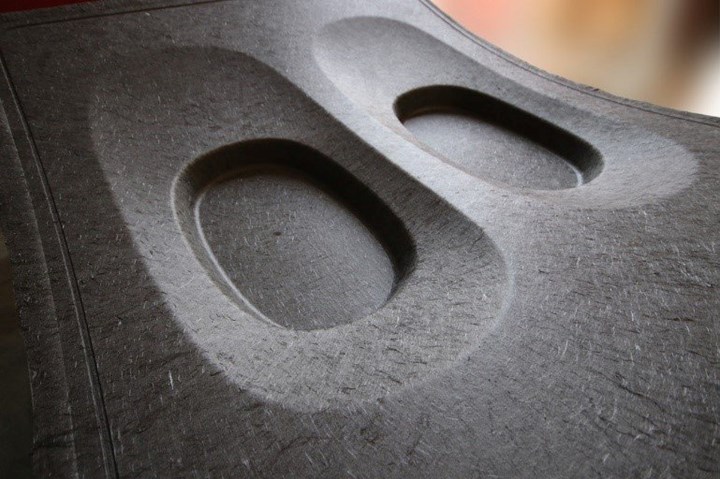
RCF-reinforced thermoplastic sidewall prototype. Photo Credit: Cannon Ergo
Cannon Group company, Cannon Ergos (Caronno Pertusella, Italy), a technologies, processing equipment and mold manufacturer for the composites industry, is working with Boeing (Chicago, Ill., U.S.) on molding trials for the feasibility of using recycled carbon fiber (rCF) for the fabrication of aircraft cabin interior sidewall panels.
The recovery and reuse of carbon fiber waste during production processes and end-of-life (EOL) applications, such as automotive and aeronautics, has proved to be economically viable, the company notes. This supports the implementation of the EU Waste Framework Directive (2008/98/EC) to greatly reduce landfill disposal which is environmentally essential and is also in line with targets set by the EU Circular Economy Package for sustainable production practices.
“For several years, together with sister companies Cannon Afros and Cannon Tipos, we have successfully undertaken numerous projects that offer new life to rCF,” Mattia Andolfatto, project manager R&D at Cannon Ergos, says. “By combining various technologies and production processes tailored for each application, we have been able to effectively process rCF whether impregnated with diverse resins, or already integrated within a thermoplastic matrix. The project with Boeing demonstrates the viability of fabricating interior sidewall panels with high-performance thermoplastics reinforced with recycled carbon fiber.”
The project’s latest stage involves Mitsubishi Chemical Advanced Materials (MCAM, Lenzburg, Switzerland), a global supplier of high-performance reinforced polymers for which Cannon Ergos has designed, manufactured and installed a customized and fully equipped thermo-compression unit. This equipment was used to produce prototype sidewall panels with the new Kyrontex material. Typical resin matrices used for Kyrontex thermoplastic composite aeronautical applications include polyamide (PA), polyetherimide (PEI), polyphenylene sulfide (PPS), polyetheretherketone (PEEK) and polyaryletherketone (PAEK).
Related Content
-
Troubleshooting thermoplastic composite stamp forming
Understand the basic science of TPC stamp forming, a manufacturing process steadily gaining momentum in aerospace and mobility applications thanks to its rapid forming, short cycle times and automated methods.
-
Cutting engine weight via thermoplastic composite guide vanes
Greene Tweed replaces metal stator vanes with its DLF material co-molded with a metal leading edge that meets performance, cost and high-rate production targets while cutting 4 kg per engine.
-
KAI demonstrates thermoplastic and infused structures for future airframes
Korea Aerospace Industries advances its expertise through a welded TPC fuselage section and resin-infused wing skin module and torsion box demonstrators.


