
AFP-XS platform demonstrates rectangular tube manufacture
Addcomposites collaborated with MBDA and Compositadour to produce lightweight, stiff and weatherproof components that are electrically insulating, chemically resistant and dimensionally stable.

Share
Read Next


In collaboration with defense manufacturer MBDA Systems (Le Plessis-Robinson, France) and the Compositadour (Bayonne, France) team, Addcomposites (Espoo, Finland) recently demonstrated the process for manufacturing rectangular tubes with its AFP-XS platform. The layup program was generated using the winding feature of the company’s AddPath software. As shown in the video above, layup on the sharp radial corners ensured wrinkle/pucker-free layup through sharp steering.
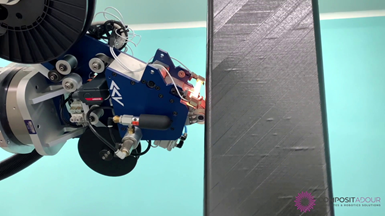
Photo Credit: Addcomposites, Compositadour
What was the reasoning behind manufacturing rectangular tubes? According to Addcomposites, this shape offers several benefits, including aesthetic appeal and high strength-to-weight ratios (compared to other forms of beams). Rectangular tubes are said to also exhibit high load-bearing properties — in both torsional and compression directions — enabling them to be suited to many different applications, as well as optimized environmental resistance, ideal for outdoor applications. Tubes are commonly used as structural elements in buildings, bridges and a wide variety of end-use consumer applications. Additional applications include tool handles, constrained telescopic structures, booms, lightweight housings, sports equipment, robot arms and antenna tubes.
The importance of using the automated fiber placement (AFP) process, says Addcomposites, further reduces wall thickness and weight, while improving stiffness and strength. This is in comparison to conventional winding and pultrusion. Moreover, each part can be optimized according to application requirements, via fiber orientation, localized reinforcements and diameters ranging from 20-1,000 millimeters. The resulting rectangular tube is a lightweight, stiff and weatherproof structure that is electrically insulating, chemically resistant and dimensionally stable.
Related Content
-
Thermoplastic composite materials and processing interactions
Selection of product material formats and their interactions with various process methods heavily influence a final TPC part’s properties and fabrication options.
-
ASCEND program completion: Transforming the U.K.'s high-rate composites manufacturing capability
GKN Aerospace, McLaren Automotive and U.K. partners chart the final chapter of the 4-year, £39.6 million ASCEND program, which accomplished significant progress in high-rate production, Industry 4.0 and sustainable composites manufacturing.
-
AFP with very-thin plies of carbon fiber/LMPAEK prepreg for sustainable helicopter structures
DLR, Airbus Helicopters, Fraunhofer and TU Dresden work in the NATURE project for environmentally friendly aviation


