
Index rises on surging new orders activity
The Composites Business Index moved higher in April 2019 due to strong acceleration in new orders activity.
.jpg;width=70;height=70;mode=crop;format=webp)
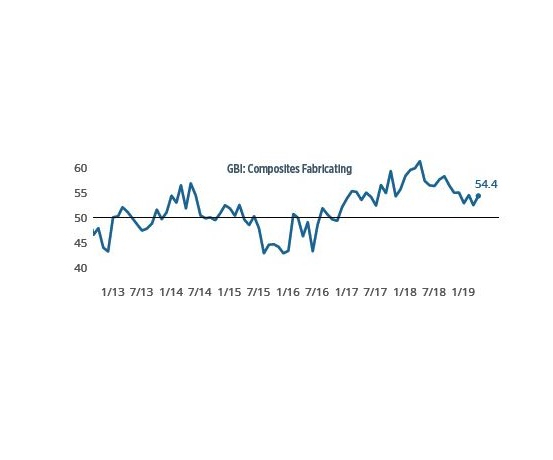
New orders lead expansion
New orders led the Composites Index higher in April, followed by production and supplier deliveries. Five of the six components that constitute the Index expanded in April.
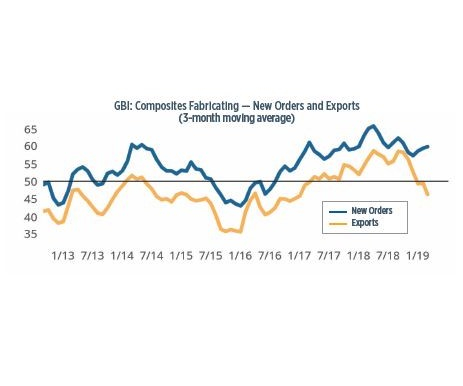
Total new orders grow despite contracting exports
April’s exports reading was the lowest since mid-2016; however, strong expansion in domestic new orders helped the industry to sustain expanding production and employment.


The Composites Index moved higher in April to a reading of 54.4, up from 52.6 in March 2019, thanks to strong acceleration in new orders activity. The latest Index reading is 12.1 percent lower compared to the same month one year ago, indicating slowing growth within the industry over the past year. Index readings above 50 indicate expanding business activity, while a value of 50 indicates no change and a reading below 50 indicates contracting business activity. Gardner Intelligence’s review of the underlying data indicates that the Index was propelled by new orders, production, supplier deliveries and employment. The Index — calculated as an average — was pulled lower by backlogs and exports; however, only exports contracted during the month.
April marked the highest reading for new orders activity in a year, while simultaneously, exports posted its lowest reading since mid-2016. The combination of total new orders expansion and contracting exports implies that domestic demand for fabricated goods more than offset shrinking global demand, according to the survey data. The surge in new orders during April is assumed to have aided backlogs that expanded in April after posting a sharp contraction in the prior month.
More information about the Composites Fabricating Index can be found at http://www.gardnerintelligence.com/
Related Content
-
Polar Technology develops innovative solutions for hydrogen storage
Conformable “Hydrogen in a Box” prototype for compressed gas storage has been tested to 350 and 700 bar, liquid hydrogen storage is being evaluated.
-
Ceramic matrix composites: Faster, cheaper, higher temperature
New players proliferate, increasing CMC materials and manufacturing capacity, novel processes and automation to meet demand for higher part volumes and performance.
-
Trends fueling the composites recycling movement
Various recycling methods are being considered for composites, from novel dismantling and processing, to building capacity and demonstrating secondary use applications.


