
The vexing economics of carbon fiber manufacturing
Hexcel's VP and GM Americas, Mike Canario, reviews tough economics the govern carbon fiber manufacturing today, and how they might affect future supply.


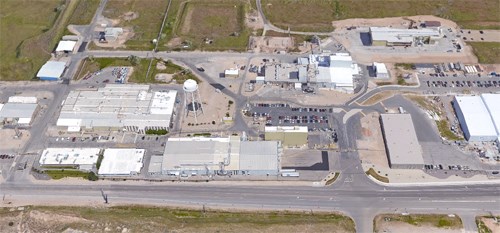
This carbon fiber manufacturing facility in Salt Lake City, UT, US, is one of several operated by Hexcel. Hexcel's VP and GM Americas, Mike Canario, talked at CW's Carbon Fiber 2014 conference last week and noted the numerous economic challenges associated with carbon fiber manufacturing expansion.
Mike Canario, VP and GM Americas at carbon fiber manufacturer Hexcel (Stamford, CT, US), spoke at CompositesWorld's Carbon Fiber 2014 conference in La Jolla, CA, US, last week, addressing opportunities and challenges associated with being a supplier of carbon fiber to the composites industry.
Canario provided a rare and frank glimpse of the economics of carbon fiber production and offered revealing insights about how Hexcel sees the market and calculates when and how to expand capacity to meet market demand for carbon fiber.


Carnario noted first that since the mid-1980s, carbon fiber demand in the aerospace industry has been fueled by a variety of important but relatively low-volume military programs, including the B-2, V-22, F-22 and F-35. On the commercial aircraft side, carbon fiber has seen limited use on a variety of Boeing and Airbus planes for many years, but it wasn't until the Boeing 787 and the Airbus A350 XWB were developed that carbon fiber firmly established its place in the aerospace industry. Each plane features carbon fiber in every major structural component (wings to fuselage to tail) and together, at full-rate production, said Canario, will consume more carbon fiber in one year than the F-35 program will over its entire life.
Looking ahead, through 2018, Canario said carbon fiber is expected to growth healthily in ever major market:
- Sports and leisure: 5.7% CAGR (compound annual growth rate)
- Aerospace: 10% CAGR
- Industrial: 14.4% CAGR
- Overall: 12.3% CAGR
What does this mean? Canario said the industry should expect 40,000 metric tons of additional carbon fiber demand in the next five years.
Good, right? Well, yes and no. In short, said Canario, carbon fiber ramp-up is not cheap. Carbon fiber manufacturing requires a polyacrylonitrile (PAN) precursor, the expense of which is exacerbated by the fact that it takes 2 kg of PAN to produce 1 kg of carbon fiber. Further, the high-temperature ovens used to convert PAN to carbon fiber are energy- and capital-intensive. Finally, construction and commissioning of a new carbon fiber plant can take 12 to 18 months, which prolongs return on capital expansion investment.
The real question, Canario said, is this: "Can the current carbon fiber economic model work?" For emphasis, he noted the following costs to manufacture the two basic types of carbon fiber:
- Aerospace grade: $85,000 to $220,000 per metric ton
- Industrial grade: $25,000 to $95,000 per metric ton
Given the current economic model, Canario noted, a carbon fiber manufacturer will expand capacity only if a sustainable rate of return can be guaranteed. This means minimizing risk and capital costs and emphasizing long-term contracts — like that which Toray has with Boeing for the 787 and Hexcel has for the A350 XWB.
For the future, Canario listed several factors that he expects will influence the type and quantity of carbon fiber on the market:
- Alternatives to PAN being developed might prove viable, but will trade performance for cost
- Capital costs will become increasingly important and challenging and will drive much capacity expansion decision-making
- Full use of carbon fiber assets will be the only way to perpetuate the current economic model
- Qualification of carbon fibers for aerospace is time-intensive and represents asset underuse.
"Under-utilized assets are the scariest thing for carbon fiber makers," Canario said.


Related Content

Low-cost, efficient CFRP anisogrid lattice structures
CIRA uses patented parallel winding, dry fiber, silicone tooling and resin infusion to cut labor for lightweight, heavily loaded space applications.
Read More
MFFD longitudinal seams welded, world's largest CFRTP fuselage successfully completed
Fraunhofer IFAM and partners have completed left and right welds connecting the upper and lower fuselage halves and sent the 8×4-meter full-scale section to ZAL for integration with a cabin crown module and testing.
Read More
Plant tour: Teijin Carbon America Inc., Greenwood, S.C., U.S.
In 2018, Teijin broke ground on a facility that is reportedly the largest capacity carbon fiber line currently in existence. The line has been fully functional for nearly two years and has plenty of room for expansion.
Read More
Combining multifunctional thermoplastic composites, additive manufacturing for next-gen airframe structures
The DOMMINIO project combines AFP with 3D printed gyroid cores, embedded SHM sensors and smart materials for induction-driven disassembly of parts at end of life.
Read MoreRead Next

From PMCs to sandwich composites: Tracing the path of test method standardization
Over the decades, progression of PMC and sandwich composite test method development and standardization has been shaped by the requirements of the composites industry.
Read More
Robotic computed laminography brings X-ray CT resolution to large composite structures
Omni NDE collaborative robots, X-ray end effectors and Voxray’s reconstruction approach enables 5-micron inspection of aerospace parts without size constraints.
Read More
Thermoplastic composite materials and processing interactions
Selection of product material formats and their interactions with various process methods heavily influence a final TPC part’s properties and fabrication options.
Read More