
XlynX Materials releases new polymer molecular glue: BondLynx
"Hyper glue" adhesive forges new bonds at the molecular level to permanently adhere difficult-to-bond polymers.


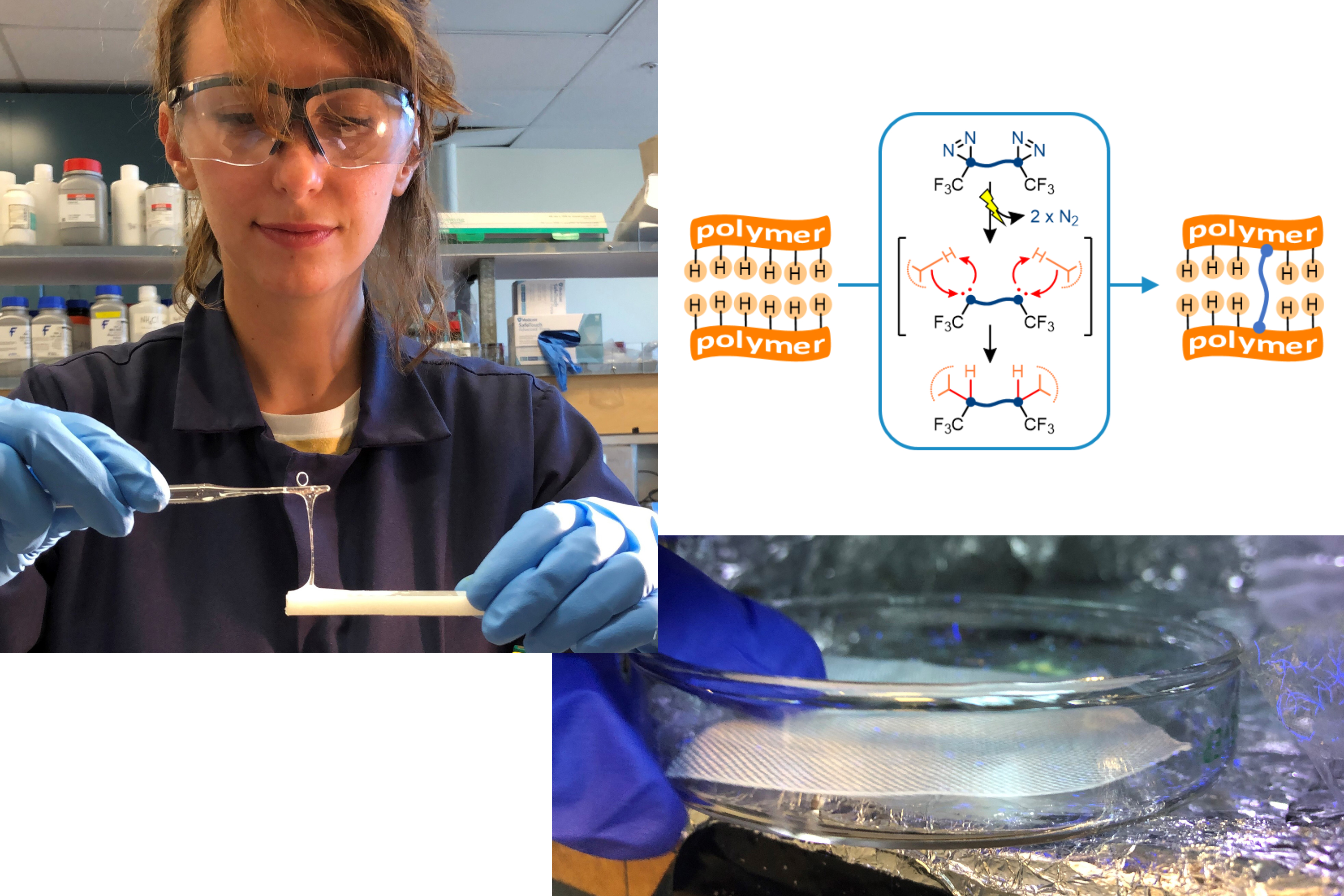
BondLynx employs bis-diazirine chemistry to create covalent chemical bonds between polymer chains, permanently crosslinking them together through strong carbon-carbon bonds. BondLynx molecular glues can also be applied to polymer textiles to link and strengthen the fibers. Photo Credit: XlynX Materials
XlynX Materials (Victoria, B.C., Canada) has announced the creation of a new class of adhesives they are calling “molecular glues.” These make it possible to permanently adhere difficult-to-bond polymers such as polyethylene and polypropylene to themselves, and to other materials, through exceptionally strong chemical bonds.
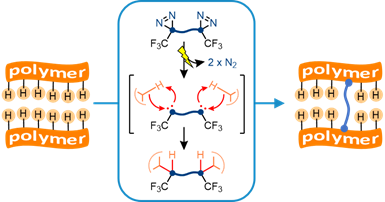
BondLynx creates covalent chemical bonds between polymer chains, permanently crosslinking them together through strong carbon-carbon bonds — the same type of joinery found between carbon atoms in the polymer chains themselves. Photo Credit: XlynX Materials
Conventional adhesives typically take advantage of mechanical forces to hold materials together. BondLynx employs bis-diazirine chemistry to create covalent chemical bonds between polymer chains, permanently crosslinking them together through strong carbon-carbon bonds — the same type of joinery found between carbon atoms in the polymer chains themselves. Once BondLynx has been applied to a polymer, the crosslinking process can be initiated by heat, ultraviolet (UV)/visible light or an electric field, depending on the specific demands of the manufacturing process.


"What's really amazing about BondLynx is that it can ‘glue’ virtually any plastic to any other plastic,” says Jeremy Wulff, professor of Organic Chemistry at the University of Victoria. “BondLynx acts by inserting itself into the carbon-hydrogen bonds that are present in almost every commodity polymer. The potential applications are limitless."
BondLynx has undergone adhesive testing on a wide range of polymer and polymer-metal combinations. Remarkably, even elastomers and damp surfaces can be bonded with BondLynx, opening broad opportunities for novel applications, for example, in the medical field.
Strengthening of fabrics
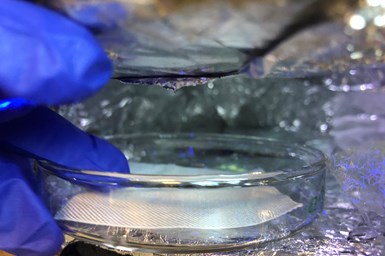
Application of BondLynx molecular glue to strengthen fabric. Photo Credit: XlynX Materials
In addition to being used directly as polymeric adhesives, BondLynx molecular glues can be applied to polymer textiles to link and strengthen the fibers. It has proven effective in strengthening ultra-high molecular weight polyethylene (UHMWPE) fabrics for ballistics protective equipment and wind sport applications.
“As a leading manufacturer of body armor products, PRE Labs had a privilege to test and use ultra-high performance fabrics crosslinked with BondLynx,” explains PRE Labs CEO Brad Field. “Our evaluations to date have confirmed that these new-generation cross-linking agents can significantly enhance the tear and perforation resistance along with mechanical properties of high-performance fabrics.” Researchers at the University of British Columbia, University of Alberta, McGill University and industry labs have already begun similar testing.
Further information
Samples for testing and research purposes are now available from XlynX Materials. Please send your request to info@xlynxmaterials.com. For a deeper look at the science behind this new technology, see: “A broadly applicable cross-linker for aliphatic polymers containing C–H bonds” in Science and “Flexible polyfluorinated bis-diazirines as molecular adhesives” in Chemical Science.
About BondLynx
BondLynx is a revolutionary new type of adhesive that takes advantage of chemical crosslinking to form ultra-strong covalent bonds between a wide range of “impossible to bond” polymers and other materials.
About XlynX Materials Inc.
XlynX (pronounced “ex-links”) is a rapidly-emerging specialty chemical company focusing on the development of novel diazirine-based crosslinking molecules, carbon materials, and the combination of both technologies to provide solutions to the world’s toughest composite materials challenges. Located on Canada’s west coast, XlynX’s team of chemists and physicists is committed to working with researchers around the world to bring new and exciting chemical products to market. XlynX Materials gratefully acknowledges the financial support of the Mitacs Accelerate program.


Related Content

CW finalizes Tech Days: Bonding and Welding agenda
A total of six presentations — four welding and two bonding — presented by industry experts will explore the drawbacks, potential and evolving technologies available to bonding and welding methods.
Read More
IPS Adhesives debuts Scigrip SG2000 adhesive in North America
The adhesive’s 1:1 mix ratio and long open time provides transportation, construction and marine industries with much-needed routine simplification and flexibility.
Read More
Click Bond unites bonding science, fastening innovation with Brighton Science acquisition
Click Bond expands its ability to deliver measurable, scientific confidence from surface to structure.
Read More
VIDEO: Plasma surface treatment technology improves adhesion
Plasmatreat demonstrates its Openair-Plasma surface treatment technology, which can enhance material adhesion.
Read MoreRead Next

Dialing in composites performance via dynamic digital twins
Sport Dynamics Lab uses Flexdynamics testing, digital models and AI tools to compare designs, materials and systems, enabling optimization with potential for propellers, drones and vibrational structures.
Read More
Post Cure: 3D printed plastic, composite mouthstick designs assist limited-mobility users
Three M Tool and Machine has used its in-house additive manufacturing capabilities to rethink medical devices like mouthsticks, which must be stiff, lightweight and comfortable enough for everyday use.
Read More
Report: Composites and Carbon Fiber Use in Hydrogen Storage
A first-of-its-kind technical report that assesses the materials, manufacturing processes, market and energy trends driving use of carbon fiber composites in global hydrogen (H₂) storage applications for fuel cell-powered trucks, buses, trains and passenger vehicles.
Read More