
X-57 Maxwell concludes high-voltage testing
All-electric composite airplane successfully spins propellors under full, high-voltage power.


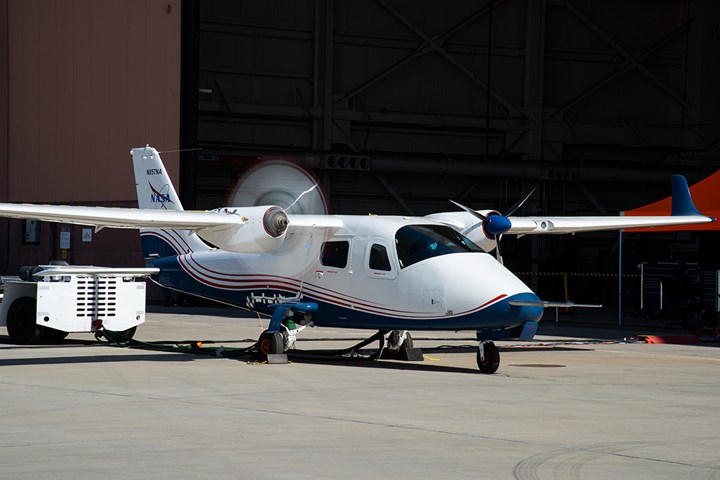
NASA’s all-electric X-57 Maxwell concluded high-voltage ground testing at NASA's Armstrong Flight Research Center in California. Photo Credit: NASA Photo/Lauren Hughes
NASA’s all-electric X- 57 Maxwell — with a wing that comprises of carbon fiber spars, skin, wing-tip nacelles and nacelles — has completed another milestone toward its first flight with the successful completion of high-voltage testing.
High-voltage testing powers the aircraft from an auxiliary power supply to test the functionality of the integrated systems under full power. A highlight from high-voltage testing included the spinning of the propellors for the first time under electric power. Though the propellors had previously spun during the X-57’s initial build phase conducted by the small business prime contractor Empirical Systems Aerospace Inc. at Scaled Composites (Mojave, Calif., U.S.), it is now up to NASA engineers to advance the system and use lessons learned from previous tests. The propellors are powered by electric cruise motors, which will also be used to power the X-57 in flight.
A principal goal of the X-57 project is to share the X-57 design and airworthiness process with regulators and standards organizations. Another goal is to establish the X-57 as a reference platform for integrated approaches of distributed electric propulsion technologies. Next up, X-57 will undergo verification and validation testing.
Related Content
-
Development of a composite liquid hydrogen tank for commercial aircraft
Netherlands consortium advances cryogenic composites testing, tank designs and manufacturing including AFP, hybrid winding, welding of tank components and integrated SHM and H2 sensors for demonstrators in 2025.
-
Otto Aviation launches Phantom 3500 business jet with all-composite airframe from Leonardo
Promising 60% less fuel burn and 90% less emissions using SAF, the super-laminar flow design with windowless fuselage will be built using RTM in Florida facility with certification slated for 2030.
-
Combining multifunctional thermoplastic composites, additive manufacturing for next-gen airframe structures
The DOMMINIO project combines AFP with 3D printed gyroid cores, embedded SHM sensors and smart materials for induction-driven disassembly of parts at end of life.


