
UMaine dedicates ocean engineering lab for wind energy testing
The lab will be used to test offshore wind turbines and similar structures, and provide facilities for thermoplastic composites research and development.

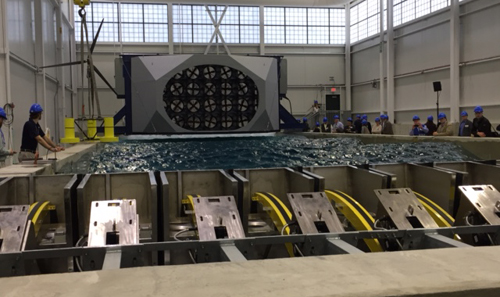
Ocean Engineering Laboratory wave tank.
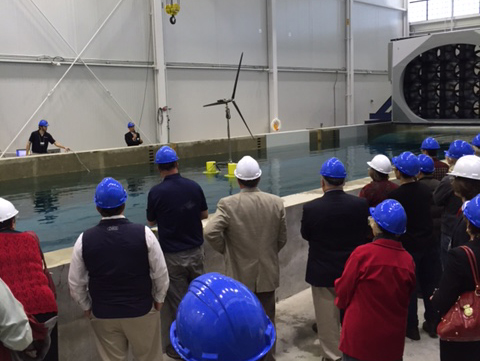


During a laboratory dedication at the University of Maine (Orono, ME, US) on Nov. 23, the Harold Alfond Foundation announced a $3.9 million grant to the University of Maine to match $9.98 million already raised, formally establishing the Harold Alfond W2 Ocean Engineering Laboratory and Advanced Manufacturing Laboratory at the Advanced Structures and Composites Center on campus.
“We are investing in people and infrastructure that will support ocean engineering, and advanced manufacturing education and research, and grow Maine jobs,” says Gregory Powell, chairman of the Harold Alfond Foundation.


The Ocean Engineering Laboratory will prototype coastal and offshore structures, including ocean energy devices, ships, aquaculture facilities and oil and gas structures under extreme wave, wind and current environments.
The Advanced Manufacturing Laboratory for thermoplastic composites will use digital, additive and robotics manufacturing to reduce cycle time and cost. Structural thermoplastics are recyclable materials that could transform composite materials use in cars, ships, boats and aerospace applications. In June, the Composites Center received $497,965 from the National Institutes of Standards and Technology to develop a national road map for advanced manufacturing of structural thermoplastics composites materials.
The total construction, equipping and start-up of the new laboratories over the first three years will cost more than $13.8 million. Of that, the center had raised more than $9.98 million through four grant competitions, including the U.S. Economic Development Administration, National Science Foundation, National Institute of Standards and Technology, and Maine Technology Institute, as well as a Maine voter-approved bond, supported by the Governor and Maine Legislature in June 2015.
The Alfond Foundation naming gift of $3.9 million will help complete the equipping of the facility, hire engineers for the start-up in 2015-16, and fund graduate and undergraduate students over three years to help start-up the facility.
“I am delighted that after years of hard work, the University of Maine is establishing world-class research capabilities in ocean engineering and advanced composites manufacturing to help Maine and the nation improve our industrial competitiveness in boatbuilding, renewable energy and aquaculture, and to help protect our coastal cities from major storms,” says U.S. Sen. Susan Collins. “Maine has a long and impressive history in both boatbuilding and composites manufacturing. The important investment in this laboratory at UMaine builds on our state’s tradition of excellence in ocean engineering. Throughout my service in the Senate, I have been a steadfast supporter of the Composites Center, and do thank the Alfond Foundation, the National Science Foundation, the U.S. Department of Commerce, the Maine Technology Institute and Maine voters for their participation in making this $13.8 million research facility a reality in Maine.”
“The University of Maine has long been a pioneer in ocean research and engineering. With the state-of-the-art Alfond Ocean Engineering and Advanced Manufacturing Laboratories, the students and faculty at UMaine will be able to build on this impressive legacy and help grow Maine’s marine economy,” said U.S. Sen. Angus King. “I commend the Alfond Foundation for its dedication to providing a brighter future for Maine, and for its continued commitment to giving our students the opportunities they need to grow, learn and thrive.”
“These will be the only labs of their kind in Maine with world-class capabilities to educate students and conduct cutting-edge research and development,” says professor Habib Dagher, executive director of the UMaine Composites Center. “The R&D will support the growth of the ocean economies and shipbuilding sectors in Maine and the nation, as well as the growth of digital and additive manufacturing of thermoplastic composite materials.”
“Two integrated world-class research laboratories will be established in Maine through this unique partnership with the Alfond Foundation,” said UMaine President Susan Hunter. “This advancement in one of UMaine’s Signature Areas of Excellence creates unparalleled opportunities for students and researchers, and supports marine-related economic development in Maine.”


Related Content

We4Ce infused 2.5-3-MW rotor blade design passes validation test
Composite rotor blade structure design by We4Ce, mold and prototype production by InDutch Composites and fatigue testing by Suzlon Group has resulted in the novel blade’s IEC61400-5:2020 certification.
Read More
SRI develops scalable, infiltration-free ceramic matrix composites
Work in two DOE projects is demonstrating C/C-SiC produced in 3-5 days with <5% shrinkage, <10% porosity and 50% the cost of conventional C/C and C/C-SiC.
Read More
Ceramic matrix composites: Faster, cheaper, higher temperature
New players proliferate, increasing CMC materials and manufacturing capacity, novel processes and automation to meet demand for higher part volumes and performance.
Read More
Composites end markets: Batteries and fuel cells (2024)
As the number of battery and fuel cell electric vehicles (EVs) grows, so do the opportunities for composites in battery enclosures and components for fuel cells.
Read MoreRead Next

Thermoplastic composite materials and processing interactions
Selection of product material formats and their interactions with various process methods heavily influence a final TPC part’s properties and fabrication options.
Read More
Composite trends gaining industrial traction for 2026
Startups & Investors topics over the last year show the industry is rapidly gaining maturity while benefiting from macro-trends in circularity, AI and TPC and high-rate manufacturing, all potential gains for investors.
Read More
From PMCs to sandwich composites: Tracing the path of test method standardization
Over the decades, progression of PMC and sandwich composite test method development and standardization has been shaped by the requirements of the composites industry.
Read More