
Mighty Buildings raises $40 million in Series B funding
Following significant increase in consumer demand, more than $70 million raised from investor to date accelerates growth, expands production capacity, automation and team.


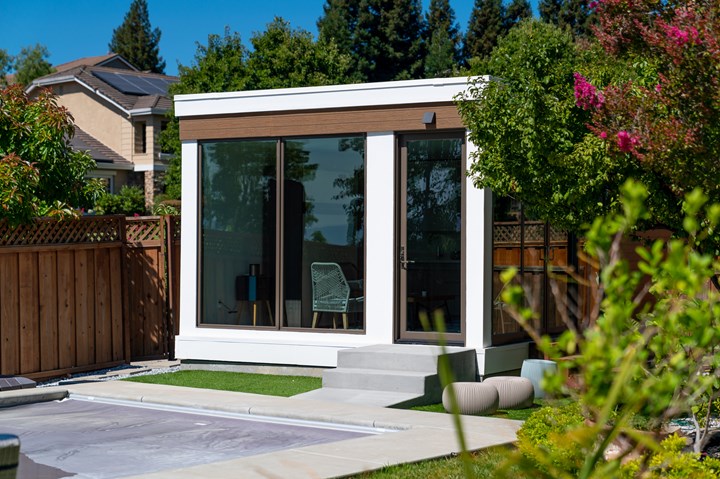
All photo credit: Mighty Buildings
Mighty Buildings (Oakland, Calif., U.S.) a startup construction tech company that creates homes using large-format 3D printing, advanced materials and automation, announced on Feb. 9 a $40 million Series B funding round following significant consumer demand since its launch in August 2020.
The round was led by Khosla Ventures and co-led by Zeno Ventures, with participation from returning investors Bold Capital Partners, Core Innovation Capital and Foundamental. Mighty Buildings also added several new investors, including ArcTern Ventures, Abies Ventures, Modern Venture Partners, Giant Ventures, MicroVentures, One Way Ventures, Polyvalent Capital and others. Included in Y Combinator’s Top companies list as a result of the funding round, Mighty Buildings reports that it has raised more than $70 million from investors to date.


“Since our launch last year, we’ve seen massive demand and more than a tenfold increase in bookings for our accessory dwelling units (ADUs) product line, with B2B contracts secured for our single family housing (SFH) product line with forward-thinking developers,” says Slava Solonitsyn, CEO and co-founder at Mighty Buildings. “Despite launching in the midst of a pandemic, we are racing to fulfill the demand and orders for 2021 at our Mighty Factory in Oakland, California.”
Launched out in stealth mode five months ago (CW covers Mighty Buildings’ prefabricated building production process), the company says it has already seen an increase in demand for this innovative new way of building. Since launch, Mighty Buildings reports successful production, delivery and installation of numerous accessory dwelling units (ADUs) and are now taking orders for Mighty Houses, the company’s newest product line. The Mighty House line, which incorporate a 3D-printed exterior panelized shell, are available for pre-order as both an ADU and SFH.
Ultimately, the company’s vision is to provide production-as-a-service.
Further, Mighty Buildings says it will be introducing its Mighty Kit System and a new fiber-reinforced material for multi-story projects to the market. With its innovative approach to housing construction includes 3D printing, robotics and a proprietary thermoset composite material termed Light Stone Material (LSM), Mighty Buildings aims to unlock more productive, sustainable and affordable construction.
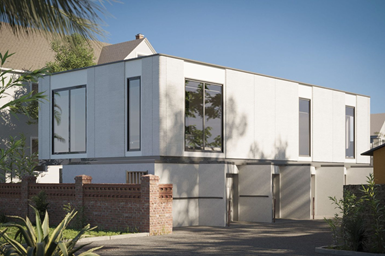
“Given the rapid growth and emerging opportunity around sustainability and climate tech, we're pleased to support Mighty Buildings in realizing their vision,” says Ryno Blignaut, operating partner at Khosla Ventures. “We're enthusiastic about the ways 3D printing, robotics and automation can be applied to the creation of beautiful, affordable and sustainable net-zero energy homes.”
According to the company, it has also obtained several firsts. This includes obtaining the first UL certification for a 3D-printed building component, the first UL Evaluation Report of a 3D-printed wall construction and becoming what it says is the first company/product certified under the new UL 3401 standard for 3D printing in construction. Mighty Buildings has also received approval under California’s Factory Built Housing program for a residential unit incorporating 3D printing for its current hybrid product.
With this new round of funding, Mighty Buildings plans to accelerate growth and expand its team. The company will continue to scale production capacity with increased automation, and build out its B2B platform for developers with sustainability as a core focus, to meet the demand from forward-looking developers. Ultimately, the company’s vision is to provide production-as-a-service, with builders and architects designing their own structures and then developers using Mighty Factories to produce them at scale.


Related Content

Combining multifunctional thermoplastic composites, additive manufacturing for next-gen airframe structures
The DOMMINIO project combines AFP with 3D printed gyroid cores, embedded SHM sensors and smart materials for induction-driven disassembly of parts at end of life.
Read More
Reinforcing hollow, 3D printed parts with continuous fiber composites
Spanish startup Reinforce3D’s continuous fiber injection process (CFIP) involves injection of fibers and liquid resin into hollow parts made from any material. Potential applications include sporting goods, aerospace and automotive components, and more.
Read More
Optimized rib-reinforced hollow composites via printed molds
Addyx topology optimization and water-soluble mandrel enables simultaneous rib and skin layup for one-shot, high-strength, lightweight structures.
Read More
Diehl Aviation, 9T Labs present Eco Bracket
Ultra-lightweight and made of recycled composites, the Eco Bracket cuts weight and cost in half and reduces CO2 emissions, in addition to providing high performance.
Read MoreRead Next

3D-printed prefab homes aim to disrupt construction market
California startup Mighty Buildings’ award-winning prefabricated building production process relies on large-format 3D printing, UV-curable resins, digital design and automation.
Read More
Kaneka BMI material attains >25% lead time, >20% tool cost reductions in Janicki evaluations
Process evaluations find that novel BMI polymer chemistry addresses longstanding manufacturing challenges of BMI tooling prepregs while maintaining high temperature performance and durability.
Read More
Bonded fastening meets the digital factory
Automation and XR tools aim to scale adhesive fastening for composites at next-gen aerospace production rates.
Read More