
Kitty Hawk ends eVTOL Flyer aircraft program
Designed with composite materials, the eVTOL aircraft was a major milestone for urban air mobility.


Source | Kitty Hawk
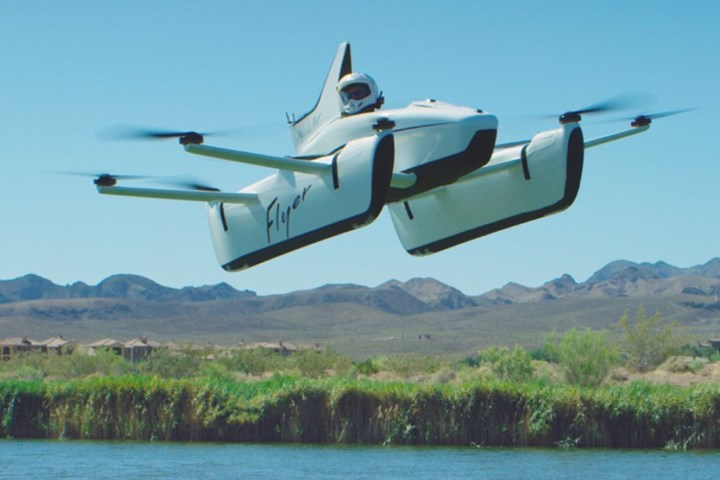
On June 3, eVTOL specialist Kitty Hawk’s (Palo Alto, Calif., U.S.) online blog post announced that the company is winding down the Flyer, its first all-electric take-off and landing (eVTOL) vehicle flown by non-pilots. The single-seater vehicle, designed for use over water, was another milestone for Kitty Hawk and its later eVTOL aircraft developments.
The blog post reports that five years ago, at the start of the project, Kitty Hawk’s CEO, Sebastian Thrun, and president of Flyer, Alex Roetter, had two goals when developing the craft: free the world from traffic and design an ultralight aircraft that could be flown by anyone — even if the pilot didn’t hold a pilot’s license. Made of composite materials, the resulting design left the Flyer sitting at 250 pounds empty weight, making it permittable for recreational use under the FAA Part 103 regulation. Powered by 10 independent lift fans, the Flyer operates 3-10 feet off the water.


Over its five years, Kitty Hawk built and flew 111 aircraft, and had more than 75 people fly the Flyer. On a single day, the company trained 50 novice Flyer pilots — none of whom were licensed —and proved that people could safely operate Flyer with less than two hours of training. In total, Kitty Hawk conducted more than 25,000 successful flights crewed and uncrewed with its Flyer fleet.
Kitty Hawk says that with the information collected from the Flyer project, including vehicle design and testing, manufacturing aircraft and how others would experience eVTOL aircraft, it plans to focus more on its new eVTOL Heaviside plane, which has a range of 100 miles, can travel up to 180 miles per hour and offers the ability to fly over cities.
To see the original blog post, click here.
Related Content
-
Sinonus launches energy-storing carbon fiber
Swedish deep-tech startup Sinonus is launching an energy-storing composite material to produce efficient structural batteries, IoT devices, drones, computers, larger vehicles and airplanes.
-
SABIC composite hybrid battery cover enhances EV safety, efficiency
SABIC collaborated with Engel, Siebenwurst, Forward Engineering, Ensinger and Envalior to develop a thermoplastic composite EV battery cover, combining strong structural performance, flame retardancy and design efficiency.
-
ECOHYDRO project to enable recyclable composites for hydrogen storage
With the involvement of two schools from the Institut Mines-Télécom, the 4-year project aims to improve the intrinsic properties of a composite material based on Elium via four concrete demonstrators.


