
James Webb Space Telescope reaches major milestone as primary mirror unfolds
Full deployment of the 21-foot, gold-coated primary mirror completes the final stage of all major spacecraft deployments in preparation for science operations.


As of Jan. 8, 2022, NASA’s (Washington D.C., U.S.) James Webb Space Telescope (JWST) team fully deployed its 21-foot, gold-coated primary mirror, successfully completing the final stage of all major spacecraft deployments (including the 70-foot sunshield) since its Dec. 25 launch, to prepare for science operations. The telescope makes ample use of composite materials.
A joint effort with the European Space Agency (ESA) and Canadian Space Agency (CSA), the Webb mission will explore every phase of cosmic history, from within our solar system to the most distant observable galaxies in the early universe.


“NASA [has] achieved another engineering milestone decades in the making. While the journey is not complete, I join the Webb team in breathing a little easier and imagining the future breakthroughs bound to inspire the world,” says NASA Administrator Bill Nelson. “The James Webb Space Telescope is an unprecedented mission that is on the precipice of seeing the light from the first galaxies and discovering the mysteries of our universe. Each feat already achieved and future accomplishment is a testament to the thousands of innovators who poured their life’s passion into this mission.”
The two wings of Webb’s primary mirror had been folded to fit inside the nose cone of an Arianespace (Évry-Courcouronnes, France) Ariane 5 rocket prior to launch. After more than a week of other critical spacecraft deployments, the Webb team began remotely unfolding the hexagonal segments of the primary mirror, said to be the largest ever launched into space. This was a multi-day process, with the first side deployed Jan. 7 and the second Jan. 8.
Mission Operations Center ground control at the Space Telescope Science Institute in Baltimore, Md., U.S. began deploying the second side panel of the mirror at 8:53 a.m. EST. Once it extended and latched into position at 1:17 p.m. EST, the team declared all major deployments successfully completed.
JWST will now begin moving its 18 primary mirror segments to align the telescope optics. The ground team will command 126 actuators on the backsides of the segments to flex each mirror — an alignment that will take months to complete. Then the team will calibrate the science instruments prior to delivering Webb’s first images this summer.
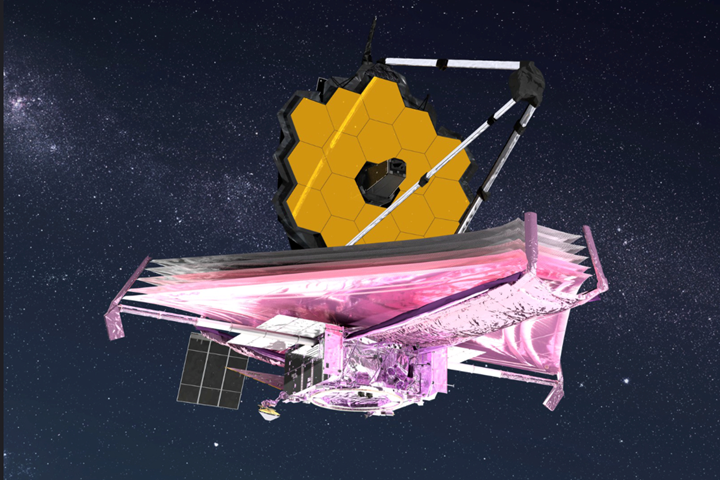
This artist’s conception of the James Webb Space Telescope (JWST) in space shows all its major elements fully deployed. The telescope was folded to fit into its launch vehicle, and then was slowly unfolded over the course of two weeks after launch. Photo Credit: NASA GSFC/CIL/Adriana Manrique Gutierrez
“I am proud of the team — spanning continents and decades — that delivered this first-of-its kind achievement,” says Thomas Zurbuchen, associate administrator for the Science Mission Directorate at NASA headquarters in Washington. “Webb’s successful deployment exemplifies the best of what NASA has to offer: the willingness to attempt bold and challenging things in the name of discoveries still unknown.”
Soon, Webb will also undergo a third mid-course correction burn — one of three planned to place the telescope precisely in orbit around the second Lagrange point, commonly known as L2, nearly one million miles from Earth. This is Webb’s final orbital position, where its sunshield will protect it from light from the sun, Earth and moon that could interfere with observations of infrared light. JWST is designed to peer back more than 13.5 billion years to capture infrared light from celestial objects, with much higher resolution than ever before, and to study our solar system, as well as distant worlds.
“The successful completion of all of the Webb Space Telescope’s deployments is historic,” concludes Gregory L. Robinson, Webb program director at NASA headquarters. “This is the first time a NASA-led mission has ever attempted to complete a complex sequence to unfold an observatory in space — a remarkable feat for our team, NASA and the world.”
For more information about the Webb mission, visit this link.


Related Content

“Structured air” TPS safeguards composite structures
Powered by an 85% air/15% pure polyimide aerogel, Blueshift’s novel material system protects structures during transient thermal events from -200°C to beyond 2400°C for rockets, battery boxes and more.
Read More
Prepreg compression molding supports higher-rate propeller manufacturing
To meet increasing UAV market demands, Mejzlik Propellers has added a higher-rate compression molding line to its custom CFRP propeller capabilities.
Read More
Plant tour: Airbus, Illescas, Spain
Airbus’ Illescas facility, featuring highly automated composites processes for the A350 lower wing cover and one-piece Section 19 fuselage barrels, works toward production ramp-ups and next-generation aircraft.
Read More
Plant tour: Aernnova Composites, Toledo and Illescas, Spain
RTM and ATL/AFP high-rate production sites feature this composites and engineering leader’s continued push for excellence and innovation for future airframes.
Read MoreRead Next

Post Cure: CFRP mainframe, modern manufacturing techniques pioneer next-generation rigid airships
Advanced composites enable the revival of rigid airships in LTA Research's 400-foot-long Pathfinder 1.
Read More
Bonded fastening meets the digital factory
Automation and XR tools aim to scale adhesive fastening for composites at next-gen aerospace production rates.
Read More
Kaneka BMI material attains >25% lead time, >20% tool cost reductions in Janicki evaluations
Process evaluations find that novel BMI polymer chemistry addresses longstanding manufacturing challenges of BMI tooling prepregs while maintaining high temperature performance and durability.
Read More