
FACC scholarship holders take off with self-constructed drone
Completed under the Lightweight Design and Composite Materials program, students successfully developed a lightweight camera drone with structural parts 40% lighter than comparable models.


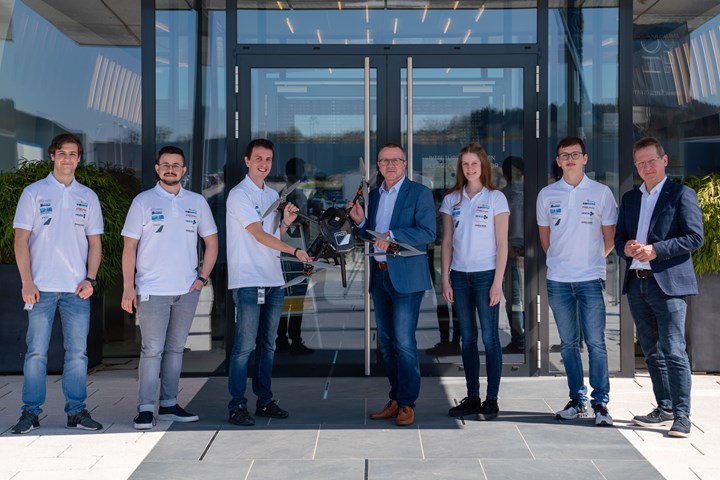
FACC scholarship holders and the self-constructed drone. Photo Credit: FACC AG
FACC AG (Ried im Innkreis, Austria) announces that students under its Lightweight Design and Composite Materials Bachelors degree program, jointly launched with the Upper Austrian University of Applied Sciences (Wels, U.K.) in 2018, have independently developed a lightweight camera drone, successfully completing the complex training and demonstration project on lightweight design. FACC says the students’ successes also demonstrate the future prospects and opportunities for further development offered by the program.
According to the company, innovative lightweight construction is a cross-sectional technology facilitating the implementation of key items, such as sustainability, efficiency and cost effectiveness. Further, it is a central theme for the mobility industry, leading to the high demand for composite in aircraft construction.


“Whereas 30 years ago, the share of composites used in aircraft was only 13%, state-of-the-art models now boast a composite share of more than 50%,” explains Robert Machtlinger, CEO of FACC AG.
“Anyone with an interest in lightweight construction and the natural sciences, such as chemistry or physics, and who wants to work in an outstanding future-oriented field is very welcome.”
In addition to making major contributions to technical progress in aerospace, and setting new standards for innovative air mobility solutions within urban agglomerations, FACC, alongside industrial partners, also focus on interacting with students. The current project, completed after a lengthy research and development phase, demonstrates a 40% weight reduction for the aircraft’s structural components compared to comparable models. FACC says the small flying object not only showcases the know-how of the students and their intensive cooperation with FACC, but will also encourage other young high potentials to deliver top performances.
FACC also notes that high-quality training programs are few and far between internationally, and lightweight construction experts are in high demand worldwide. “Knowledge and competence are crucial for the development and application of novel technologies — the demand for future specialists is high. In 2018, we took over the patronage of the new and innovative Bachelor’s degree program in Lightweight Construction and Composite Materials at the campus of the Upper Austrian University of Applied Sciences. There is no substitute for knowledge, and it becomes all the more valuable with a regional education that creates international opportunities,” says Machtlinger.
“Top-class and exclusive study content, excellent job prospects in a strong economic province, an attractive research environment and modern infrastructure at the Faculty of Engineering and Applied Natural Sciences at the Upper Austrian University of Applied Sciences in Wels — the unique Bachelor’s degree program in Lightweight Construction and Composite Materials speaks for itself,” emphasizes the head of the research group, FH Prof. DI Dr. Roland Hinterhölzl. The application period for admission to the program has already begun, and there are still a few sought-after places available for the program beginning in autumn. Dr. Hinterhölzl encourages students to join. “Anyone with an interest in lightweight construction and the natural sciences, such as chemistry or physics, and who wants to work in an outstanding future-oriented field is very welcome,” he says.
Applications are open to those who have successfully completed higher technical colleges (HTL), colleges for higher vocational education (BHS) and academic secondary schools (AHS), and to future students without a higher education entrance qualification (Matura) who are enrolled in a university entrance qualification course (Studienbefähigungslehrgang). Further information can be found at www.fh-ooe.at/lcw.


Related Content

Plant tour: Collins Aerospace, Riverside, Calif., U.S. and Almere, Netherlands
Composite Tier 1’s long history, acquisition of stamped parts pioneer Dutch Thermoplastic Components, advances roadmap for growth in thermoplastic composite parts.
Read More
First Airbus A350 crash confirmed in Haneda
Shortly after touch-down, a JAL A350-900 aircraft recently collided with a De Havilland Canada Dash 8. Exact circumstances are still unknown.
Read More
Otto Aviation launches Phantom 3500 business jet with all-composite airframe from Leonardo
Promising 60% less fuel burn and 90% less emissions using SAF, the super-laminar flow design with windowless fuselage will be built using RTM in Florida facility with certification slated for 2030.
Read More
Cutting 100 pounds, certification time for the X-59 nose cone
Swift Engineering used HyperX software to remove 100 pounds from 38-foot graphite/epoxy cored nose cone for X-59 supersonic aircraft.
Read MoreRead Next

FACC successfully develops novel composite flap system for Wing of Tomorrow
RTM’d five-meter-long, complex multicell flap prototype constructed via a highly integral, cost-effective manufacturing process.
Read More
Ceramic matrix composites: Faster, cheaper, higher temperature
New players proliferate, increasing CMC materials and manufacturing capacity, novel processes and automation to meet demand for higher part volumes and performance.
Read More
Scaling up, optimizing the flax fiber composite camper
Greenlander’s Sherpa RV cab, which is largely constructed from flax fiber/bio-epoxy sandwich panels, nears commercial production readiness and next-generation scale-up.
Read More