
Dieffenbacher D-LFT line offers increased application, throughput flexibility
Efficiency, flexibility and increased performance are enabled by larger extruder pairs specially designed for the use of different thermoplastic materials.


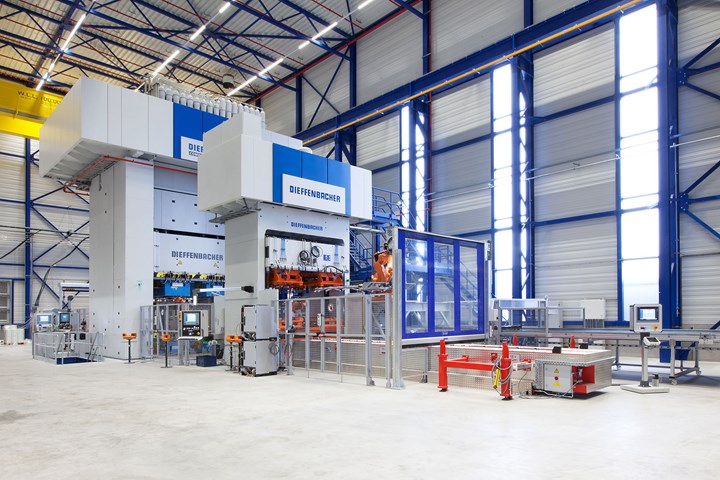
Photo Credit: Dieffenbacher GmbH
It was reported in December that, in order to help thermoplastic component manufacturers capitalize on increased demand for their products —particularly with the shift toward e-mobility and a circular economy— Dieffenbacher GmbH (Eppingen, Germany) has increased the application and component flexibility and throughput of its direct-long-fiber thermoplastic molding (D-LFT) plants. According to the company, this added flexibility enables the use of recycled polymers while also increasing plant performance.
Dieffenbacher D-LFT plants typically use a two-machine technology (Dieffenbacher recently manufactured a modified version of this for a customer, which does not require a second extruder) with two extruders whose parameters such as speed, temperature, etc. can be set independently of each other. In the first extruder, plastic and additives are melted and processed into a homogeneous mixture, while in the second extruder, glass fibers are retracted into the barrel, and cut and impregnated with the polymer. According to the company, this material-friendly separation of the process steps is essential for the production of high-quality components with long fibers. However, to make the conventional D-LFT technology more efficient and flexible, new and expanded Dieffenbacher lines have larger extruder pairs specially designed for the use of different thermoplastic materials.
Further, in combination with other processes such as the Dieffenbacher Tailored-Blank technology, manufacturers can produce components with sophisticated mechanical properties, an additional benefit of the new D-LFT technology. The patented plant technology enables the material-efficient and load-dependent use of unidirectional (UD) tapes. Back-injection molding in closed compression mold or hybrid solutions provide further possible combinations.
Related Content
-
Partners recycle A350 composite production waste into adjustable-length rods for MFFD
Herone, Spiral RTC, Teijin Carbon Europe and Collins Aerospace Almere recycle A350 thermoplastic composite clips/cleats waste into rods for the all-thermoplastic composite Multifunctional Fuselage Demonstrator’s crown.
-
Plant tour: Collins Aerospace, Riverside, Calif., U.S. and Almere, Netherlands
Composite Tier 1’s long history, acquisition of stamped parts pioneer Dutch Thermoplastic Components, advances roadmap for growth in thermoplastic composite parts.
-
Combining multifunctional thermoplastic composites, additive manufacturing for next-gen airframe structures
The DOMMINIO project combines AFP with 3D printed gyroid cores, embedded SHM sensors and smart materials for induction-driven disassembly of parts at end of life.


